
Our Space Journey, part 4

To make sense of my story and obtain the best knowledgeable experience, please go to the beginning and read part 1 here.
British spelling.
Part 4.
Mars has a year that adds up to 687 Earth days, and the 25 hours in its day are almost the same as a day on Earth. This planet can be as far away as 400 million kilometres and as close as 56 million kilometres from the Earth.
It is the fourth-closest planet to the Sun, orbiting at an average distance of just over 228 million km.
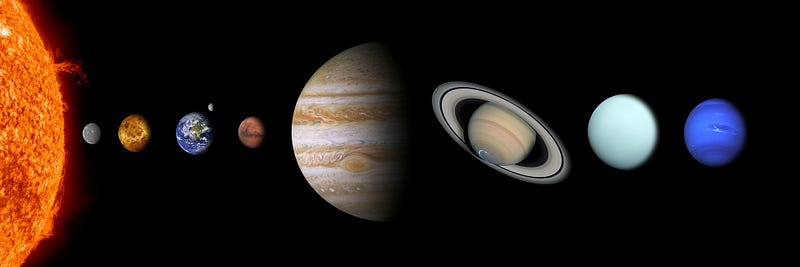
Mars is much smaller than the Earth, with a diameter of just 6,794 km. The surface temperatures near the poles can drop to minus 125 degrees Celsius and rise to 20 degrees Celsius at the equator, giving an average temperature of around minus 65 degrees Celsius. The thin atmosphere consists mostly of carbon dioxide and features clouds, weather systems, and winds.
As I said, for Mars to make a complete trip around the Sun, it takes 1.88 Earth years, referred to as a Martian year. An interesting feature on Mars is the giant inactive volcano Olympus Mons, which is 22,000 metres high and is the largest in the entire solar system. As a comparison, Earth’s highest mountain, Mount Everest, is a mere 8,848 metres high.
Mariner 9 was launched on May 30, 1971, from Cape Canaveral in the USA. It became the first artificial satellite of Mars when it arrived and went into orbit on November 14, 1971.
Launched on August 20, 1975, NASA’s Viking 1 project found a place in history when it became the first mission to safely land a spacecraft on the surface of another planet, namely Mars.
A lot has happened since then. Opportunity landed safely on the red planet in 2004, it was sent to look for any signs of past life. Opportunity made a few discoveries, including evidence that in the distant past, some areas of the planet stayed wet for a long time, and the conditions at that time could have been favourable for sustaining microbial life.
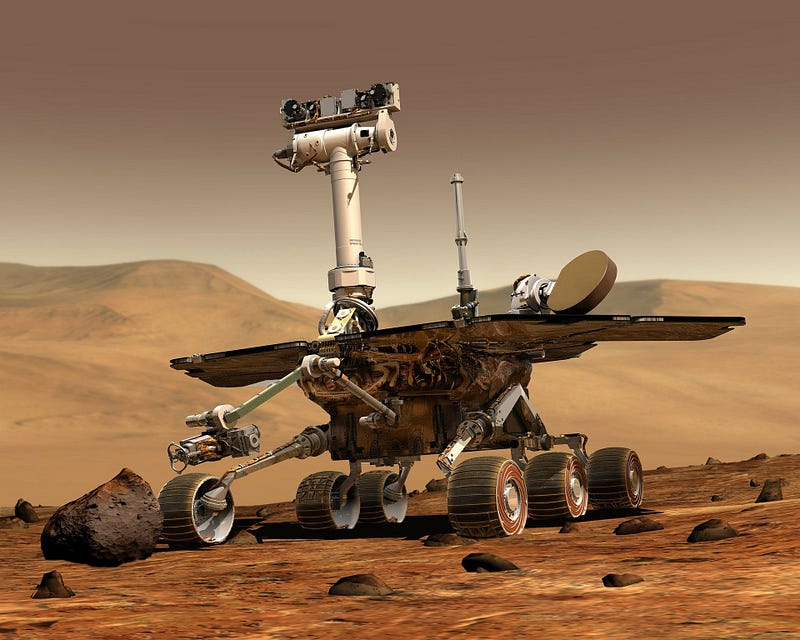
After a severe dust storm in June 2018, Opportunity fell silent. It is thought that its solar panels became covered in dust, which resulted in the loss of power. The rover covered a total distance of 45 kilometres during its working life; how impressive a feat that is after all those years on a very inhospitable planet! I wonder how long it will be before someone from Earth stands by its side.
Reaching Mars is hard and unforgiving. As of this date, October 2023, over 50 unmanned missions have attempted the journey; many were not successful as there is little room for error, which shows how difficult these missions to faraway destinations can be.
As of October 2023, Curiosity, another rover, is still working on the planet, exploring an area known as the Gale Crater. It was launched from Cape Canaveral on November 26, 2011, touching down on Mars on August 6, 2012, only 2.4 kilometres from its planned landing site, which is not a bad outcome considering its very long journey. Another amazing achievement for the human race.
Nasa’s latest rover, Perseverance, launched from Cape Canaveral, Florida, on its journey to Mars in July 2020. That was a time when the Earth and Mars were in a good position relative to each other for that long flight to the red planet. Careful consideration was crucial in placing the rover in the most promising area of the planet to achieve an effective scientific study.
Its four main objectives will be to determine if life ever arose on Mars, study the climate, gain more information on the geology of Mars, and prepare for human exploration. It will also leave rock core samples at certain places; they will be picked up by another mission and returned to Earth sometime in the future.
I hope it will find some evidence of microbial life that did exist when Mars had a friendlier environment. There is compelling evidence that Mars had, at one time, ample water flowing on its surface.
On February 18, 2021, Perseverance safely landed on the surface of Mars; it took almost 7 months to travel the 480 million km. Perseverance hit the Martian atmosphere, travelling at 20,000 kilometres per hour. The atmosphere slowed it down enough for the parachute to deploy, and then it was up to the 8 retrorockets on the descent stage to slow it down even more.
The sky crane gently lowered it the last 20 metres for a soft landing. As the rover’s wheels touched the surface, the cables that were attached to the descent stage were severed, and it flew away to crash at a safe distance.
The rover touched down on its intended target, inside the Jezero crater, which was a Martian lake billions of years ago. Everything went according to plan, and now it is continuing to carry out its important scientific work. Good luck Perseverance.
Mars has two orbiting moons, which are called Phobos and Deimos. Not including shepherd moons, Deimos is classified as the smallest moon in the Solar System.
Most scientists agree that everything that we know and experience around us today, from speeding galaxies to ancient gas clouds, began approximately 13.8 billion years ago. The evidence available to date has detected that most of the galaxies are moving away from each other, some reaching speeds of many hundreds of thousands, if not millions, of kilometres per hour, which shows us the universe is expanding.
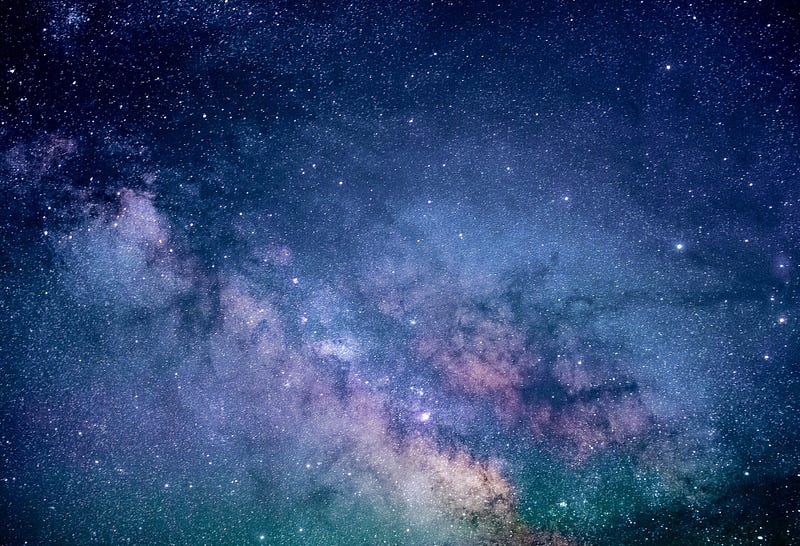
Now, if you were to reverse that process, everything in the universe must have originated from a single point, and it is thought that it was from that point 13.8 billion years ago that a gargantuan explosion or expansion occurred, known as “the Big Bang.” This was the beginning of everything we know and see today, including space and time.
Someone once said that in the beginning there must have been a day without a yesterday. If scientists are right in assuming that time started with the Big Bang, then that statement must be true.
The burst of energy produced by the Big Bang caused an unbelievable expansion of space. Was it possible that the newborn universe expanded faster than the speed of light? Maybe not, but even at the speed of light, the universe would have grown to 36 million kilometres in diameter in the first minute of its life.
Around 380,000 years after that event, the conditions were right for the first atoms to form; they were mainly hydrogen and helium. It cannot be underestimated how important hydrogen was and still is in the universe.
After about 200 million years after the creation of the universe, hydrogen and helium were drawn in by gravity and began forming denser areas in space, resulting in the formation and birth of the first stars and, later, the galaxies.
What was missing around these first stars were planets. It took the first stars millions of years to create elements that were heavier than hydrogen and helium; even heavier elements were created when the stars came to the end of their lives and exploded in supernovae. Massive amounts of these new elements were thrown far out into space; eventually, they would form the first planets and other celestial objects like the ones we see throughout the universe today.
Information regarding the elements will come later.
A supernova is a massive explosion that takes place when some larger stars come to the end of their life cycle.
An elliptical orbit is the revolving of one object around another; they are oval-shaped paths. The planets in the Solar System orbit the Sun in elliptical orbits. When a planet gets closer to the Sun in its orbital path, it speeds up, and when it travels away, it slows down.
Celer is approaching Mars; when I look back into the darkness of space, I can see the Earth as a tiny white dot, and surprisingly, the Moon is also just visible.
Celer log, departing Mars, waypoint, Jupiter.
Jupiter is the largest of all the planets in the Solar System by far, with a diameter of almost 143.000 km. Its average distance from the Sun is just over 778 million km; to give an idea of its size, Jupiter could hold in its volume up to 1,300 Earths.
The average distance between Mars and Jupiter is 550 million kilometres. Celer will arrive at this gigantic planet in almost 31 minutes.
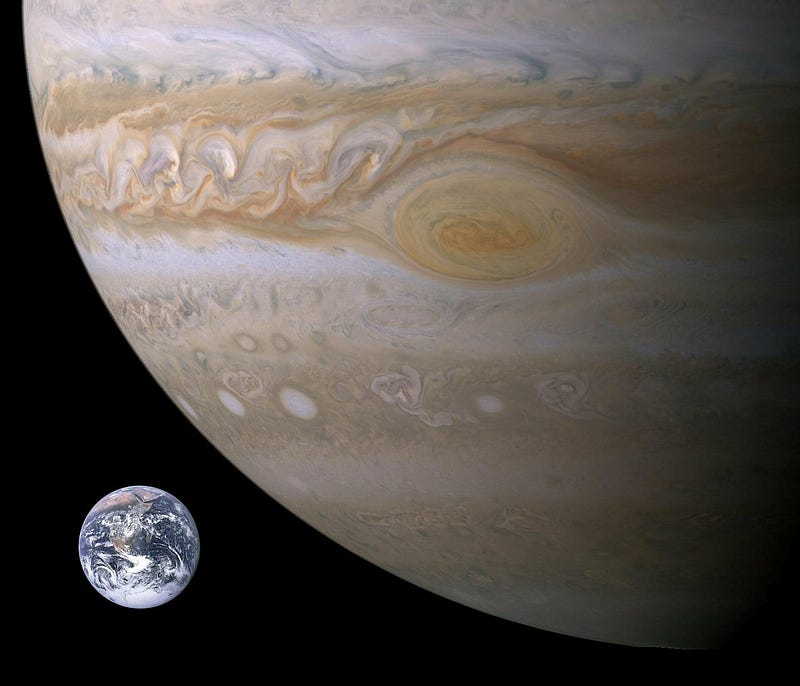
Look at the size of the Earth in comparison to Jupiter.
Jupiter is the fifth planet from the Sun, with 2.5 times more mass than all the remaining 7 planets combined; its mass would be the equivalent of 318 times that of the Earth.
Jupiter is the first of the gas giants that we will visit. The atmosphere on Jupiter is made up of 75% hydrogen and 24% helium; in addition, there is water, methane, and ammonia in trace amounts, and the core of the planet is thought to contain rock and metallic hydrogen.
This giant planet takes almost 12 years to complete one orbit around the sun, which is known as the Jovian year, and the duration of its day is only 10 hours. The temperature in its clouds can be as low as minus 145 degrees Celsius. The red spot on Jupiter, which can be seen with a telescope, is a hurricane that has been raging for centuries. To give an idea of its size, this red spot is three times the size of the Earth.
79 known moons are in orbit around Jupiter’s centre; its largest moon, Ganymede, is also the biggest in the Solar System, with a diameter of 5,268 km. The water ice in Ganymede is thought to contain more water than all the oceans on Earth.
Nine robotic spacecraft have visited Jupiter over the years; the latest one, Juno, left the Earth on August 5, 2011, and went into orbit around Jupiter on July 4, 2016, circling as close as 3,500 km from its surface. It was sent to study Jupiter’s auroras, atmosphere, magnetosphere, structure, and origins.
Between Mars and Jupiter lies the asteroid belt, which starts approximately 330 million km from the Sun. Ceres, discovered in 1801, was the largest asteroid known until it was reclassified as a dwarf planet. It has a diameter of 950 km and an orbital period around the Sun of 4.6 years. Vesta is now the largest known asteroid.
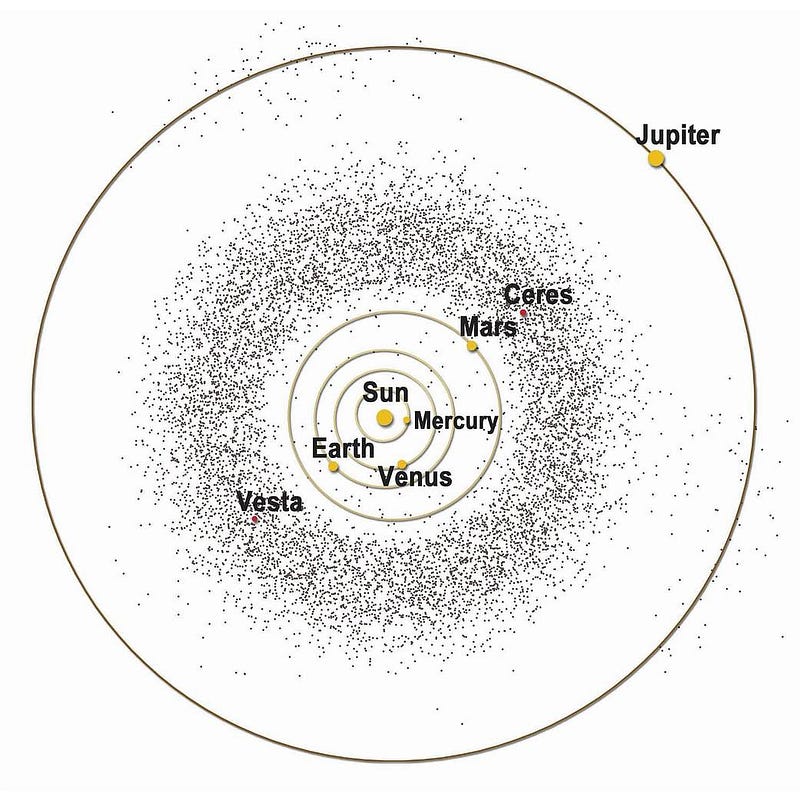
In September 2007, NASA’s spacecraft Dawn was launched into space and began its long journey to the asteroid belt. Dawn went into orbit around Vesta on July 16, 2011, and after a scientific study lasting 14 months, it departed and travelled to Ceres, arriving in March 2015. Dawn studied Ceres from a few different orbital heights, the lowest being 375 km from its surface in December 2015. Dawn finally ran out of its hydrazine fuel and retired in November 2018, but it will stay in orbit around Ceres indefinitely.
Celer log, departing Jupiter, waypoint, Saturn.
Jupiter and Saturn are separated by an average distance of 649 million km. Celer will arrive at Saturn at a slightly longer time of 36 minutes.
Saturn is the sixth planet from the Sun and the second-largest gas giant. It has a diameter of 120,600 km, and its average distance from the Sun is 1,427 million km.
The rings surrounding Saturn are mostly lumps of frozen water, thought to be remnants of a moon, that came too close to this giant planet and was torn apart by its gravitational force.
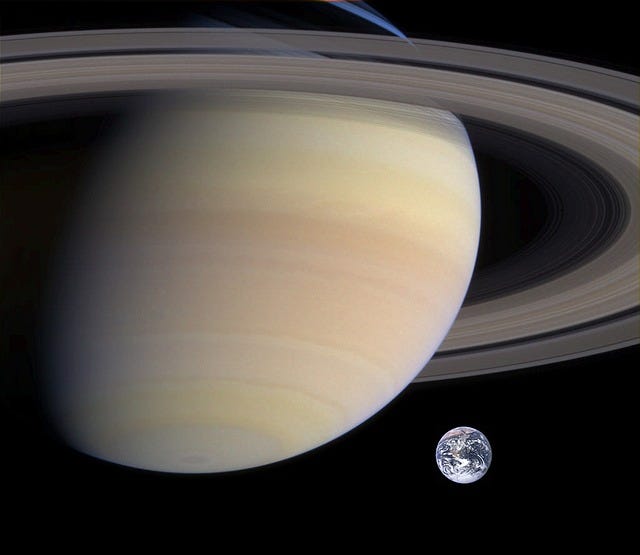
Again, look at the size difference between the two planets, Earth and Saturn.
Saturn’s volume could theoretically hold up to 760 Earths and has 95 times the Earth’s mass. It takes over 29 years to make one orbit around the Sun, which is called the Saturnian year, and the duration of its day is almost 11 hours.
There are 146 moons with confirmed orbits that circle Saturn. Enceladus is the sixth-largest of these moons; it has a liquid ocean of water covered by a frozen crust. The heat needed for liquid water to exist is thought to be caused by gravitational interactions with other moons orbiting Saturn.
At this moment in time, there is no evidence of any other life forms within the solar system or indeed farther out into the universe. Could it be possible that microbial life could live on Enceladus? Maybe not. I am sure that someday a mission will be sent there to try to answer that question.
There have been four scientific missions sent to Saturn to study the planet and some of its moons, the first of which was Pioneer 11 way back in 1979.
Voyager 1 visited in 1980, Voyager 2 passed by in 1981, and the last one, the Cassini-Huygens mission, which was launched on October 15, 1997, commenced orbiting Saturn in July 2004, being the first artificial satellite to do so.
On December 25, 2005, Huygens separated from the orbiter and landed on Saturn’s moon, Titan. The mission ended on September 15, 2017, when Cassini depleted its fuel supply and entered Saturn’s upper atmosphere, where it was intentionally destroyed, much to the dismay of all the people who had worked on the project for over twenty years.
There are exciting times ahead in the hunt for more information on the Cosmos. After over 20 years of construction, the James Webb space telescope has been completed and has passed its rigorous testing. It will be the successor to the very successful Hubble space telescope, from which we have gained so much knowledge about what is out there in the Cosmos.
The James Webb telescope has been constructed using 18 hexagonal mirrors, which combined are 6.5 metres in diameter and are designed to collect infrared light. This new telescope will be much more powerful than the Hubble telescope, which has seven times the light-collecting area.
The launch was originally scheduled for October 2018 but has been rescheduled for lift-off sometime in late 2021. It will be transported into space on an Ariane 5 rocket.
The estimated cost of the James Webb telescope is over 10 billion dollars. It is hoped that the mission will be able to carry out scientific work for up to 10 years, or until its fuel supply runs out. Will it see objects that are much farther away than what the Hubble telescope is capable of seeing? We should find out soon.
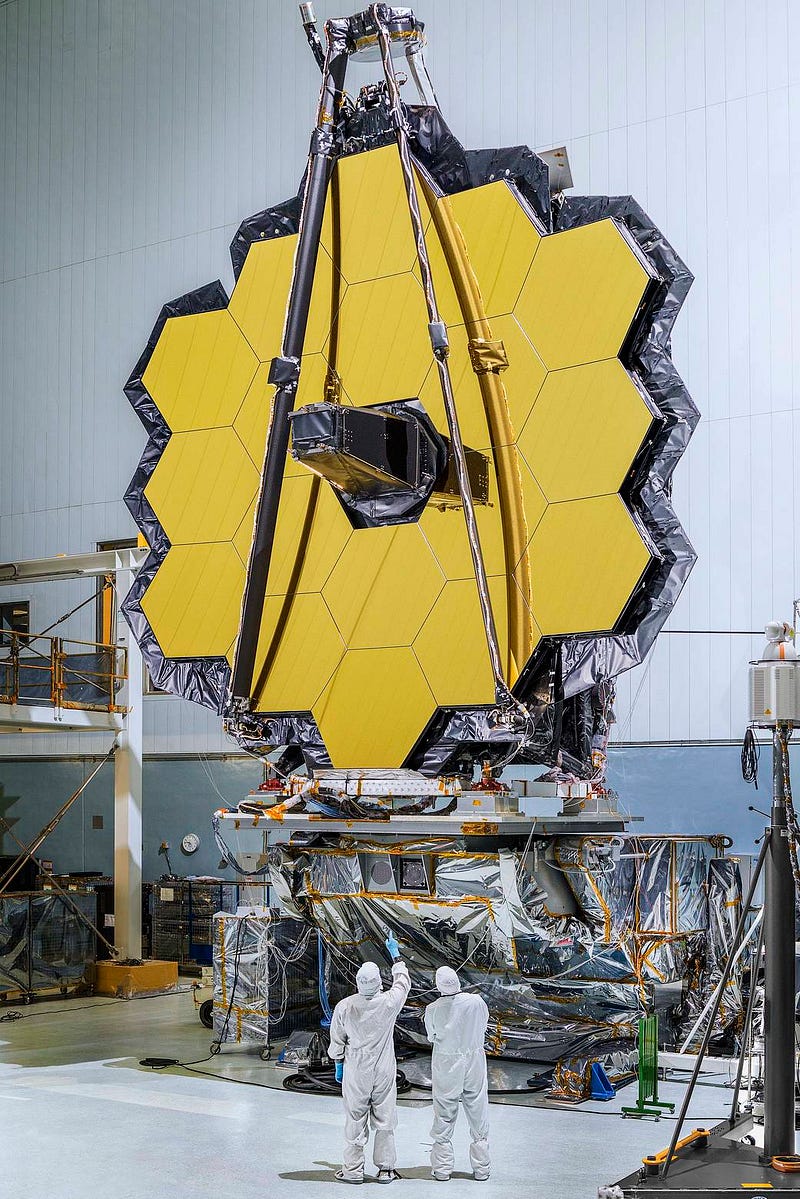
Is the James Webb telescope going to be a success? That must be a concern for the thousands of people who have worked on the project, some for over 20 years. After the Hubble telescope was launched into space and arrived at its destination it was found to have a problem with its primary mirror, fortunately, the Hubble telescope is just 550 km from the surface of the Earth, close enough for astronauts to travel there and carry out repairs.
Over the years Astronauts have visited the Hubble telescope 5 times to carry out repairs. Sadly, there are no plans to ever go back again.
The James Webb telescope is different; it will orbit the Earth at a distance of 1.5 million km. As of now, that distance is too large for astronauts to travel there and fix any problems that may arise.
There are also a few very big ground-based telescopes under construction. The large Vera C. Rubin Observatory in northern Chile is due to be in operation as early as 2023,
The commissioning of the Giant Magellan Telescope might start as early as 2029. It too is in Chile, It is expected to have a resolving power 10 times greater than the Hubble Telescope.
As early as 2027 the Extremely Large Telescope or ELT should be taking its first look at extremely distant objects. It will have 256 times the light gathering area, and it will take images that are 16 times sharper than Hubble images. It should vastly advance astrophysical knowledge. Two of its aims will be to study planets orbiting other stars and maybe find the first galaxies that formed in the universe. And yes it is also in Chile.
Why are so many telescopes situated in Chile? it is home to the Andes Mountains and the Atacama Desert, areas that have some of the stillest and driest air in the world.
Part 5