
Our Space Journey, part 12

British spelling
To make sense of my story and obtain the best knowledgeable experience, please go to the beginning and read part 1 here.
Part 12.
Celer log, departing IC1101, waypoint, 13.8 billion light-years from home
This vast distance of 13.8 billion light-years is roughly 130 sextillion kilometres, which is a staggering 130,000,000,000,000,000,000,000, or over 13 trillion astronomical units. The estimate for the total number of galaxies in the observable universe is two trillion. Can you imagine how many stars and planets there are contained in all those galaxies?
Elements.
At the time of the Big Bang, the universe was extremely hot and dense, but as the newly created universe cooled, conditions became favourable for the rise of quarks and electrons, a few millionths of a second later, quarks aggregated to produce protons and neutrons, and within minutes, these protons and neutrons combined into nuclei.
As the universe continued to expand, events happened more slowly. It took nearly 380,000 years for electrons to be trapped in orbits around nuclei, thus forming the first atoms. These new atoms formed the first low-mass elements, mainly hydrogen and helium; they are still the most abundant elements in the universe today.
As I said earlier, each element is composed of the same type of atoms, which have the same number of protons in their atomic nuclei, and that is also their atomic number. 118 chemical elements have been identified; the larger the atomic number, the less stable they become.
Arguably, 92 elements occur naturally on Earth, and there are also some synthetic elements. The most abundant element making up the Earth’s crust is oxygen. The high abundance of oxygen, silicon, and iron on Earth reflects their common production in stars.
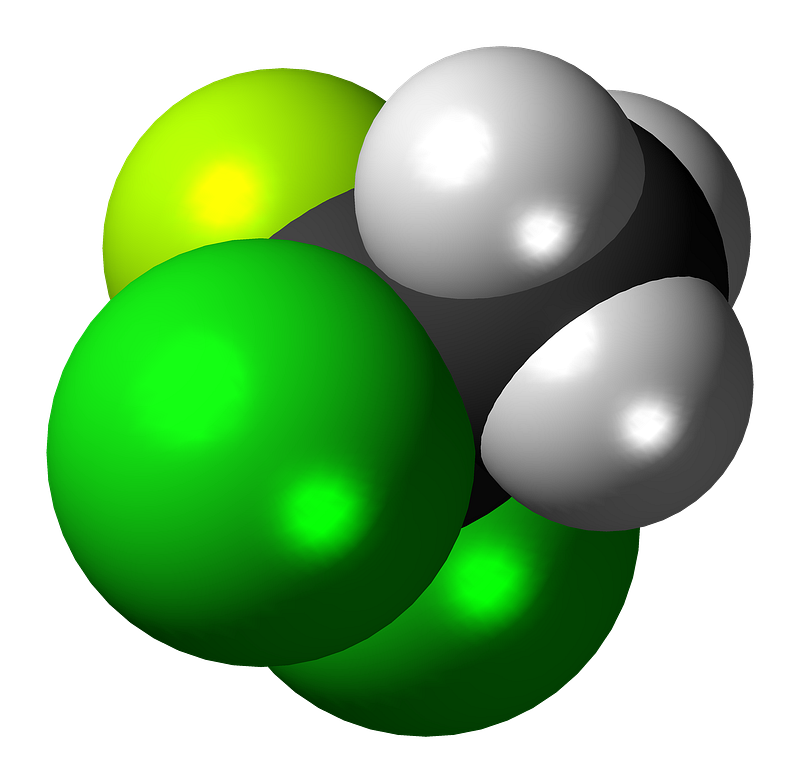
Elements with more than 26 protons are formed mainly by supernova nucleosynthesis. It was reported in October 2017 that a kilonova explosion had been observed. These explosions are caused by two neutron stars merging or a neutron star and black hole merging. These events can also produce heavy elements.
It is thought that 25 elements are essential for life, and as I mentioned earlier, six elements make up about 99% of the mass of a human body: carbon, oxygen, hydrogen, nitrogen, calcium, and phosphorus.
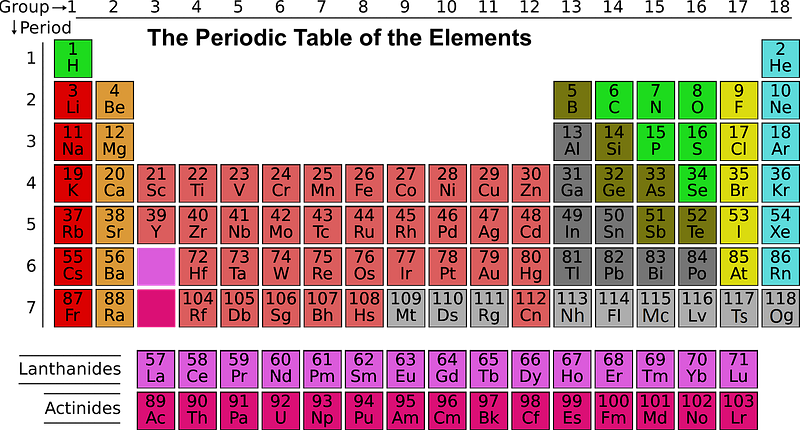
The Periodic Table has all the chemical elements arranged in rows and columns; in the rows, the elements are placed in order of their atomic numbers. The columns form groups of elements that have similar chemical properties.
There are 118 elements in the periodic table. The lightest naturally occurring element is hydrogen with the symbol (H) and atomic number 1, the next element in the table is helium with the symbol (He) and atomic number 2, lithium is the next with the symbol (Li) and atomic number 3, and so on. The heaviest natural element is uranium, with an atomic number of 92. The atomic number simply means the number of protons in the nucleus of an atom.
There is no natural process on Earth that can create elements, but some amazing things can happen on and inside our planet. We all know the saying “diamonds are a girl’s best friend,” but where did they originate from?
Diamonds, the hardest natural substance that is known to man, were created between one and three billion years ago when the Earth was much hotter.
Intense heat and pressure way down 150 kilometres or more below the Earth’s surface can cause carbon atoms to crystallise and form diamonds. We would never have known about them had it not been for deep-source volcanic eruptions, which transported some of them to the surface of the Earth. The volcanic material where most diamonds are found is called kimberlite, and it is in these kimberlite deposits that most diamond mining takes place.
We are now 1.5 billion years into our epic journey. There will have been no total solar eclipses for a very long time back on Earth. The Moon will have travelled so far away from the Earth that a total solar eclipse of the Sun will be impossible.
A solar eclipse happens when the moon travels in front of the sun and casts a shadow on the earth. A total solar eclipse is when the whole sun gets completely covered by the moon, and this was only possible because the sun and the moon appeared the same size when viewed from the surface of the earth.
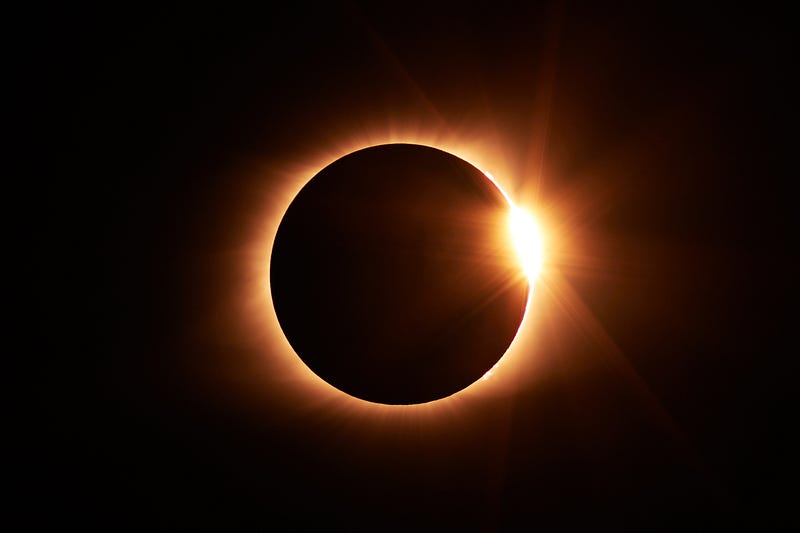
The Moon is now much farther away from the Earth than it was when we left on our journey; it will now be visibly too small to cover the whole of the Sun, and from now on it will only manage a partial eclipse.
A lunar eclipse is when the Earth travels between the Sun and the Moon and casts a shadow on the Moon.
Although there is probably no life left on Earth that can gaze up at the sky and watch these events, could there be a chance that humans are still looking up at the sky from the surface of Mars and witnessing solar eclipses there? Having said that, Mars has only two very small moons, Phobos and Deimos.
At this stage of our journey, I want to reflect on the possibility of life on other worlds. As far as we know, the only known forms of life that exist are on our planet, Earth. Celer has passed countless Earth-like planets; could any of them enjoy the conditions favourable for supporting life as we know it?
Once primitive life got started on our planet, there was no holding back; it took a very long time, but from the top of mountains to the deepest parts of the oceans, we can see an abundance of complex life forms. We find life in the most unexpected places on Earth.
Imagine for a moment, if human beings were the only life to have evolved and exist on our planet, and say we visited another world that harboured life, and living on that planet were animals that resembled a whale, a snake, maybe a large bird, or a fish. How alien would they look to us?
We have no idea how extraterrestrial life would look, but we do know that they would have to be made of the same elements found throughout the universe. They could be made of a different mix of elements, but one thing is sure: for alien beings to evolve and advance their knowledge, they would need to have evolved fingers or some sort of digits to give them the ability to create.
Are we alone in the universe?
We now have science and technology, which might prove that we are not alone in our galaxy. Could there be other intelligent life out there? The most well-known organisation looking for life beyond our solar system is the SETI Institute, which is made up of technicians, scientists, engineers, teachers, and support staff.
The SETI Institute uses a specially designed instrument, the Allen Telescope Array, located in the Cascade Mountains of California. One of its objectives is to study newly discovered exoplanets that are in habitable zones around their star. Primitive life cannot send signals across space that can be detected on Earth, but scientists are searching for primitive life by investigating the atmospheres and characteristics of distant planets for any clues.
The Kepler Space Observatory was launched into space on March 7, 2009, with its mission being to look for exoplanets orbiting other stars. After nine years of operation, NASA announced its retirement in 2018.
Over its lifetime, Kepler observed over 530 thousand stars, looking for any dimming caused by planets crossing in front of a star. Around 2,662 exoplanets have been catalogued by Kepler, and more have yet to be confirmed.
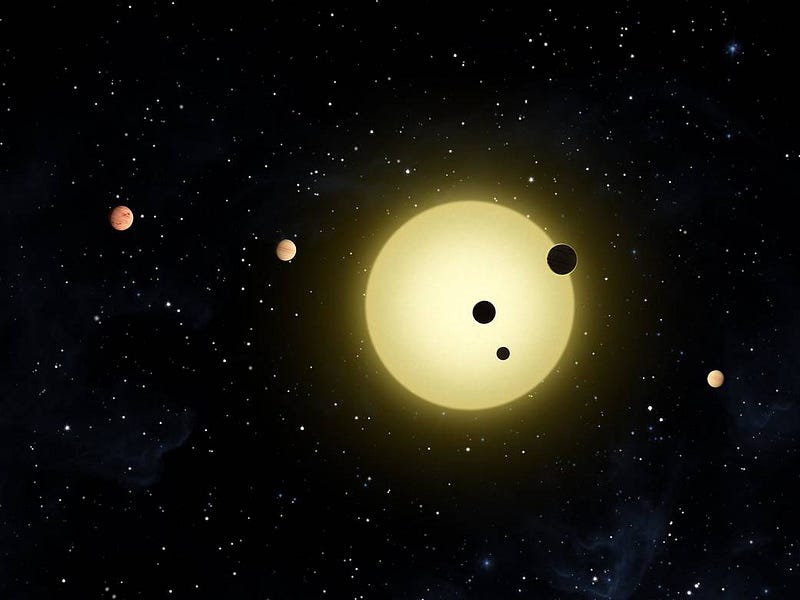
Information from Kepler was sent home and analysed to determine the size of these exoplanets. The smallest one found was about twice the mass of the moon, and the largest is over twice the diameter of Jupiter. Some astronomers consider this mass too large to be classified as a planet, so it could be a brown dwarf.
As of October 2023, 5,500 exoplanets have been confirmed by different scientific methods.
Some exoplanets in our galaxy have been identified as orbiting habitable zones similar to those of the Earth. It is estimated that there could be 6 billion potentially habitable Earth-like worlds in our galaxy alone; now that’s something to ponder over.
The discovery of these exoplanets orbiting nearby stars has greatly increased speculation that there may be some kind of life on planets outside our solar system. It is highly unlikely that any life forms will be found on any of the planets or moons within our solar system.
All life on Earth consists largely of water, and as I have mentioned before, for a planet to harbour life as we know it, it cannot be too cold or water will freeze, nor can it be too hot, which would cause the water to evaporate or boil away.
Part 13


