avatarCarlyn Beccia

Free AI web copilot to create summaries, insights and extended knowledge, download it at here

3151

Abstract

re><p id="f374">But two years after Wilde's photo shoot, Ehrich Bros.'s printer, Burrow-Giles Lithographic Co, made unauthorized lithographs of the photo and used Wilde's image in an advertising campaign to sell hats.</p><p id="acf9">Understandably, Sarony was pissed. He sued Burrow-Giles for copyright infringement. The case, <a href="https://www.law.cornell.edu/supremecourt/text/111/53"><i>Burrow-Giles v. Sarony</i></a>, went to the Supreme Court.</p><p id="d9ae">This case might seem like a slam dunk today, but at the time, the public did not view photography as a creative endeavor worthy of copyright.</p><p id="6559">Fortunately, Sarony won his case and was awarded a settlement of 610 (approximately 13,000 today).</p><p id="4fcf">The landmark case forever changed copyright laws and attitudes toward photography. Before the ruling, the public viewed photography as a product of a “machine,” and the works of a machine were not subject to copyright.</p><p id="9a84">The debate should sound uncannily familiar.</p><p id="2fdd">Recently, the <a href="https://www.jdsupra.com/legalnews/u-s-copyright-office-cancels-2310695/#:~:text=The%20Office's%20cancelation%20decision%20shows,to%20be%20eligible%20for%20copyright.">U.S. Copyright Office issued a statement on AI-generated art.</a> The office ruled that works may be registered for copyright protection only if they are "works of authorship," defined as <i>human</i> authorship. Basically, art created solely by A.I. can not be copyrighted.</p><p id="ec9d">Like many of my fellow artists, I fear this ruling will not stick.</p><p id="1fba">And while I am experiencing my share of existentialist angst over AI-generated art, I see both sides of the debate.</p><p id="4f60">On the one hand, entering a clever text prompt into an image generator such as Midjouney does not qualify as an act of authorship. Prompts are instructions. They are similar to the creative briefs an art director gives an illustrator to complete an assignment. Yes, the art director plays a vital role in the creative process, but they are not the author of the final work.</p><p id="3156">But one could also view the instructions one gives an image generator as similar to posing a subject, choosing the props, and setting the aperture on a camera lens. What if a MidJourney user asked the program to render a softly lit image of Oscar Wilde in a velvet vest and silk stockings, staring directly at the viewer with hooded eyes and a veiled expression of disdain?</p><p id="e28f">In other words, at what point does the art director become the artist?</p><p id="8cf3">Whatever side of the debate you fall under, most people agree that AI-generated art should not be clumped with human-generated art. Similarly, we recognize photography as art but separate it from painting.</p><p id="9050">And yes, anything can be considered art. But while you can stick a banana on a wall and get clueless humans to clap, there will be irreversible consequences to displacing artisans. Great art is a connection between the mind and the hand.</p><p id="f6f5">Toward the end of his life, Sarony advised aspiring photographers, 'The ar

Options

t of posing is in not posing. The true pose is not a pose, but a natural position.'</p><p id="84ea">Does AI capture a "natural position," or is it merely a blurred copy of the genius that came before it?</p><p id="532b">Programs like Midjourney are not like photography — a tool at the hands of <b><i>one</i></b> artist. Midjourney creates its art from the hands of <b><i>thousands</i></b> of past and present artists.</p><p id="ba12">Oscar Wilde might have taken a typical Dorian Gray stance regarding this debate and mused, "To define is to limit."</p><p id="f838">Should the definition of art have limits? That's a question we might only be able to answer once we understand the consequences of a limitless technology. Unlike a camera, AI learns.</p><p id="a259">Perhaps Dorian Gray understood this predicament all too well. When the soul of art no longer remains with the artist but with the portrait, only one soul can remain.</p><h2 id="9b8e">More from the Grim Historian:</h2><div id="62f1" class="link-block"> <a href="https://readmedium.com/lets-play-medical-detective-with-these-famous-paintings-b29f5353aada"> <div> <div> <h2>Let's Play Medical Detective with These Famous Paintings</h2> <div><h3>I spy van Gogh's depression, Bronzino's syphilis, and way too many goiters</h3></div> <div><p>medium.com</p></div> </div> <div> <div style="background-image: url(https://miro.readmedium.com/v2/resize:fit:320/1*QXV3pJGDuV-hr8pcYuixDQ.jpeg)"></div> </div> </div> </a> </div><div id="a8fa" class="link-block"> <a href="https://readmedium.com/8-inventions-that-once-freaked-people-out-way-more-than-a-i-27e703a52b90"> <div> <div> <h2>8 Inventions That Once Freaked People Out Way More Than A.I.</h2> <div><h3>Sewing machines once turned women into sex-craved she-devils, and toilets were shit-exploding nightmares.</h3></div> <div><p>medium.com</p></div> </div> <div> <div style="background-image: url(https://miro.readmedium.com/v2/resize:fit:320/1*dZ7GmbSyU-qBlDMEdgXzNg.jpeg)"></div> </div> </div> </a> </div><h2 id="892f">To read more, please visit my affiliate link. A portion of your Medium subscription supports my work:</h2><div id="428c" class="link-block"> <a href="https://carlynbeccia.medium.com/membership"> <div> <div> <h2>Join Medium with my referral link - Carlyn Beccia</h2> <div><h3>Read every story from Carlyn Beccia (and thousands of other writers on Medium). Carlyn Beccia is an award-winning…</h3></div> <div><p>carlynbeccia.medium.com</p></div> </div> <div> <div style="background-image: url(https://miro.readmedium.com/v2/resize:fit:320/0*R9eYHmQchtts-6h-)"></div> </div> </div> </a> </div></article></body>

Oscar Wilde No. 18: The Photo is Famous. The Story Behind It Has Been Forgotten…Until Now

Will history repeat with AI-generated art?
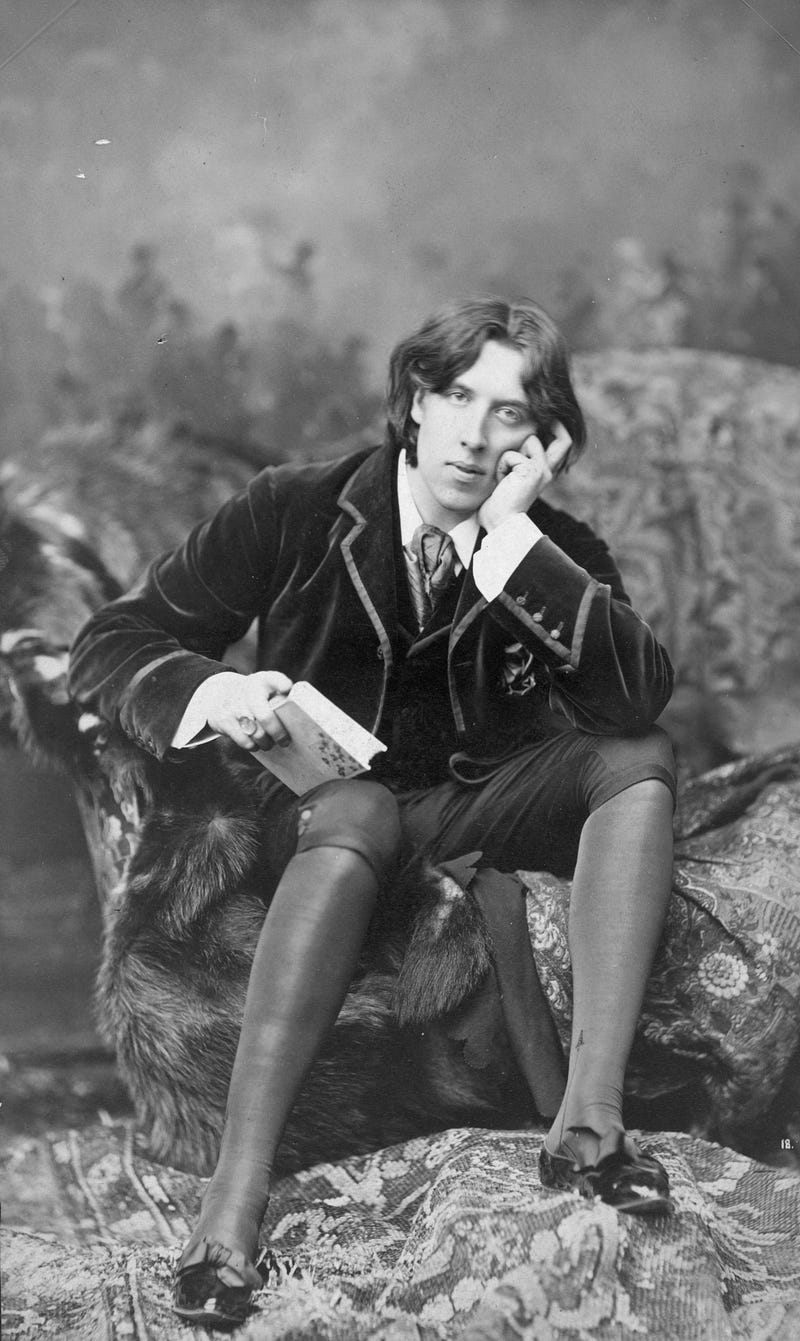
Portrait of Oscar Wilde, Napoléon Sarony, 1882 | Public Domain

In 1882, when Oscar Wilde arrived in America, he was asked the usual question by customs officials — "Do you have anything to declare?"

Wilde dryly quipped, "I have nothing to declare but my genius."

Cheeky as his response may have been, Wilde's genius was not exactly recognized yet. He had not written "The Picture of Dorian Gray" (1891) or the countless plays that would later cement his fame.

Oscar Wilde was pretty much the Kardashian of his day — his fame was built around his aesthetic and not any talent. New Yorkers adored him for his flamboyant fashions, witty bot mots, and biting aphorisms. Wilde was the celebrity everyone wanted at their soirée, and no one knew why.

Of course, unlike influencer culture today, Wilde saw the chimeric nature of fame and often caricatured himself. He played both the simpleton and the sage with paradoxical verve.

And as an object of both curiosity and repugnance (he was scandalously bisexual at a time when homosexuality was viewed as perverse) everyone wanted a photograph of Oscar Wilde.

So when Wilde walked into photographer Napoleon Sarony's New York studio foppishly dressed in a velvet vest, silk stockings, and shoes decorated with grosgrain bows, we can understand why Sarony declared, "A picturesque subject indeed!"

While Wilde was the quintessential artist's muse, Sarony's artistry is unquestionable. He posed Wilde cocooned in fur and damask drapery. A closed book rests on Wilde's knee. His chin rests on his hand. Wilde's quizzical eyes confront the viewer with a mocking, almost insouciant expression. Wilde is not the thinker. He is the disrupter.

What Wilde thought of the picture is unknown. While today we pay photographers to take our portraits, in the nineteenth century, photographers paid famous people to sit for them. And sometimes, they paid exorbitant amounts. Sarony reportedly paid actress Sarah Bernhardt $1500 to pose for him (approximately $45,000 today).

Photographers would then retain the rights and sell the photos as cabinet cards. Photography could be lucrative for those who had the money to pay for celebrity subjects. And Sarony had his share of celebrity sitters — Mark Twain, William Sherman, Walt Whitman, and Wilkie Collins.
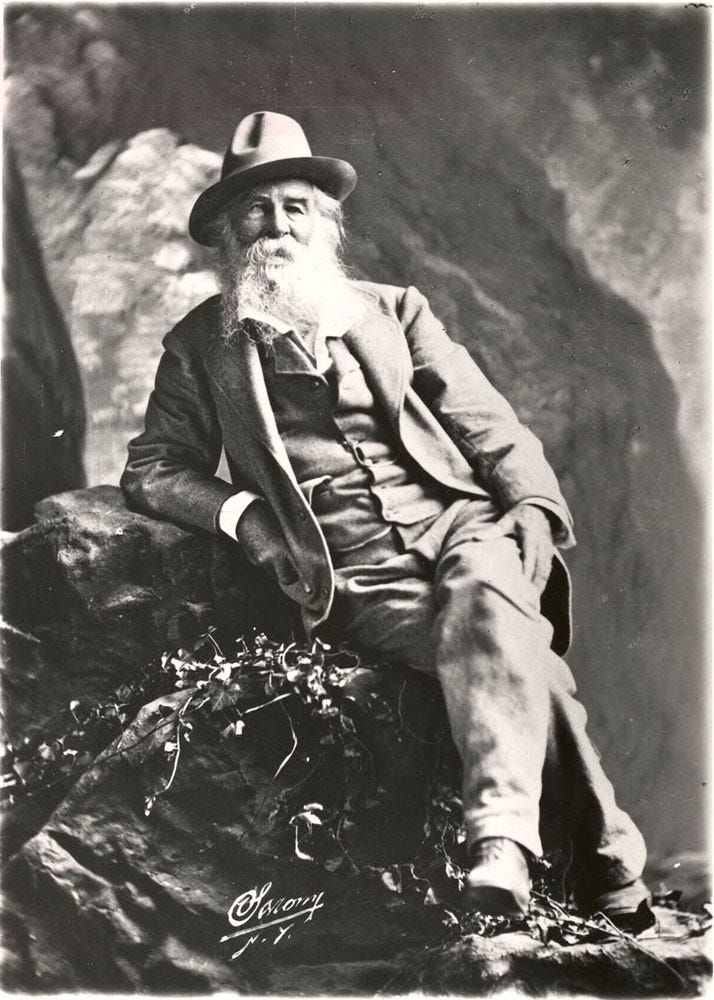
Walt Whitman, Photo by Napoleon Sarony, Public Domain

But two years after Wilde's photo shoot, Ehrich Bros.'s printer, Burrow-Giles Lithographic Co, made unauthorized lithographs of the photo and used Wilde's image in an advertising campaign to sell hats.

Understandably, Sarony was pissed. He sued Burrow-Giles for copyright infringement. The case, Burrow-Giles v. Sarony, went to the Supreme Court.

This case might seem like a slam dunk today, but at the time, the public did not view photography as a creative endeavor worthy of copyright.

Fortunately, Sarony won his case and was awarded a settlement of $610 (approximately $13,000 today).

The landmark case forever changed copyright laws and attitudes toward photography. Before the ruling, the public viewed photography as a product of a “machine,” and the works of a machine were not subject to copyright.

The debate should sound uncannily familiar.

Recently, the U.S. Copyright Office issued a statement on AI-generated art. The office ruled that works may be registered for copyright protection only if they are "works of authorship," defined as human authorship. Basically, art created solely by A.I. can not be copyrighted.

Like many of my fellow artists, I fear this ruling will not stick.

And while I am experiencing my share of existentialist angst over AI-generated art, I see both sides of the debate.

On the one hand, entering a clever text prompt into an image generator such as Midjouney does not qualify as an act of authorship. Prompts are instructions. They are similar to the creative briefs an art director gives an illustrator to complete an assignment. Yes, the art director plays a vital role in the creative process, but they are not the author of the final work.

But one could also view the instructions one gives an image generator as similar to posing a subject, choosing the props, and setting the aperture on a camera lens. What if a MidJourney user asked the program to render a softly lit image of Oscar Wilde in a velvet vest and silk stockings, staring directly at the viewer with hooded eyes and a veiled expression of disdain?

In other words, at what point does the art director become the artist?

Whatever side of the debate you fall under, most people agree that AI-generated art should not be clumped with human-generated art. Similarly, we recognize photography as art but separate it from painting.

And yes, anything can be considered art. But while you can stick a banana on a wall and get clueless humans to clap, there will be irreversible consequences to displacing artisans. Great art is a connection between the mind and the hand.

Toward the end of his life, Sarony advised aspiring photographers, 'The art of posing is in not posing. The true pose is not a pose, but a natural position.'

Does AI capture a "natural position," or is it merely a blurred copy of the genius that came before it?

Programs like Midjourney are not like photography — a tool at the hands of one artist. Midjourney creates its art from the hands of thousands of past and present artists.

Oscar Wilde might have taken a typical Dorian Gray stance regarding this debate and mused, "To define is to limit."

Should the definition of art have limits? That's a question we might only be able to answer once we understand the consequences of a limitless technology. Unlike a camera, AI learns.

Perhaps Dorian Gray understood this predicament all too well. When the soul of art no longer remains with the artist but with the portrait, only one soul can remain.

More from the Grim Historian:

To read more, please visit my affiliate link. A portion of your Medium subscription supports my work:

History
Art
Artificial Intelligence
Photography
Culture
Recommended from ReadMedium