avatarColby Hess

Free AI web copilot to create summaries, insights and extended knowledge, download it at here

3280

Abstract

oo long ago, I’d stumbled upon another article in the same vein as that mentioned above. I don’t precisely recall the title (because I’m now banned from viewing it), but it was something along the lines of “White People Have No Right to Have Opinions on Racism.”</p><p id="66dc">Being fully committed to free speech and the notion that anyone has the right to discuss any subject they wish, and that no one should be silenced based on the color of their skin, I duly replied in the comments section.</p><p id="7348">Perhaps I’m totally off-base, but I thought my reply was neutral, reasoned, and polite. Yet rather than generate a response (even an angry one), I was shocked to discover that apparently, the author simply blocked me for having stated it. I’m going to include the comment in its entirety so that you, the reader, may judge for yourself. I said:</p><blockquote id="3800"><p>The closest analogy that I would hope I’m permitted to speak on is when non-parents try to tell a parent how best to parent. It’s really annoying because they generally don’t know what the hell they’re talking about. But I don’t categorically deny them the right to offer their opinion. I merely point out how it’s not very relevant or useful. And non-parents aren’t completely off-base in offering parenting advice anyway, being as they were once parented themselves.</p></blockquote><blockquote id="384f"><p>Likewise, while white people may never experience racism per its recent redefinition, they can still experience bigotry, they can still experience hatred directed toward them because of their appearance, or the way they talk, or the passport they carry. But they’re not allowed to try to apply that experience as a bridge towards shared understanding? They’re instead told to sit down and shut up? How is that in any sense just? How is that not oppressive, even downright inhumane?</p></blockquote><blockquote id="153e"><p>I believe that everyone has full rights to weigh in on any subject, regardless of their qualifications or experience. If they’re totally off-base, they should be easy to dispute. But to <i>a priori</i> eliminate them from the conversation is ridiculous.</p></blockquote><blockquote id="e64b"><p>How is that ever going to spur constructive conversation and work toward eliminating bigotry of all forms so that, as MLK hoped (and modern anti-racists have apparently rejected) people can be judged not by the color of their skin but by the content of their characters?</p></blockquote><p id="627d">I’m thinking perhaps Black people just aren’t very fond of white people quoting MLK. Which is a shame, because he’s so <a href="https://www.npr.org/2010/01/18/122701268/i-have-a-dream-speech-in-its-entirety">eloquent</a> and eminently quotable. But such is life.</p><p id="2170">Anyway, the point of all this is to ask: How creepy is it when you’re suddenly blocked from viewing publicly available content, for reasons you’re neither privy to, nor able to protest or appeal?</p><p id="d3fa">Can you imagine if you were reading a paper book and words suddenly started disappearing before your eyes like a literary Marty McFly? It would be insanity. Yet that’s precisely the world we live in when everything is electronic and society is not

Options

firmly committed to truth and integrity.</p><figure id="d494"><img src="https://cdn-images-1.readmedium.com/v2/resize:fit:800/1*mWjniaJ_7ykhX7VfXlWleQ.jpeg"><figcaption>“Big Brother is watching.” (CC BY 4.0) Image credit: The Thought Police via <a href="https://commons.wikimedia.org/wiki/File:Groupthink.jpg">Wikimedia Commons</a></figcaption></figure><p id="a40c">I think there are a few major takeaways from all this.</p><p id="6c2c">First, as has been made abundantly clear by the recent <a href="https://readmedium.com/road-dahl-censored-by-sensitivity-readers-54849a74a33c">Roald Dahl</a> censorship fiasco, it’s perhaps more important than ever to still own actual, physical, paper books. I own thousands of them. Barring jackbooted fascists breaking down your door to seize them and toss them on a bonfire in the town square, this will ensure that no future censorship can alter or distort them from the author’s original intent.</p><p id="bf68">Second, whenever you find anything even remotely contentious on the Internet that you think you might want to reference later, be sure to do all of the following:</p><ol><li>Print it in its entirety as a PDF that you store offline on a thumb drive or backup hard drive. This will ensure that you always have access to it. Better yet, if you still have the old-school equipment to do so, burn it onto a CD or DVD to protect it from being erased by an <a href="https://en.wikipedia.org/wiki/Electromagnetic_pulse">EMP </a>blast or solar flare.</li><li>Take screenshots of the relevant portions you wish to preserve, and save them as image files, together with the PDF.</li><li>Copy and paste the entire, original URL so that you can hopefully track it down later on the <a href="https://archive.org/web/">Wayback Machine</a>. This has saved my bacon (and my sanity) more than once.</li></ol><p id="6f79">Lastly, use your power as a writer or a concerned citizen to speak out against censorship whenever and wherever you encounter it. This is critically important. Rights and liberties are far more easily lost than gained. As <a href="https://www.monticello.org/research-education/thomas-jefferson-encyclopedia/eternal-vigilance-price-liberty-spurious-quotation/">Thomas Jefferson</a> is said to have said (although no one’s sure who actually said it), “The price of liberty is eternal vigilance.”</p><p id="4a45">So, to anyone who values their rights and their <a href="https://readmedium.com/what-the-hell-is-wrong-with-freedom-9541ab7f655">freedoms</a>, stay vigilant. Stay free. And above all, never stay silent.</p><figure id="3a44"><img src="https://cdn-images-1.readmedium.com/v2/resize:fit:800/0*m5yXUpi2j0Jc0tP6.png"><figcaption></figcaption></figure><p id="0aad"><i>Colby Hess is a freelance writer and photographer from Seattle, and author of the freethinker children’s book <a href="https://www.amazon.com/Stranger-Wigglesworth-Colby-Hess/dp/0578985535"></a></i><a href="https://www.amazon.com/Stranger-Wigglesworth-Colby-Hess/dp/0578985535">The Stranger of Wigglesworth<i></i></a><i>.</i></p><p id="c34b">If you enjoy my writing and would like to receive stories by email whenever I publish, please click <a href="https://medium.com/subscribe/@colby.t.hess"><b>here</b></a>.</p></article></body>

Orwell and the 410 Error

Censorship is censorship, anytime, anywhere
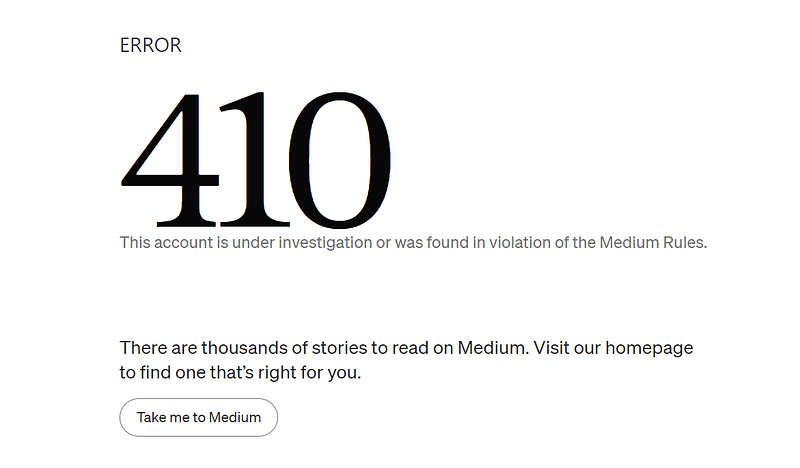
The error message displayed by Medium when an article has been censored. Screenshot by the author.

A few weeks ago, I stumbled upon an article on Medium titled “Yes My Dear, All White People are Racists.” Unable to resist its click-baity premise, I clicked, and not to be disappointed, both the content and tone of the article were every bit as infuriating as promised.

I was in the process of writing an essay in response to the points it brought up, an essay along the lines of it being “the most smug, condescending, hateful rubbish I’ve ever encountered, like something straight out of Mein Kampf,” when I discovered, both to my delight and my horror, that the link to the article was no longer functional. Instead, I was redirected to the “410 Error” message shown above.

Like I said, I was happy to see that Medium’s standards were being evenly applied, and that such an intolerant diatribe making slanderous accusations against an entire race of people based on their skin color was deemed unworthy of inclusion in a site committed to civil discourse.

But at the same time, I found my sudden lack of access to it extremely unsettling. After all, as someone passionately committed to the concept of free speech, and a staunch opponent of any and all forms of censorship, it was disturbing to find that I could no longer view something that, prior to being taken down, had generated thousands of views, comments, and claps. Hateful or not, once part of the public record, it ought to have remained there — for research purposes, if nothing else.

But no. Gone. Vanished into thin air. Like it never existed. Like we were never at war with Eastasia. Like Eurasia was always our ally.
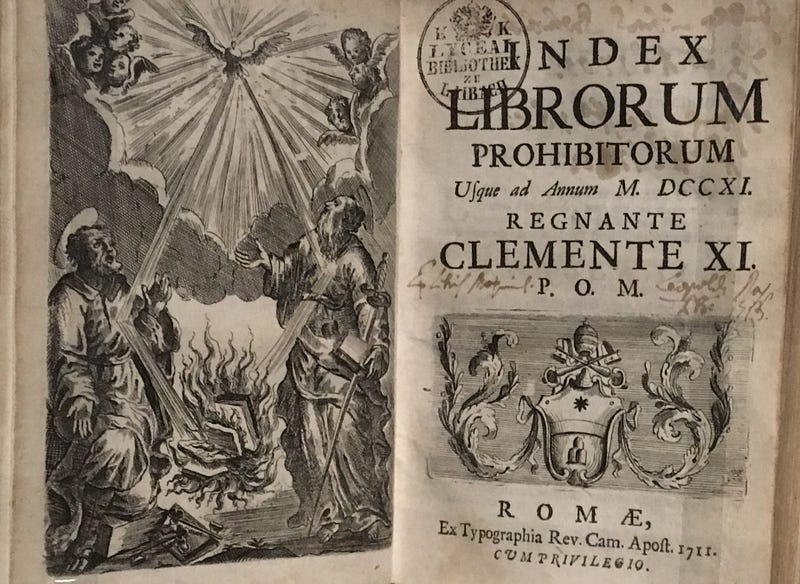
The infamous Index Librorum Prohibitorum, “a list of publications which the Catholic Church censored for being a danger to itself and its members” (CC BY 4.0) via Wikimedia Commons

Articles being suddenly “disappeared” is not just a problem confined to those writings deemed worthy of inclusion in the modern version of the Index Librorum Prohibitorum (“List of Prohibited Books”) by the censorious powers that be. No, in the spirit of democratizing such oppression, this same power of censorship is granted to every single reader and writer via the “Block this author” button.

To give an example, not too long ago, I’d stumbled upon another article in the same vein as that mentioned above. I don’t precisely recall the title (because I’m now banned from viewing it), but it was something along the lines of “White People Have No Right to Have Opinions on Racism.”

Being fully committed to free speech and the notion that anyone has the right to discuss any subject they wish, and that no one should be silenced based on the color of their skin, I duly replied in the comments section.

Perhaps I’m totally off-base, but I thought my reply was neutral, reasoned, and polite. Yet rather than generate a response (even an angry one), I was shocked to discover that apparently, the author simply blocked me for having stated it. I’m going to include the comment in its entirety so that you, the reader, may judge for yourself. I said:

The closest analogy that I would hope I’m permitted to speak on is when non-parents try to tell a parent how best to parent. It’s really annoying because they generally don’t know what the hell they’re talking about. But I don’t categorically deny them the right to offer their opinion. I merely point out how it’s not very relevant or useful. And non-parents aren’t completely off-base in offering parenting advice anyway, being as they were once parented themselves.

Likewise, while white people may never experience racism per its recent redefinition, they can still experience bigotry, they can still experience hatred directed toward them because of their appearance, or the way they talk, or the passport they carry. But they’re not allowed to try to apply that experience as a bridge towards shared understanding? They’re instead told to sit down and shut up? How is that in any sense just? How is that not oppressive, even downright inhumane?

I believe that everyone has full rights to weigh in on any subject, regardless of their qualifications or experience. If they’re totally off-base, they should be easy to dispute. But to a priori eliminate them from the conversation is ridiculous.

How is that ever going to spur constructive conversation and work toward eliminating bigotry of all forms so that, as MLK hoped (and modern anti-racists have apparently rejected) people can be judged not by the color of their skin but by the content of their characters?

I’m thinking perhaps Black people just aren’t very fond of white people quoting MLK. Which is a shame, because he’s so eloquent and eminently quotable. But such is life.

Anyway, the point of all this is to ask: How creepy is it when you’re suddenly blocked from viewing publicly available content, for reasons you’re neither privy to, nor able to protest or appeal?

Can you imagine if you were reading a paper book and words suddenly started disappearing before your eyes like a literary Marty McFly? It would be insanity. Yet that’s precisely the world we live in when everything is electronic and society is not firmly committed to truth and integrity.
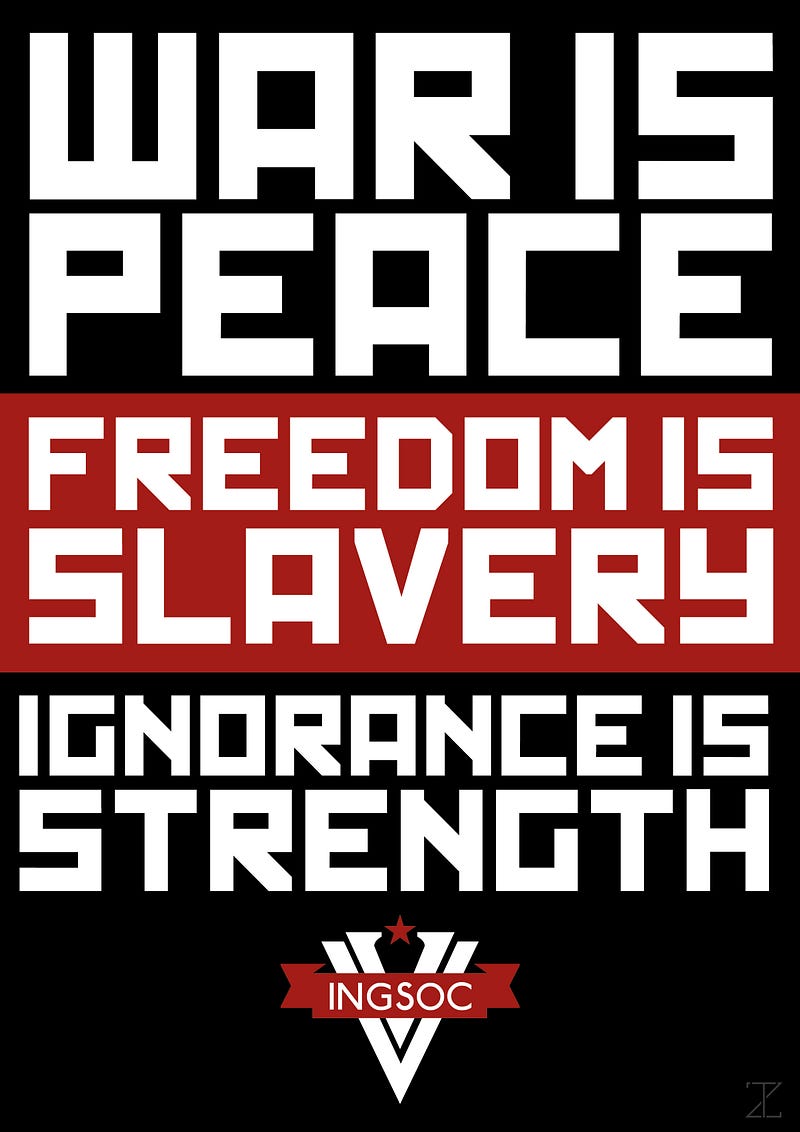
“Big Brother is watching.” (CC BY 4.0) Image credit: The Thought Police via Wikimedia Commons

I think there are a few major takeaways from all this.

First, as has been made abundantly clear by the recent Roald Dahl censorship fiasco, it’s perhaps more important than ever to still own actual, physical, paper books. I own thousands of them. Barring jackbooted fascists breaking down your door to seize them and toss them on a bonfire in the town square, this will ensure that no future censorship can alter or distort them from the author’s original intent.

Second, whenever you find anything even remotely contentious on the Internet that you think you might want to reference later, be sure to do all of the following:

  1. Print it in its entirety as a PDF that you store offline on a thumb drive or backup hard drive. This will ensure that you always have access to it. Better yet, if you still have the old-school equipment to do so, burn it onto a CD or DVD to protect it from being erased by an EMP blast or solar flare.
  2. Take screenshots of the relevant portions you wish to preserve, and save them as image files, together with the PDF.
  3. Copy and paste the entire, original URL so that you can hopefully track it down later on the Wayback Machine. This has saved my bacon (and my sanity) more than once.

Lastly, use your power as a writer or a concerned citizen to speak out against censorship whenever and wherever you encounter it. This is critically important. Rights and liberties are far more easily lost than gained. As Thomas Jefferson is said to have said (although no one’s sure who actually said it), “The price of liberty is eternal vigilance.”

So, to anyone who values their rights and their freedoms, stay vigilant. Stay free. And above all, never stay silent.

Colby Hess is a freelance writer and photographer from Seattle, and author of the freethinker children’s book The Stranger of Wigglesworth.

If you enjoy my writing and would like to receive stories by email whenever I publish, please click here.

Society
Censorship
Orwell
Internet
Archive
Recommended from ReadMedium