
D as Diagramming: The Organization-for-Opportunity Framework
The Ecological Practice Approach is about finding opportunity. Now we need a framework for turning opportunity to outcome.
I am recently working on the D as Diagramming project which focuses on exploring the power of Diagrams and Diagramming. From the perspective of Activity Theory, Diagram means a tool while Diagramming means an activity. Thus, the D as Diagramming project is both about tools and activity. From the perspective of cognitive science, diagramming is about spatial cognition which is my favorite topic. From the perspective of Curativity Theory, Diagrams are knowledge containers for knowledge curation.
Moreover, what I really want to know is about the value of diagrams for turning tacit knowledge into explicit knowledge. Thus, I set this goal as the present objective of the D as Diagramming research project.
I use three approaches for the project:
- Reflect on my own works
- Interview others
- Collect examples
You can find more details from a previous article: The D as Diagramming Project.
This article shares the work of the Diagramming as Thinking Sprint. In past weeks, I was running the sprint with the following three steps:
- Draw diagrams on index cards.
- Design diagrams with softwares.
- Write short notes about these diagrams on Linkedin or Twitter.
On Aug 10, I did a sprint too. You can see the original tweet thread here.
This article offers more details and references for this work. This step is not part of the Diagramming as Thinking Sprint because the sprint means writing/drawing something quickly in order to capture your intuitive inspirations as soon as possible. The sprint is the beginning of turning tacit knowledge into explicit knowledge.
This article divides into three parts:
- Part 1 is the archive of the original tweets.
- Part 2 offers some notes for expanding the tweets.
- Part 3 moves to discuss Diagramming as Thinking.
Part 1: The Archive
You can find the original tweet thread here. The below part only shows original texts and diagrams.
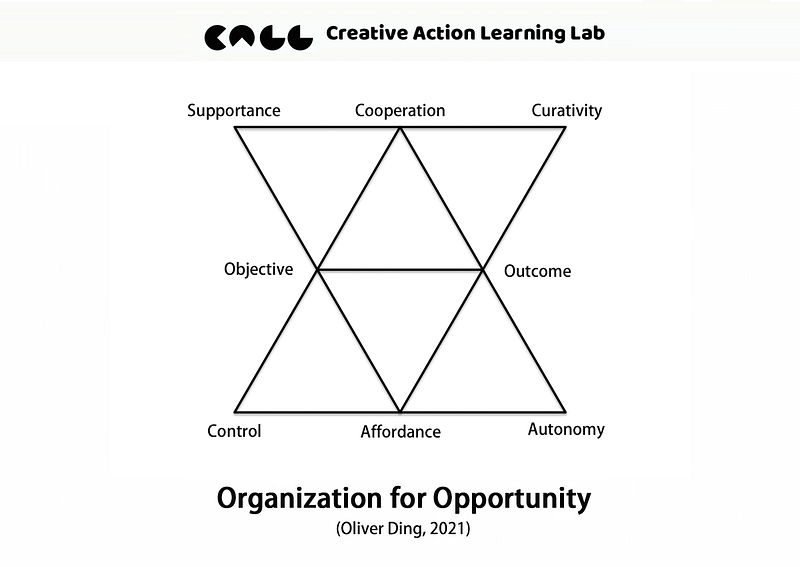
1. Yesterday I designed a new framework: the Organization-for-Opportunity framework.
2. I used the following three resources for this work:
- 2A. Three concepts from the Ecological Practice Approach (my own work)
- 2B. Robert W. Keidel’s book Seeing Organizational Patterns.
- 2C. A diagram from the Platform-for-Development framework (v1.0).
It’s a diagram blending!
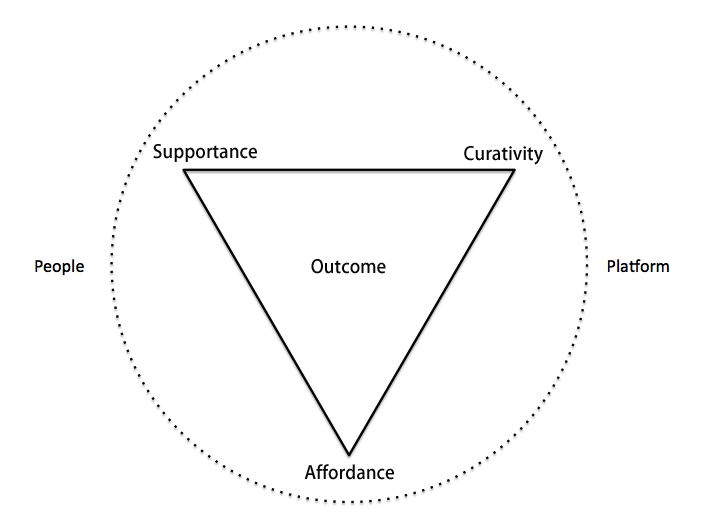
3. First diagram highlights three concepts from Ecological Practice approach:
- 3A — Affordance: the opportunity offered by physical environment
- 3B — Supportance: the opportunity offered by social environment
- 3C — Curativity: the opportunity of turning pieces into a whole
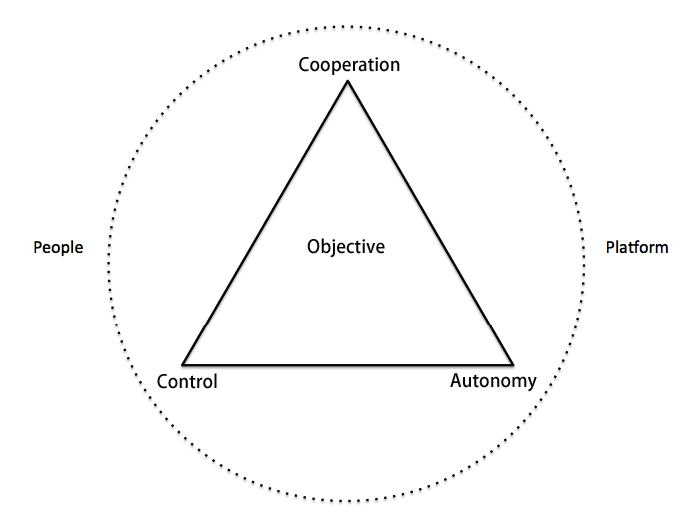
4. Second diagram highlights three variables of organization:
- 4A — Individual Autonomy
- 4B — Hierarchical Control
- 4C — Spontaneous Cooperation
This is adopted from Robere W. Keidel’s book Seeing Organizational Patterns (1995).
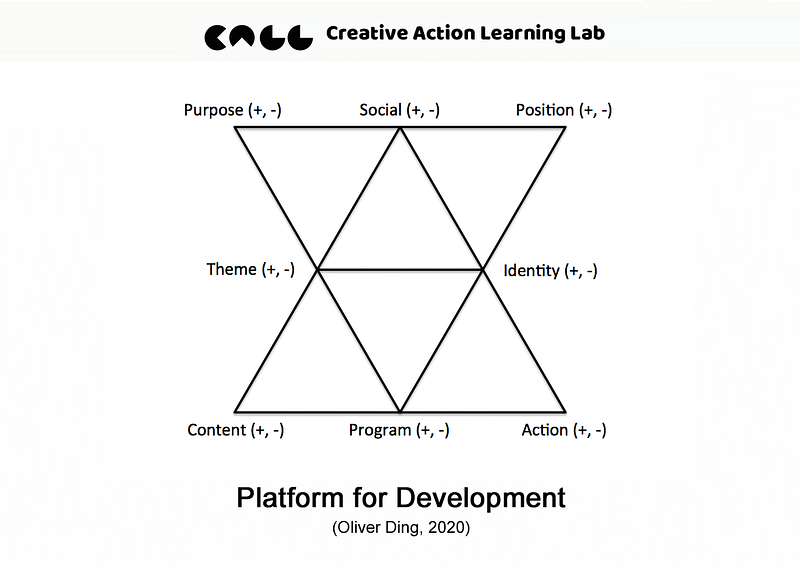
5. The meta-diagram comes from the Platform-for-Development framework (v1.0).
I renamed the framework as Developmental Project Model. I used its diagram as a meta-diagram for blending two triangles together.
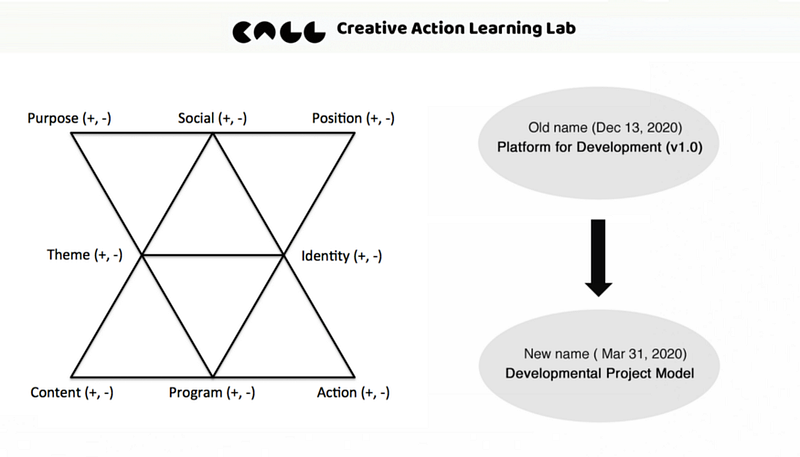
6. The original Platform-for-Development framework (v1.0) is formed by two triangles.
- 6.1 three dimensions of developmental resources
- 6.2 project as situational context
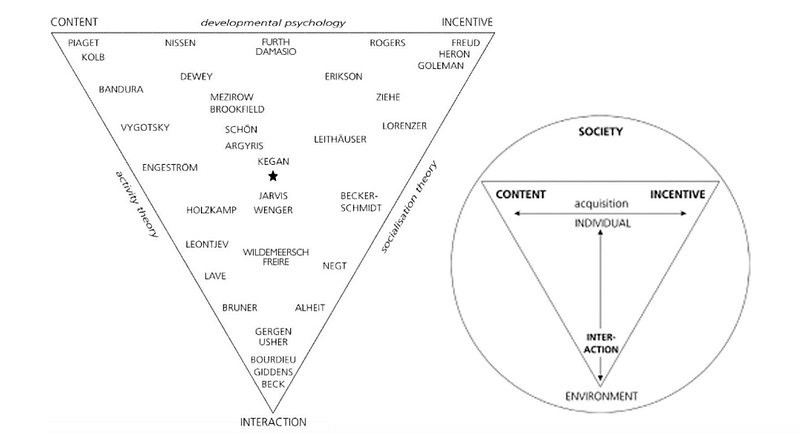
7. three dimensions of developmental resources are Social, Action, and Content.
This is inspired by Knud Illeris’ How We Learn: Learning and Non-Learning in School and Beyond (2007).
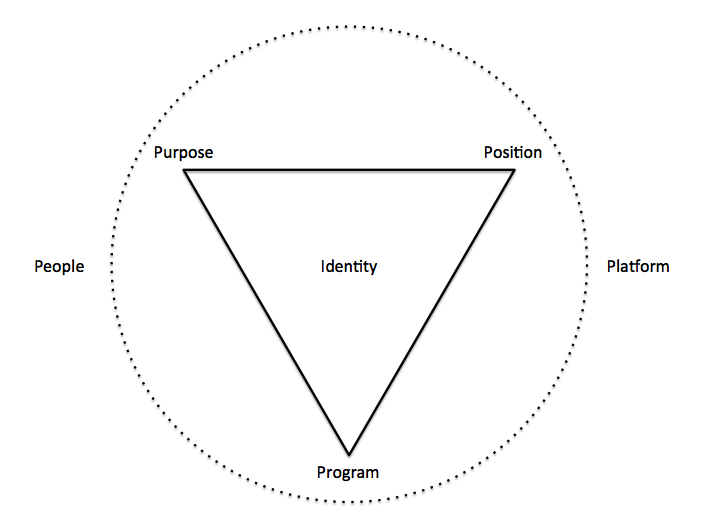
8. Project as Situational Context This is originally named as 5A framework.
It is inspired by:
- 8A. Derek Layder’s Social Domains Theory.
- 8B. Andy Blunden’s idea “project as a unit of activity”.
9. Five Analysis Modules The original Platform-for-Development framework offers five analysis modules:
- 9A: Developmental Resources Analysis
- 9B: Situational Context Analysis
- 9C: Cultural Projection Analysis
- 9D: Social Engagement Analysis
- 9E: Activity Landscape Analysis
10. Five Modules for the Meta-Diagram
- 10A: First Triangle
- 10B: Second Triangle
- 10C: Theme Blending (Each Triangle has a center theme)
- 10D: Element Engagement (Each element leads to a positive or negative experience)
- 10E: Network Analysis (The whole diagram connects to others)
Part 2: The Notes
The Organization-for-Opportunity framework connects my work the Ecological Practice Approach and Organizational Theories through a diagram blending work.
The Ecological Practice Approach is inspired by Ecological Psychology. The three key concepts of the approach are Affordance, Supportance, and Curativity. Both these three concepts are about opportunities offered by environments.
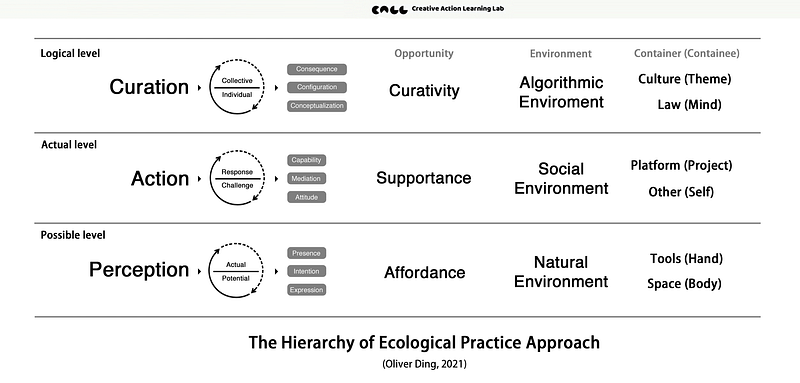
You can find details about the historical development of the approach here.
I have worked on the approach for three years, but so far it only talks about the relationship between Person and Environment. Though I have moved from detecting opportunities to obtaining opportunities, I have not discussed such things from the collective perspective.
Three weeks ago, I shared the diagram below on Linkedin. The diagram uses three keywords to connect practice and theory: Opportunity, Objective, and Outcome. This diagram is part of my recent project Career Curation which aims to apply Curativity Theory to discuss Career Development and Personal Innovation. You can find more details on the original post on Linkedin.
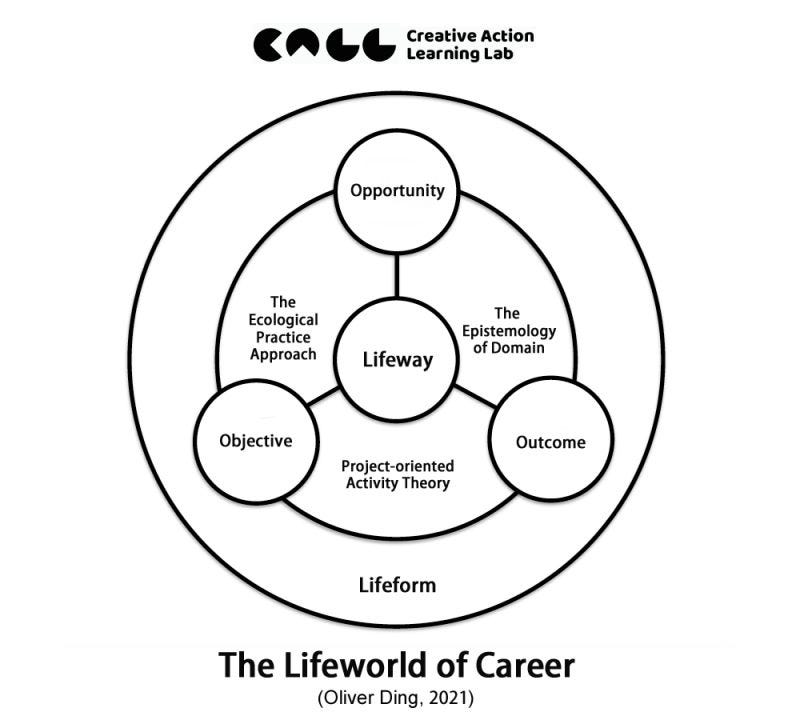
The above diagram highlights three theoretical accounts:
- The Ecological Practice Approach
- Project-oriented Activity Theory
- The Epistemology of Domain
The Organization-for-Opportunity framework echoes the direction of the Career Curation project. It’s clear that I am working on a new path. While the diagram of “Lifeworld of Career” highlights three keywords: Opportunity, Objective, and Outcome, the Organization-for-Opportunity framework adds a new element: Organization.
I have mentioned that I am collecting examples of diagrams for the D as Diagramming Archive. For example, I bought two books last week. One book is about using Triangle diagrams to discuss organizational design while the other one book is about the 2x2 Matrix diagram for business thinking.
I was inspired by Robert W. Keidel’s book Seeing Organizational Patterns. According to Robert W. Keidel, “Here are more than 200 triads — taken primarily from Western academic and popular management and organizational literature (and secondarily from writings on cognition and physical design) — that parallel autonomy/control/cooperation.”
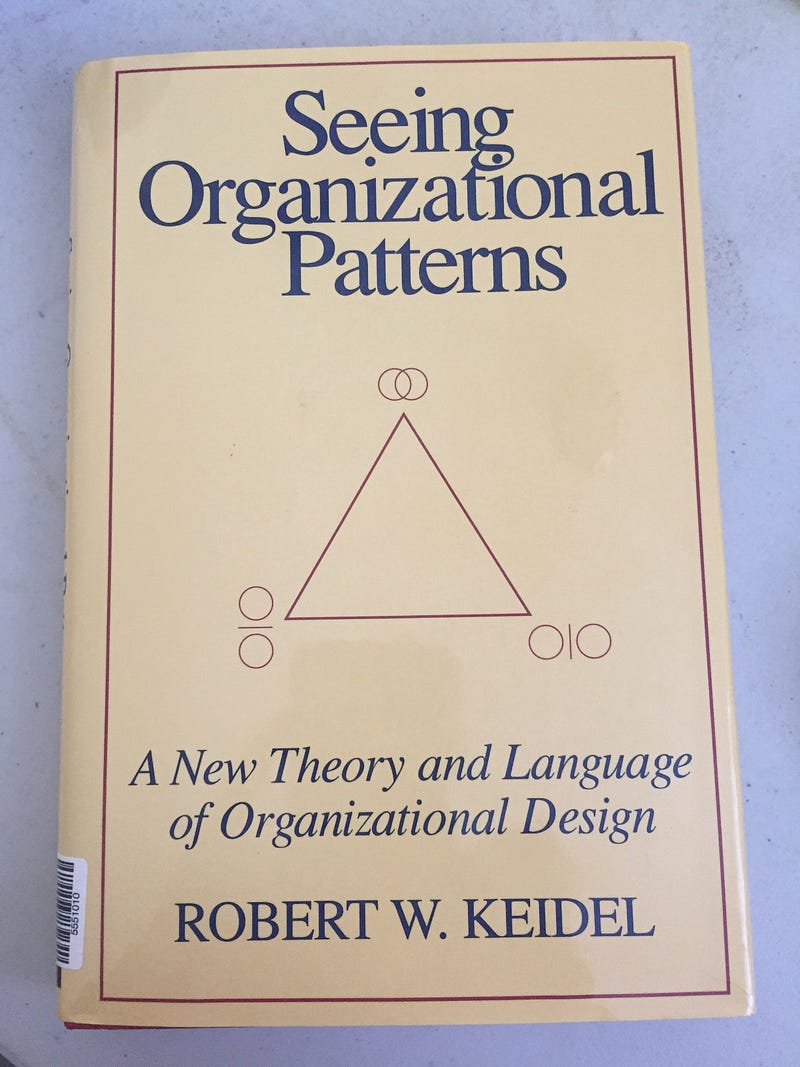
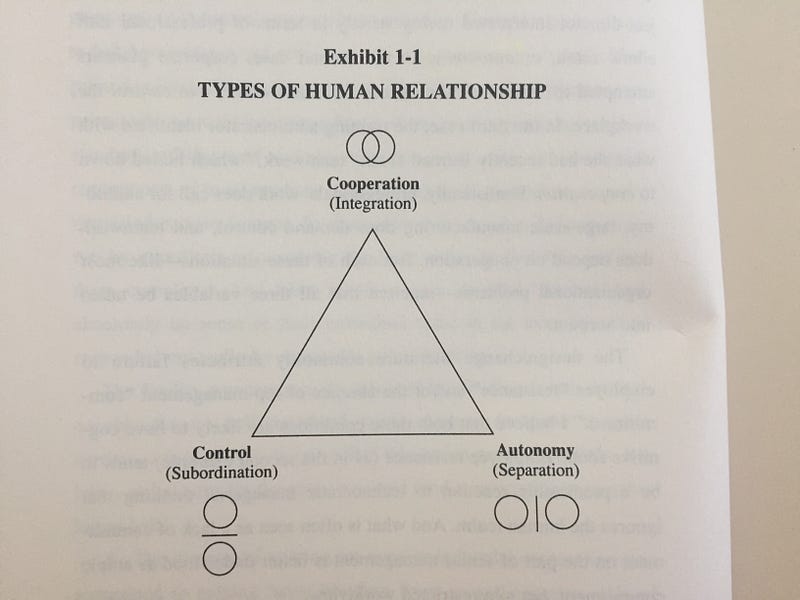
Robert Keidel did a great work of knowledge curation for understanding organizational design. He explains that most organizational issues are a balance of three variables: Individual autonomy, Hierarchical Control, and Spontaneous Cooperation.
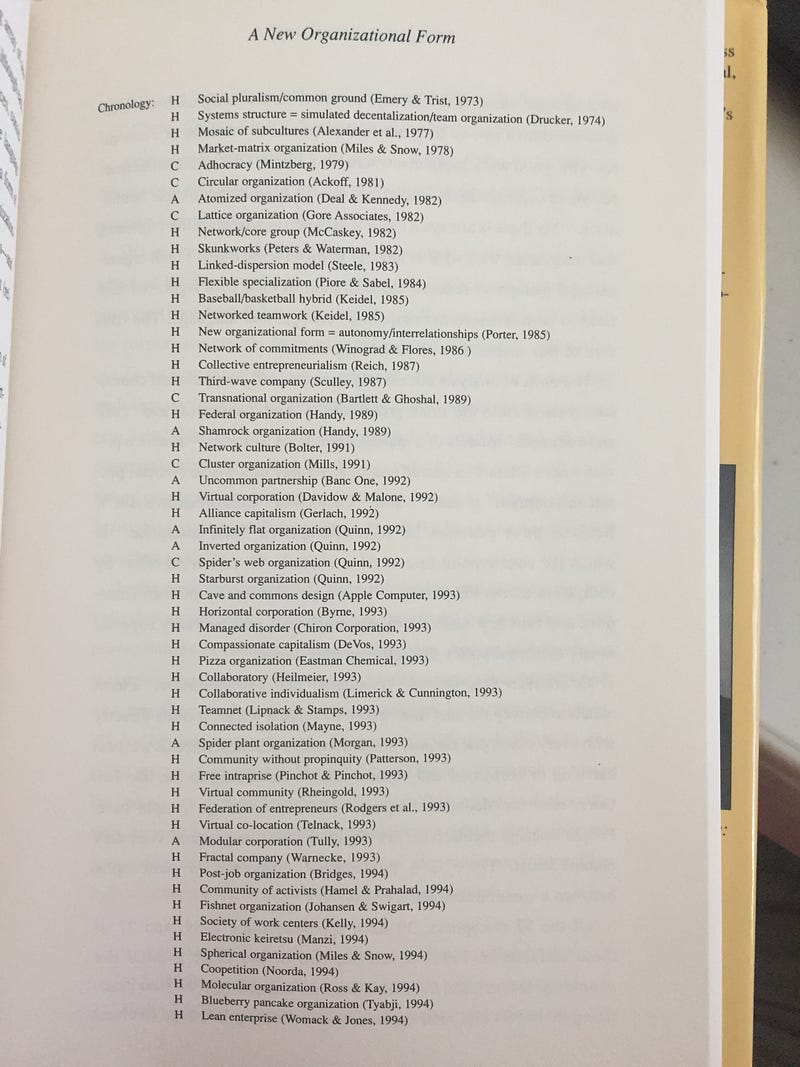
Robert Keidel collected 57 metaphors about organization from organizational theorists and he found that emergent organizational patterns cluster along an axis between two variables: Cooperation and Autonomy, and away from hierarchical control.
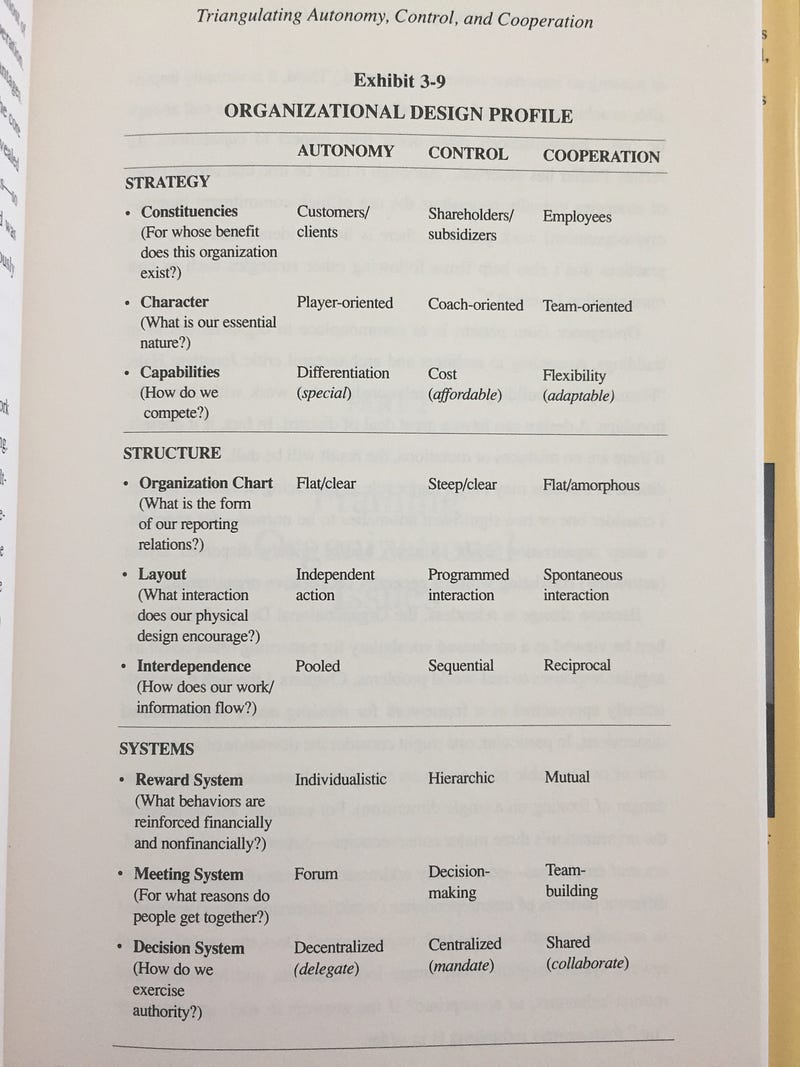
In the last paragraph of the book, Robert Keidel mentioned a special resource, “I should also note a parallel with the Tavistock Anthology, The Social Engagement of Social Science, edited by Trist and Murray (1990; 1993; forthcoming;): Volumes 1, 2, and 3 are subtitled, respectively: the social-psychological (autonomy), socio-technical (control), and socio-ecological (cooperation) perspectives.” (1995, p.151)
Robert Keidel’s organizational triangle inspired me to create the Organization-for-Opportunity framework which connects the Ecological Practice Approach with Organizational Theories.
The Platform-for-Development framework (v1.0) offers a meta-diagram for this work. You can find details about the framework here.
Part 3: The Discussion
The original tweets are just a list of items. Each item links to my tacit knowledge or my explicit knowledge.
What’s my explicit knowledge behind the tweets?
- The Ecological Practice Approach
- The Platform-for-Development Framework (v1.0)
I have written many articles about these two works including theoretical concepts, diagrams, sub-frameworks, canvas, and case studies. These works are my explicit knowledge.
How about my tacit knowledge behind the tweets? The idea of tacit knowledge was coined by Michael Polanyi in his 1958 book Personal Knowledge. It’s hard to give an accurate operational definition for the concept. I just roughly use it for this discussion.
I think I can claim the following items as my tacit knowledge in this case:
- I knew there is a connection between Robert W. Keidel’s book Seeing Organizational Patterns and my work the Ecological Practice Approach.
- I knew it’s possible to generate a meta-diagram from the Platform-for-Development Framework (v1.0)
- I knew it’s possible to visualize the connection by adopting the meta-diagram.
Thus, the sprint meants put these tacit knowledge into reality. The outcome offers two things for further development.
- The Organization-for-Opportunity Framework (v1.0)
- The X-for-Y meta-diagram
Is it a diagram blending?
Yes! If we consider the triangle diagram as a meta-diagram, then the X-for-Y meta-diagram is formed by two triangles. If a diagram is formed by two or more diagrams, then I claim that the process of creating the diagram is diagram blending.
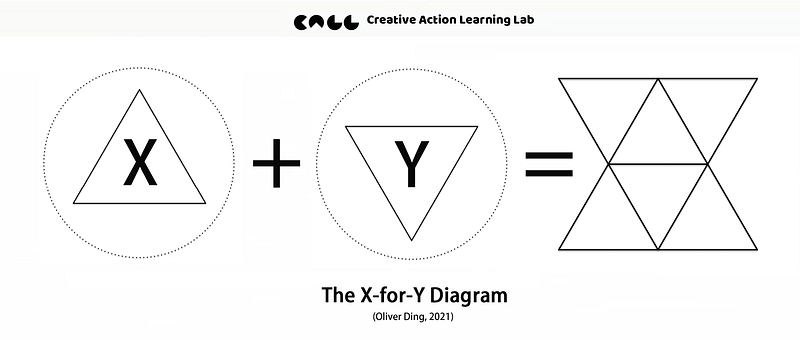
You can find an example of diagram blending from a previous article D as Diagramming: Tripartness and Diagram Blending.
Why do we need the X-for-Y diagram if we can use two triangles? Because there is something emergentes from the process of forming a whole. For example, the Organization-for-Opportunity Framework is a new diagram. It can be understood from the following parts which are generated by the process. Each line connects two or three concepts together and offers a new creative trigger for thinking and discussion.
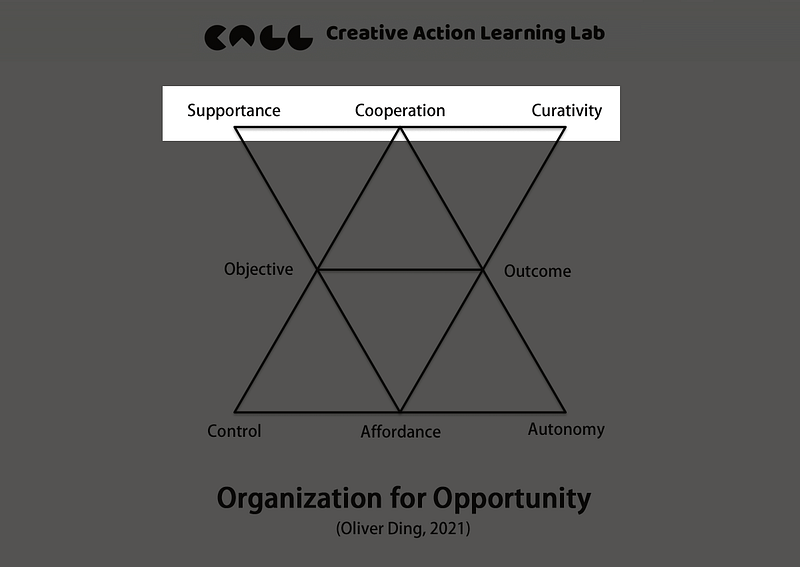
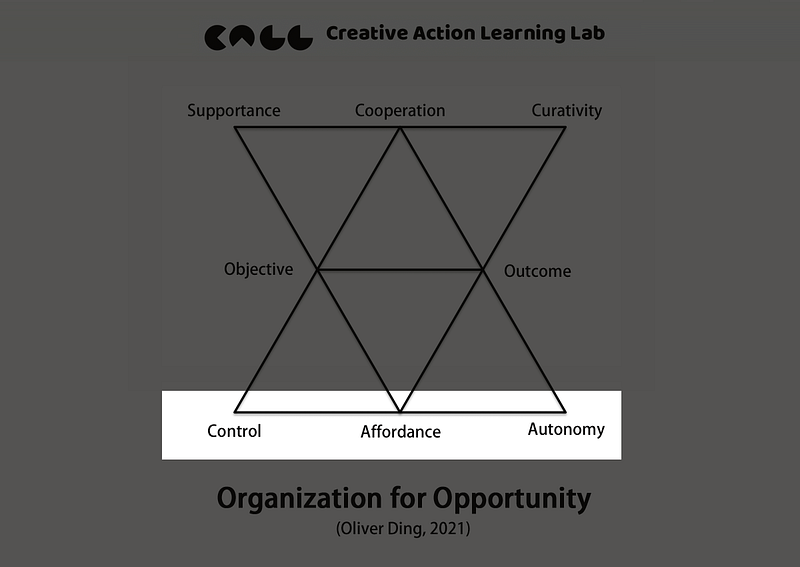
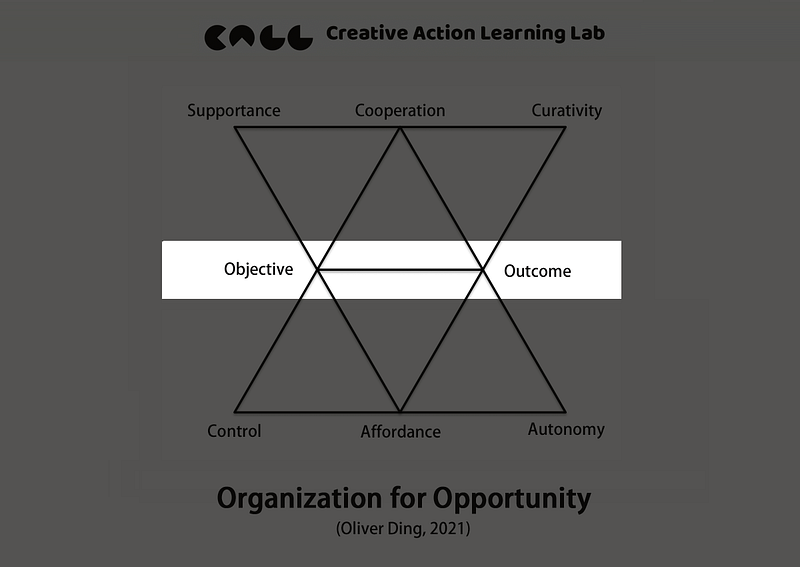
We can also discover six emergent triangular zones from the whole. Each small triangle connects three concepts together and offers a new space as a creative trigger. We can discover deep themes within each triangular zone.
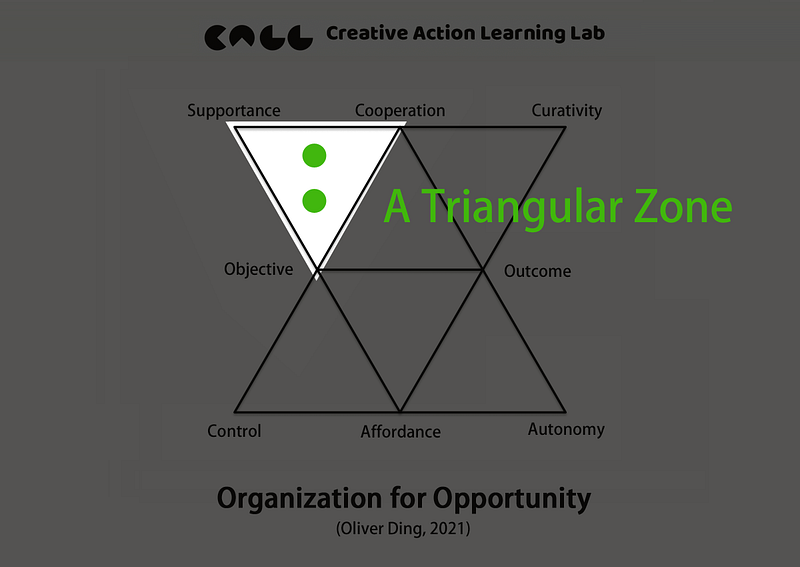
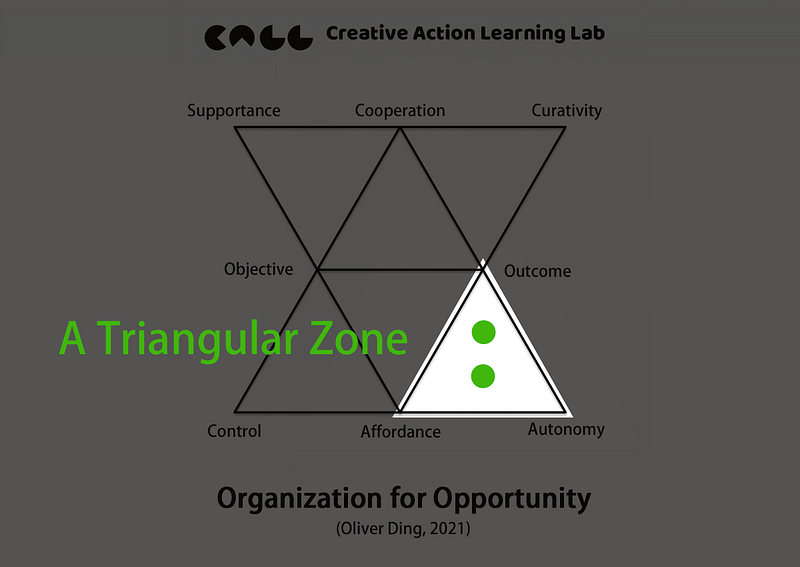
The Organization-for-Opportunity framework is a heuristic tool for practical work. It offers a set of ways to connect concepts together in order to inspirate open thinking and discussing.
I also mentioned five analysis modules from the X-forY meta-diagram. You can find a concrete example from the Platform-for-Development framework (v1.0).
You are most welcome to connect via the following social platforms:
Polywork: https://www.polywork.com/oliverding Twitter: https://twitter.com/oliverding Boardle: https://www.boardle.io/users/oliver-ding Linkedin: https://www.linkedin.com/in/oliverding
License
This work is licensed under the Creative Commons Attribution-NonCommercial-ShareAlike 4.0 International (CC BY-NC-SA 4.0) License. Please click on the link for details.


