
“Opposites Are Complementary”- Ancient TCM Wisdom for Modern Health and Well-Being
Its wisdom on the holistic approach, personalized care and prevention is even more relevant today
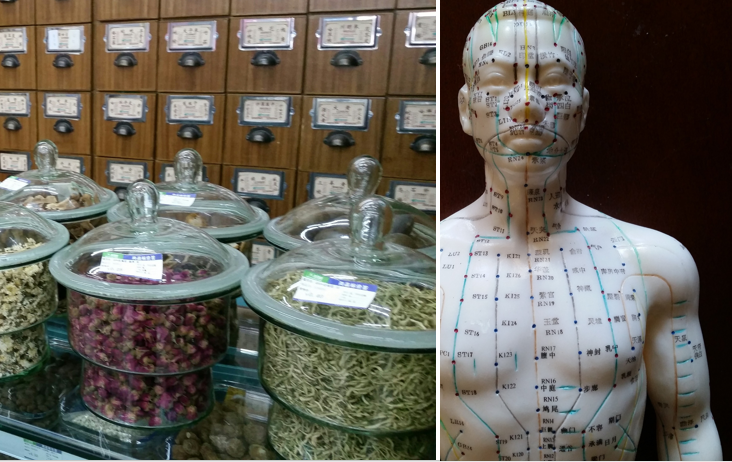
Around this time three years ago, National Geographic published a special edition “The Future of Medicine”. It provided an in-depth look at how cutting-edge technologies and ancient Chinese remedies are changing modern healthcare. The story on TCM (Traditional Chinese Medicine) struck a chord with me.
Growing up in a medical family on the campus of TCM university in China, I reconnected with TCM years later, thanks to a few aha moments. Along the way, I became fascinated with the ancient wisdom, which has helped me to better connect to the body’s voice, and get rid of some discomfort at its budding stage. Interestingly, strategies of failure analysis in corporate work also provided a different perspective for me to connect the dots and appreciate TCM and its framework.
While modern medicine could treat some diseases beautifully with clearly established micro-mechanisms empowered by the advancement of technology, ancient TCM uses terminologies such as Yin Yang Balance, Five Elements (also called Phases), Four Examinations, Eight Principles, Channel (also called Meridian) system as the foundation and guiding principles for prevention, healthcare, diagnostics, and disease treatment. It’s quite abstract, philosophical or metaphysical, intangible, not to mention it’s ancient and also foreign to most Westerners. Understandably, not as easy to grasp. It has been considered the art of healing by some folks. Others may think it is just tribal knowledge or a placebo. That is an unfortunate misunderstanding.
Founded on Taoism and documented in medical classics Huangdi Neijing more than 2000 years ago, TCM is still being applied side by side with modern medicine in China, and also has spread to other continents. Its wisdom on holistic approach, prevention and personalized care is even more relevant today.
Let’s take a look at a couple of key features of TCM and its variety of approaches to health and prevention.
Holistic: Yin Yang balance the fundamental pillar
Yin Yang is the most fundamental philosophy in Chinese culture, established several thousands of years ago. It has profound influences across many fields, especially in TCM, where the holy secret of health is to have Yin Yang balance.
The concept is reflected by Taoism’s Tai-ji symbol -the two forces or phenomena opposite to each other, yet interrelated and dependent on each other, none can exist without the other, unfolding through dynamic balance and together becoming a whole. It’s a simplistic yet sophisticated concept to comprehend many phenomena in nature and the universe.
“Opposites are complementary” is credited to Niels Bohr, the Nobel Laurent in physics, and founder of quantum mechanics. When Niels Bohr was awarded the Order of the Elephant In 1947, a prestigious Danish distinction, he designed his own coat of arms around the Yin-Yang symbol with the motto “CONTRARIA SUNT COMPLEMENTA”, meaning “opposites are complementary”. It’s a principle he formulated as a cornerstone of quantum mechanics, enabling the fundamental understanding of the paradoxical features of quantum phenomena such as wave-particle duality.
Across ancient TCM to modern physics, from macro world to sub-atomic articles, this Yin-Yang connection is simply amazing.
The application of Yin Yang principle in TCM is extremely flexible, from the human body constitution, blood and Qi, the cause of the health issue, syndrome progression, disease differentiation and treatment, characteristics of organs and Channels, to the nature and function of herbs and food, etc. Our human body is the most complicated and intelligent live system. There are many dynamic and self-regulated balances constantly ongoing inside the body. But once in a while, it could require a nudge to get back to its balance.
Yin Yang can be dissected into many layers in TCM. On the macro scale, I believe Yin Yang balance represents the compatibility and harmony of multiple organs, body and mind, different emotions, and nature and us. And their interrelationship can be further revealed in the framework such as Five Elements.
Holistic: Interrelationship
According to TCM, the body is a connected whole. Its interrelationship is reflected by Yin Yang, Five Elements, Channel system, etc.
In Five Elements, 5 matters in the natural world, 金Metal, 水Water, 木Wood, 火Fire, 土Soil -土 has been translated as Earth, but I believe Soil is a more proper translation here, are linked to five key organ systems (Lung, Kidney, Liver, Heart, Spleen, with broad meaning vs anatomy). It is also connected to many phenomena of the human body and nature: emotion, color, taste, sound, seasonal changes, etc, categorized by similar functions or characteristics. They are interrelated, mutually influencing each other.
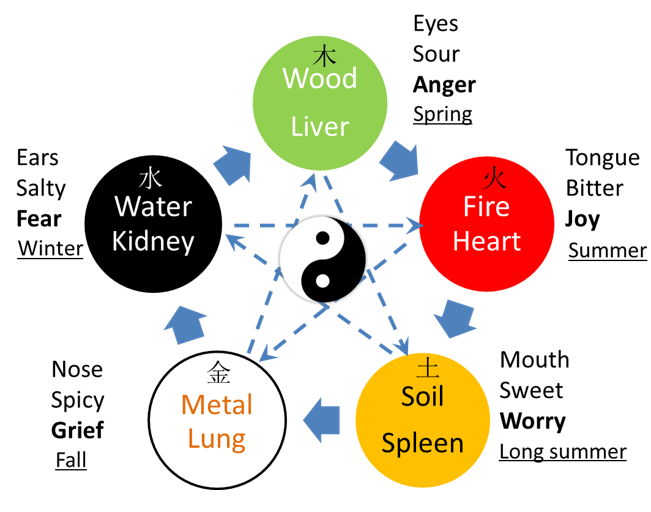
For instance, according to TCM, the ear is linked to the kidney. Medical research in recent years has shown that kidney disease could increase the risk of hearing loss in several studies. According to researchers, “The link can be explained by structural and functional similarities between tissues in the inner ear and in the kidney”. Intriguing, isn’t it? And side effects from certain antibiotics causing kidney damage could also impact hearing due to toxicity to the inner ear.
One key aspect of Five Elements is emotion, a strong influencer on health according to TCM. While all emotions have their place in life, unbalanced or extreme emotions can directly impact organ function. In the meantime, weakened organ function could lead to even worse unhealthy emotions. For example, based on Five Elements model, excessive grief or sadness lingering for an extended period, if not properly relieved, could interfere with lung function, leading to breathing difficulty. Intense worry, overthinking and anger could result in digestion issues or loss of appetite. It’s a good idea to keep our emotions in check.
Channel aka the Meridian system behind acupuncture is another tool reflecting Yin Yang and interrelationship. It’s practically the information highway of the human body, acting like a net, connecting the body from head to toe and interior to exterior. If people get a headache and seek acupuncture treatment, don’t be surprised that they could get poked not only on the head but also elsewhere such as on the feet and legs. This is because there are multiple Channels along the head. Depending on the location of the headache, there could be other spots along the corresponding Channel to be treated to help reduce the pain.
Holistic: Diagnosis through Four Examinations
In TCM the methodology for diagnosis is called Four Examinations望闻问切 (wàng wén wèn qiè).
望: observing i.e. general appearance, body build, skin tone, facial complexion, vibe, tongue, eye, etc
闻: listening i.e. voice, pitch, breathing, different sounds of coughing, and smelling
问: Q&A i.e. history of the disease, sleep, diet, appetite, digestion, habit/lifestyle, etc
切: taking the pulse
Upon collecting various information on patients, TCM doctor would combine the multi-dimensional information to construct the disease pattern and health profile, then come up with a personalized treatment plan. Ying Yang, Five Elements, Eight Principles along with Channel system provide powerful ways to classify and organize the variety of information for diagnosis and treatment. This is called 辨证论治 (bei zheng shi zhi)- syndrome differentiation for treatment.
Personalized care and prevention
The holistic approach of TCM could allow early detection of discomfort before the problems get worse to be visible by conventional tests. And there is a wide range of approaches for prevention, self-care and treatment.
First, herbal medicine. This was what I preferred whenever I got sick during growing up, despite the bitter taste of herbal soup, as I was simply afraid of getting shots, and also not comfortable with swallowing pills. Years later while living in the US, I also witnessed how my mom, when she was visiting here, prescribed herbal medicine to help a woman overcome her difficulty to conceive and had her dream baby.
While a typical TCM prescription involves a few or ten plus herbs, more than 300 common herbs are available, and the total amount has expanded beyond one thousand along the way. Imagine different combinations and doses, very versatile. Besides, prescriptions can be adjusted depending on the progression of syndrome during treatment. Thankfully, a number of classic prescriptions by medical sages are also available, which can be adapted and tailored to the individual’s syndrome.
While herbal medicine is the mainstream to treat disease in China, acupuncture is much more popular and widespread in the US, as an inside expert told me. In my view, the channel system behind acupuncture is practically the natural fault isolation system in our body for diagnosis and treatment, as well as preventative care for the body and mind. And getting poked is not the only way to benefit from the system, as acupressure can just be as effective, especially in the early stage of discomfort. I’ve certainly been pleasantly surprised by its power to help me quickly reverse discomfort, an effective approach to self-care.
Dietary therapy is an integral part of TCM, and food as medicine in addition to its nutrition effect has a rich history for disease care or to complement treatment, because of the therapeutic function of some foods without effect.
Food (and herbs) is characterized by Nature and Taste in TCM — Nature is categorized as Cold, Cool, Neutral, Warm, Hot while Taste as Salty, Sour, Bitter, Sweet, and Spicy. This is based on their effect on the human body and their association with channel and organs. Cold or Hot here is not referring to the physical temperature of the substance, and Taste is not necessarily the actual taste.
For example, Taste of seaweed is Salty as it belongs to the 水/Water/Kidney category in Five Elements. Ginger is Warm in Nature and often used as a home remedy to dispel wind-cold. But once ginger is roasted in fire, its Warm nature becomes stronger and changes to Hot. Certain food such as ginger, and dates are key ingredients in some classic herbal recipes.
There is also body-mind exercise, such as Tai Chi and Ba Duan Jin. According to a 2021 report from Harvard medical school, the low-intensity, slow-motion exercise of Tai Chi not only can help muscle strength, flexibility and balance, but also can improve cognitive functions for a sharper mind. Similarly, the gentle stretch exercise of Ba Duan Jin combining breathing is known to benefit health by promoting flexibility, circulation, and vital functions of the body. It even helped me before to speed up my recovery from pain due to a skiing fall.
Moxibustion, Cupping, Gua Sha, and Tu Na aka Therapeutic massage are other cost-effective options in TCM with practical success.
Besides relieving symptoms, these TCM approaches or the combination of them could also help the underlying causes to improve the body’s defense system for overall health and well-being. The principle of treatment is called 扶正祛邪 (Fu Zhen Qu Xie)- strengthen the body’s defense and dispel the evil/pathogen.
To build the body’s defense, healthy lifestyle is the key strategy for prevention and healthy living following TCM balance principle. As outlined in the medical classic Huangdi Neijing: “法与阴阳, 和与术数, 食饮有节, 起居有常”, means moderation and routine on eating, drinking, and sleeping, living in harmony with nature and following nature’s rhythm.
“Opposites are complementary”. In the 21st century, TCM is not just surviving but thriving as it continues to gain popularity in the US and other parts of the world. It has provided us with a unique framework to understand health and the human body macroscopically, along with a variety of methods for prevention and disease care. In the not-so-distant future, the complementary and integrated system with modern medicine could bring Eastern and Western medicine closer to optimize health and well-being in the dynamic times we are facing.
Thank you for reading. I write about culture, work-life learning, and the ancient wisdom of Traditional Chinese Medicine for better living. Click here if you would like to be notified when I publish.


