
Counterbalance Emotion With Emotion, an Intriguing TCM Concept for Health and Wellbeing
A wild story and the basics of TCM Five Elements for the balance of emotions

Emotion has long been considered a crucial component in the human health landscape by Traditional Chinese Medicine (TCM). In Nei Jing, the TCM bible documented more than 2000 years ago, it’s highlighted that excessive and unbalanced emotions impact the circulation of Qi and organ health (and vice versa).
Even more, there is an intriguing concept, called 以情胜情, meaning to use one emotion to counteract another extreme emotion to achieve balance and harmony. This idea is based on the Five Elements (also called Phases) framework.
Before getting to the essential basics of the theory, let me share a story called 范进中举 (Fan Jin Passed Imperial Exam), a chapter in the famous satiric novel 儒林外史 (The Scholars). It was written by 吴敬梓(Wu Jingzi, 1701–1754) in the Qing dynasty.
Below content is my shortened translation from the original story for brevity.
Fan Jin lived a poor life, a cowardly man and a pushover, especially by his father-in-law butcher Hu. He always craved fame and fortune but only became a basic scholar until he was 54 years old.
Despite all the distrust and doubt, he managed to go for the Imperial Exam.
Surprisingly to all, he passed.
When he was notified of the great news, Fan Jin was astounded and thought people were pulling his leg. Upon confirmation, he clapped his hands and cracked up, shouting, “Fantastic! I passed!” Unexpectedly, he fell down and fainted.
People rushed to pour warm water into his mouth. He woke up and laughed loud again, “I passed! I passed!” Suddenly he went crazy and ran away.
The crowd was shocked, then realized Fan Jin must have lost his mind as he was absolutely overjoyed.
One person came up with an idea, saying to let the father-in-law, whom he was afraid of the most, slap him hard, which perhaps could jolt him back to sanity.
Folks finally tracked down Fan Jin. His hair was messed up, face dirty, and one shoe missing. Senior Hu walked straight to him and gave him a super hard slap. Fan was knocked out.
After a while, he gained consciousness, “What happened to me? I was totally confused as if I had been dreaming.” He whispered. Then he spit out some phlegm and things were back to normal.
In this story, Fan Jin hit the jackpot by passing the Imperial Exam beyond his wildest dream. He was so thrilled that he went crazy. He later gained consciousness after getting a horrible slap from the person he was terribly afraid of.
While it was an extreme case in fiction, it illustrates the concept that excessive overjoy could be counteracted by fear and fright, according to a theory embedded in Five Elements. There are other actual medical cases recorded in historic TCM books applying this concept of counteracting emotion with emotion as part of the strategy to treat emotion-related ailments.
The concept is associated with the control sequence in the TCM Five Elements.
Five Elements is a crucial pillar in the TCM system to categorize patterns, interrelationships, and dynamics of development, a simplistic yet elegant framework. It is one of the powerful tools used by TCM doctors to classify and organize a variety of information to construct the health profile of patients for diagnosis and personalized treatment. In addition to Yin Yang, Four Examinations, Eight Principles, and Meridian (also called Channel) system.
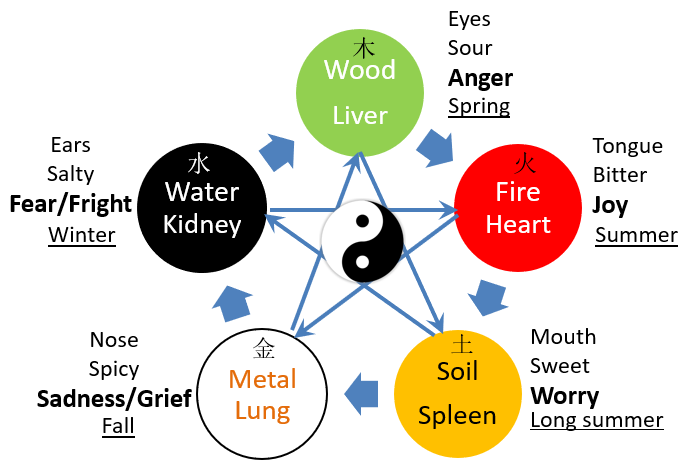
As shown in the Five Element diagram, key organ systems (broad meaning than modern anatomy definition) are connected with many phenomena of the human body and nature, categorized by similar functions or characteristics. They are interrelated, mutually influencing each other.
And emotions are closely intertwined with the physical health of key organs: anger is correlated with the Liver, worry with the Spleen, sadness and grief with the Lung, joy with the Heart, and fear and fright with the kidney.
For instance, excessive grief or sadness lingering for an extended period, if not properly relieved, could lead to weakened Lung function and breathing difficulty. Intense worry and overthinking could result in digestion issues or loss of appetite.
In the Five Element system, there are two kinds of sequences: mutual growth or development goes along the clockwise order, and counteraction or restriction between two components is indicated by the arrows. When it comes to emotion, extreme grief can be counterbalanced by the emotion of joy, intense anger can be restrained by sadness, and overjoy can be counteracted by fear, etc.
While all emotions have their place in life, it’s a good idea to keep our emotions in check. In the view of TCM, health is all about balance, which includes the balance of emotions. By maintaining the right balance and perspective, we can lower the risk of negative emotions lingering too long, or doing something stupid due to the outburst of extreme emotions, which we would likely regret later.
While there are other known ways to regulate emotions in modern days, counterbalancing emotion with emotion is one interesting coping strategy, an intriguing adaption of the TCM Five Elements framework to achieve balance to benefit health and well-being.
This post is for informational purposes only. It should not be considered health advice.
Thank you for reading. I write about culture, work-life learning, and the ancient wisdom of Traditional Chinese Medicine for better living. Click here if you would like to be notified when I publish.


