
Oops, I’m Practicing Mindfulness
Another funny outcome of this whole experiment.
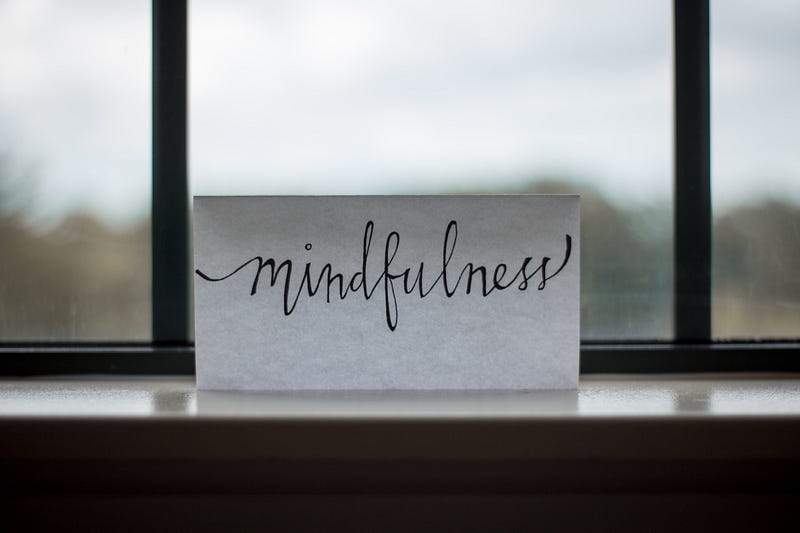
I was in therapy the other day, and in telling my therapist about this experiment, she pointed out something interesting: I’d unintentionally created a mindfulness exercise for myself.
Writing something every day requires a certain dedication, and for me, writing is something that I do in the moment. As I’ve discussed before, I tend to write in these frantic episodes, where the writing just kind of flows from my brain to the page. When I write, it’s just me and the keyboard. Everything else falls away.
As I described this to my therapist, she commented that it sounded like mindfulness to her. To be mindful, you need to be present in the moment, aware of what you’re doing. It’s rooted in Buddhist traditions and meditation, to some degree, and mindfulness exercises are a common way to deal with panic attacks and manic episodes for many people.
There are many of these exercises that help people. I’ve seen variants of breathing exercises — breathe in for eight seconds, hold for seven seconds, breathe out for eight seconds, hold for six seconds, or something like that. There is also the “senses” exercise — identify five things you can see, four things you can hear, three things you can smell, two things you can feel, and one thing you can taste. Ideally, it pulls you out of your panic and into the moment.
Very often, that doesn’t work for me. Breathing exercises tend to make me focus not on the moment, but how panicked I am. The senses exercise tends to overload me. However, when I’m practicing my hobbies, such as spoon carving or writing, I tend to hyperfocus on those things.
A friend commented at one point that my use of spoon carving as a method of mindfulness sounded like the concept of “flow.” In a nutshell, flow is the premise that one can “get into the groove” and just work on something for a long period uninterrupted. It’s a state of intense focus, where the only things that exist in the world are you and your project. Everything else just falls away.
As I write this, I’m listening to music. I listen to music a lot when I write; for a long time, I would listen to musicals, such as Hamilton and Les Miserables. My supervisor at the time thought this was weird — she understood listening to music, but she couldn’t do music with lyrics, much less music with a plot. How could I focus, she asked, when there was so much going on in my ears?
For me, the music brings familiarity. It blocks out the external noise, which is random and chaotic, and brings a sense of familiarity. I often don’t actually register the music I’m listening to, and as such, I will often put in Phantom of the Opera, start writing, and before I know it, I’m “Past the Point of No Return,” over an hour into the soundtrack, with no idea how I got there and several thousand words on the page.
The ultimate upshot of this is that I have accidentally created a daily mindfulness exercise for myself. Every day, before I do much, I sit down and write. These are things I want to write about, things that are fun for me to write down and discuss. Sometimes they’re poignant, sometimes, they’re serious, and sometimes I can’t be arsed and publish family recipes. The point is that I write something every day.
So, this has become my daily mindfulness exercise. What I write about doesn’t matter in this case — I can write about not having any idea what I want to write about. The point is not the subject of the writing but the action of writing itself.
And now, my daily exercise draws to a close, as I don’t really have much else to say about the topic. I encourage you to read more about mindfulness, whether in my linked articles or through your own research. Who knows? It might be useful for you.


