
How Making Spoons Helped Me Achieve Mindfulness
How a metaphor and an inside joke turned into a mindfulness exercise.
I live with bipolar disorder and have since I was in middle school. My life with mental illness has been difficult at times, but I have spent a significant amount of energy getting to a point where I am more or less healthy. I take my meds, I try to eat well and take care of my physical body, and I engage in self-care.
As someone who lives with mental illness and has done a decent amount of reading on the subject, I am very familiar with the concept of spoon theory. For those unfamiliar with it, let me give a quick rundown.
Spoon theory was created by Christine Miserandino as a means of describing what it’s like to live with a chronic illness (in her case, Lupus). The premise is that each activity costs a unit of energy, which she represented with a spoon. A person without chronic illness has a large supply of spoons to get through each day, while a person with a chronic illness has a much smaller number of spoons and must ration them.
In practical terms, this can often mean that vital tasks get skipped to conserve energy. Often, things like cooking and taking a shower are the first to go, and chores often get neglected on low spoon days. You can help keep up your spoons with self-care, but sometimes, you just can’t manage anything more than a few spoons a day no matter how well you’re taking care of yourself.
I have adopted spoon theory into my daily lexicon, as have most of the people around me. “I don’t have the spoons for this” is a common phrase in my friend group, whether said as a joke about something dumb or as a serious comment about major problems. It is an easy shorthand for how I am feeling on a given day.
Another major tenant of living with mental illness is the aforementioned self-care. Doing regular self-care, such as exercising, eating well, and engaging your mind can help keep up your energy and spoon levels. I’ve talked about self-care a lot before, so if you’re interested, you can read more here.
One aspect of self-care that has gained a lot of attention lately is mindfulness. Rooted in Buddhist meditation and practices, it is (more or less) the act of being incredibly conscious of yourself and your surroundings. It is often linked with meditation practices as well.
There are many examples of mindfulness exercises that you can do to “center” yourself. A common exercise I see is engaging all of your senses — identify five things you can see, four you can feel, three you can hear, two you can smell, and one you can taste. By doing this, you can sort of force your mind to calm down and focus on the here and now.
Mindfulness has sort of hit a craze right now. There are countless mindfulness and meditation apps available, and it has become a sort of buzzword. For many people, it works well. Some people think it’s nonsense. A recent study found that mindfulness and meditation lead to a sort of “spiritual superiority,” the sense that your expanded mindset makes you superior to others.
For me, mindfulness is a good exercise to calm down my manic brain and focus on the here and now, and now that I’ve spent the past 500+ words explaining spoons and mindfulness, I can get into the meat of my story.
A friend of mine, whom I shall call Bear, bought me a spoon carving kit.
It had initially started as a joke — in addition to spoons having a relevant mental health component to both of us, they also have a cultural significance to his Hungarian heritage. Wooden spoons have several traditional places in Hungarian weddings. Among other things, Hungarian wives are often gifted wooden spoons with which to smack unruly husbands.
Having talked about this tradition, and also spoons in a chronic illness sense, he offered to get me a set of knives to carve spoons. This didn’t come out of nowhere, though — I am a writer and work in an office, and have never been particularly handy or crafty. As such, I have wanted to learn some sort of handcraft — something to do with my hands that isn’t typing. Thus, the offer for a spoon carving kit.
As someone who has trouble knowing what I want, I gave a bit of a waffling answer and said that I might be interested. Bear, who gives gifts to all of his friends for any reason or no reason at all, went ahead and bought me the kit. If I decided that I liked it, he said, I could carve spoons for wedding gifts for when his children got married. Naturally, I responded with something along the lines of “I’ll probably never get that good.”
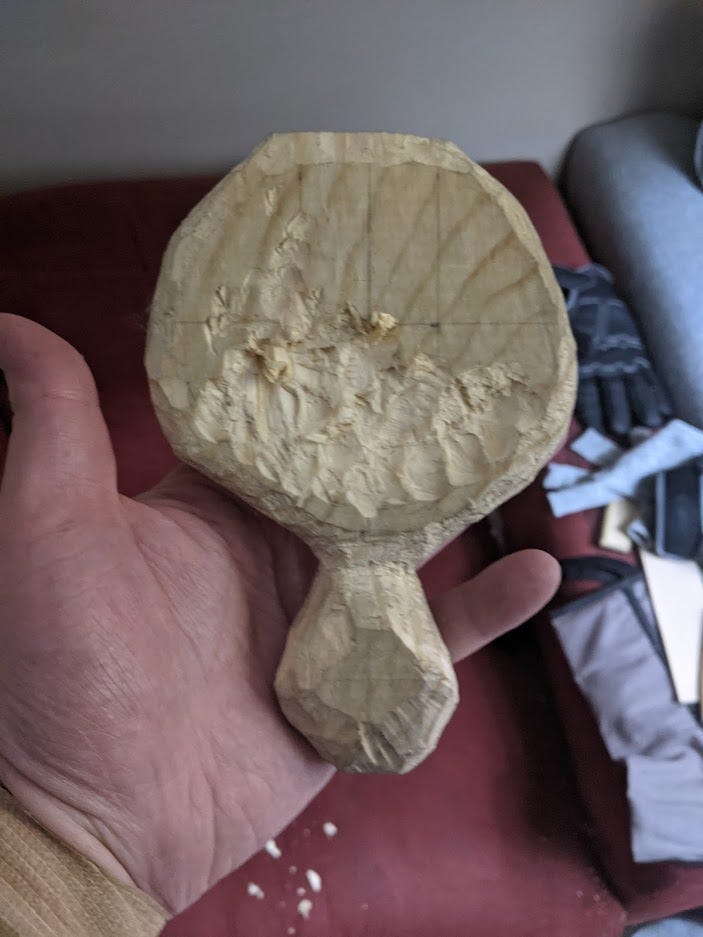
Eventually, the kit came, and I immediately did nothing with it for a month. Eventually, however, I decided to try it out. I got some wood scraps from another friend who does woodworking as a hobby, and after sitting on it for another week, I grabbed my kit and got to work. My first project was a spoon rest that I planned to carve from a piece of pine board that my friend had given me to practice with.
At this point, I was going through a medication transition and was experiencing some mood swings. As such, I was a bit manic while working on this first project. After working on it for two or so hours, my knife slipped and I cut my wrist open. It was rather painful.
After my wife bandaged me up, I put the tools down for a bit. I was a bit dejected, but not done yet. I spent some time researching and watching videos on how to carve spoons, something I should’ve done in the first place. I joined a spoon carving group on Facebook. Most importantly, I bought some safety gear — leather gloves with long cuffs and a leather thumb guard.
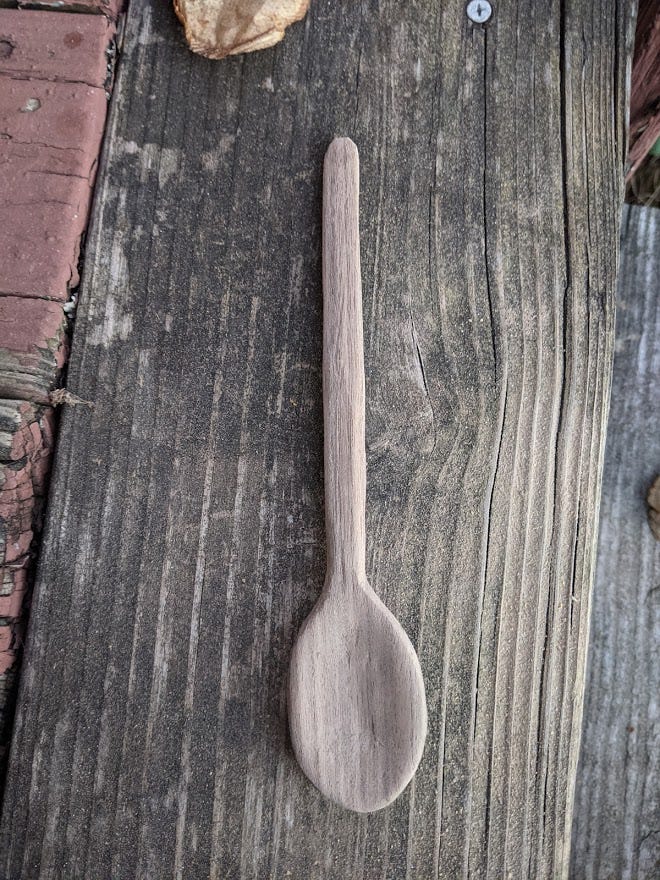
Then, after all of that, I tried again. I took a piece of walnut wood and got to work. Overall, I probably put about five hours into that spoon, between sawing out the form, carving on it, figuring out how to best use my knives to achieve the desired effect, and sanding it down. Honestly, I still haven’t finished it properly, but nonetheless, I had carved my first spoon.
The experience was fantastic. For me, it was a great mindfulness exercise, one which spawned from an injury. I had to be conscious of my work since I was using a very sharp knife to carve wood, and I didn’t want to slip again and cut myself further. As I was learning how to use the tool, I had to be aware of each cut, how the knife interacted with the wood, how the grain of the wood affected the cuts, how to avoid taking too much off with each stroke.
In carving my first spoon, I had found a focus for my brain. I had tuned out all of the surrounding noise, external or internal, and all that was left was the knife, the wood, and me. As someone who is accustomed to mania, this was a level of focus that I had previously only achieved with writing.
I had to do another one.
After learning that walnut is a fairly hard wood, I went to the hardware store and got a strip of 1x2 fir, a much softer wood to work with. I cut off a piece and started a second spoon.
This one took less time than the first, maybe two hours of carving and another half-hour of sanding. I had seen people talk about how they can bash out a simple spoon in twenty minutes or so, but I was still comfortable with the knowledge that it would likely take me a while to get to that point.
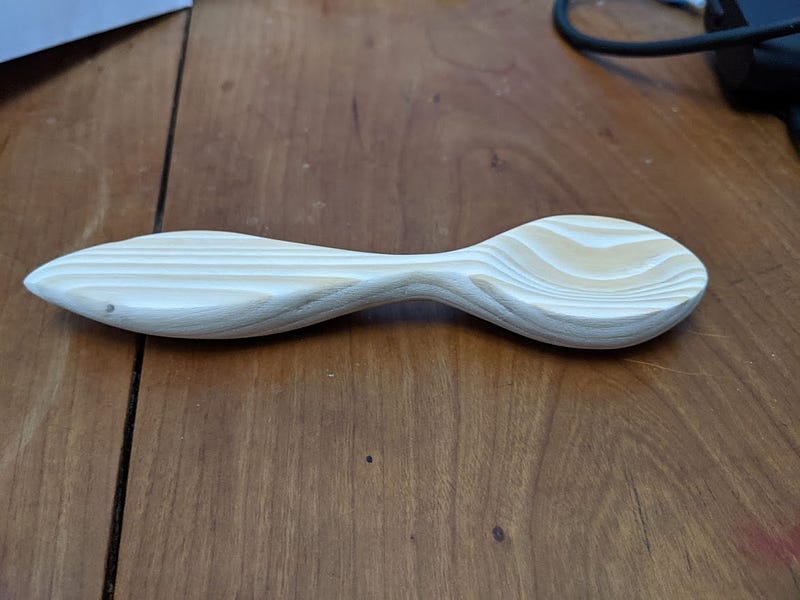
This spoon was a fancier design, and I once again achieved that level of mindfulness that I had wanted. Each piece of wood is unique and responds to the knife differently, with varying grainlines and knots that affect how it’s carved. To carve a spoon, you have to be aware of how the wood wants to be worked.
I know that this sounds like a sort of Zen thing, and in a way, it is. As I said, mindfulness comes from Buddhist principles, and getting lost in a task is a sort of mindfulness. Writing is my first love, my original mindfulness task, but I am quickly coming to enjoy spoon carving as a backup.
While mindfulness can often be brushed aside or looked down upon, I think it’s good for all of us to practice it sometimes. When done properly, research has shown that mindfulness helps us decouple our minds from anxiety and stress over the past or future and instead focus on the here and now. That is a helpful tool for many people with anxiety-related illness or symptoms, including myself.
Even people without mental illness can benefit from mindfulness, and many do without even realizing it. People who use hobbies to destress — woodworking, fishing, writing, drawing, building models of trains, whatever — are unintentionally practicing mindfulness by focusing on the hobby and not the stresses of the world. Often, people with hobbies talk about how everything just kind of falls away when they’re doing their hobby, and all that’s left is them and their work. That’s mindfulness.
For me, spoon theory has been a useful shorthand for low-energy days. Its roots as a means of explaining life with chronic illness to people without a chronic illness are helpful for explaining my illness to friends. Additionally, its prevalence in the mental health and chronic illness communities allows us to have a language to express ourselves in a way that is instantly understood. It is a fantastic tool that pulls double-duty as insider language and an external shorthand for the chronic illness community.
In a way, it’s sort of appropriate that spoons and mindfulness converged into a strange therapeutic thing for me. I’ve used the language of spoon theory for years, and my therapist has been trying to get me to practice mindfulness for quite a while. I just didn’t think that the two would come together like that.
So, I think if there is any lesson to be taken from this, it’s that mindfulness can come from unexpected places. Even for someone like me, who thought that I’d never achieve it due to my racing thoughts, mindfulness can be found. Sometimes, it just takes a metaphor and an inside joke to get there.


