avatarVanessa Gallman

Free AI web copilot to create summaries, insights and extended knowledge, download it at here

5203

Abstract

ocracydocket.com/news/december-redistricting-roundup-where-things-stand-in-all-50-states/">Democracy Docket,</a> which files election-reform lawsuits.</p><p id="2381"><b>Redistricting</b></p><p id="e623">Redrawing legislative and congressional districts every 10 years to strengthen political clout is routine for both parties. However, more Democratic-controlled states have set up independent or bipartisan committees to do the work. Twenty-three states have completed the process; the rest will start soon, according to <a href="https://www.democracydocket.com/news/december-redistricting-roundup-where-things-stand-in-all-50-states/">Democracy Docket</a>, which files election-reform lawsuits.</p><p id="d0c9">DOJ has sued Texas for extreme gerrymandering that diminished the clout of its exploding Latino population. Advocates have filed lawsuits in <a href="https://www.democracydocket.com/cases/topic/redistricting-litigation/state/alabama/case-status/filed/">Alabama</a>, <a href="https://www.democracydocket.com/cases/topic/redistricting-litigation/state/alaska/case-status/filed/">Alaska</a>, <a href="https://www.democracydocket.com/cases/topic/redistricting-litigation/state/idaho/case-status/filed/">Idaho</a>, <a href="https://www.democracydocket.com/cases/topic/redistricting-litigation/state/north-carolina/case-status/appealed/">North Carolina</a>, <a href="https://www.democracydocket.com/cases/topic/redistricting-litigation/state/ohio/case-status/filed/">Ohio</a> and <a href="https://www.democracydocket.com/cases/topic/redistricting-litigation/state/texas/case-status/filed/">Texas</a> over new maps for various reasons such as diluting voting strength of minorities and using race as the prime factor in redistricting. A federal court has <a href="https://www.democracydocket.com/alerts/federal-court-takes-control-of-illinois-legislative-maps/">taken control</a> of Illinois redistricting. And courts are weighing maps after impasses in <a href="https://www.democracydocket.com/cases/louisiana-redistricting-challenge/">Louisiana</a>, <a href="https://www.democracydocket.com/cases/minnesota-redistricting-challenge/">Minnesota</a>, <a href="https://www.democracydocket.com/cases/pennsylvania-impasse-litigation/">Pennsylvania</a> and <a href="https://www.democracydocket.com/cases/topic/redistricting-litigation/state/wisconsin/">Wisconsin</a>.</p><p id="8d03"><b>Overturning elections</b></p><p id="f345">As of Dec.15, 32 new laws in 17 states changed the rules so that legislatures or their appointed representatives could influence or even nullify votes, according to the bipartisan<a href="https://statesuniteddemocracy.org/resources/decupdate/"> States United Democracy Center.</a></p><p id="cd83">These laws undermine nonpartisan election commissions, take away authority from local governments to administer elections, and criminalize routine errors by election administrators. <a href="https://abcnews.go.com/Politics/dozen-state-laws-shift-power-elections-partisan-entities/story?id=79408455">At least eight states</a> have restricted the power of elected secretaries of state, many of whom stood firm against political pressure to overturn the 2020 presidential election.</p><p id="eb91"><a href="https://www.wpr.org/absolutely-preposterous-wisconsin-elections-commission-pushes-back-nonpartisan-audit">In Wisconsin,</a> the nonpartisan elections commission is under fierce attack from lawmakers even though no fraud or mismanagement has been uncovered. U.S. <a href="https://en.wikipedia.org/wiki/Ron_Johnson_(Wisconsin_politician)">Sen. Ron Johnson</a> has urged tbe legislature to take over the running of federal elections and direct local officials to ignore guidance from the commission.</p><p id="5b55"><b>Replacing election officials</b></p><p id="01ad"><a href="https://www.washingtonpost.com/politics/trump-allies-election-oversight/2021/11/28/3933b3ce-4227-11ec-9ea7-3eb2406a2e24_story.html">At least 10 candidates running for secretary of state and eight running for attorney general</a> have received Trump’s endorsement because they backed his lie about the election. Some are in the key 2020 swing states of Michigan, Arizona and Georgia.</p><p id="e123">Bannon has <a href="https://www.propublica.org/article/heeding-steve-bannons-call-election-deniers-organize-to-seize-control-of-the-gop-and-reshape-americas-elections">urged election deniers</a> to volunteer for for other election-related jobs. For example, in eight of the 11 largest Michigan counties, county GOP parties have replaced appointees to canvassing boards with those who embrace the election conspiracy. Some states now allow precinct workers to scrutinize and complain about voters at the polls.</p><figure id="a19f"><img src="https://cdn-images-1.readmedium.com/v2/resize:fit:800/1*c9Js6zq33g-sx-AewkaLNw.png"><figcaption><b>States United Democracy Center</b></figcaption></figure><p id="1f52"><b>Threatening election workers</b></p><p id="bc35">Vile threats against election workers, even volunteers, did not end with the 2020 election. A report by <a href="https://www.propublica.org/article/for-election-administrators-death-threats-have-become-part-of-the-job">ProPublica, docume

Options

nted </a>that more than 20 election supervisors resigned or retired between March and August, 2021. For reasons they cited public pressure, political interference and social media disinformation.</p><p id="3483">An August <a href="https://www.reuters.com/investigates/special-report/usa-election-threats-law-enforcement/">Reuters report</a> documented 102 threats of death or violence received by more than 40 election officials, workers and their relatives in eight battleground states. Many attacks targeted children and forced workers to flee from their homes. The more people who leave election positions, the more MAGA supporters can fill them.</p><p id="b08e">DOJ has vowed to prosecute those who threaten election workers, but there has been no public announcement of a case. However, two Georgia election workers <a href="https://www.reuters.com/article/us-usa-election-threats-georgia-exclusiv-idCAKBN2IP0VZ">recently sued </a>Trump lawyer Rudy Giuliani and right-wing website Gateway Pundit for unfairly targeting them.</p><p id="2bfb"><b>Limiting judicial power</b></p><p id="f049">Fourteen state legislatures have passed 19 laws to limit judicial independence or increase political influence over the courts, <a href="https://www.brennancenter.org/our-work/research-reports/legislative-assaults-state-courts-december-2021-update">according to Brennan Center analysis</a>. Most election cases are heard by judges in state capitals and critics say they have been biased against the GOP.</p><p id="f00a">A new law in <a href="https://www.legis.ga.gov/legislation/59827">Georgia</a>, for example, will make it more difficult for some judges in the state to extend polling place hours to accommodate voters because of long lines or other logistical issues. New laws in <a href="http://www.kslegislature.org/li/b2021_22/measures/hb2332/">Kansas</a>, <a href="https://apps.legislature.ky.gov/record/21rs/hb574.html">Kentucky</a>, and <a href="https://capitol.texas.gov/BillLookup/History.aspx?LegSess=872&amp;Bill=SB1">Texas</a>, also contain provisions that prohibit the judiciary or government officials from altering or suspending state election laws.</p><p id="8463">A new law in <a href="http://laws.leg.mt.gov/legprd/LAW0210W%24BSIV.ActionQuery?P_BILL_NO1=140&amp;P_BLTP_BILL_TYP_CD=SB&amp;Z_ACTION=Find&amp;P_SESS=20211">Montana</a> permits the state’s Republican governor to fill vacancies on the state’s supreme court and trial courts without vetting by the state’s independent judicial nominating commission.</p><h2 id="71e9">What now?</h2><p id="2a18">The success of these strategies may also depend on fights within the GOP as Trump and supporters seek to increase clout within the party and broaden appeal outside of it.</p><p id="ee6f">Also, while Trump focuses on punishing the disloyal, a civil war brews within MAGA world as high-profile supporters seek to either lead the charge or survive the House investigation into the insurrection. Yet even without focused leadership, the state-level strategies will continue to do damage.</p><p id="6cde">At this point, voting-rights legislation appears blocked in a 50–50 Senate, with Democratic Sen. <a href="https://en.wikipedia.org/wiki/Kyrsten_Sinema">Kyrsten Sinema</a> of Arizona, in particular, resistant to changes to the filibuster rule, which requires 60 votes to debate a bill. Republican Leader Mitch McConnell vows no GOP support for bills he calls a federal overreach, although Congress has the power to set election standards.</p><p id="0612">Voting-rights advocates continuet o protest, pressure and sue. Sirius-FM Radio personality Joe Madison started a hunger strike Nov. 8 to highlight the bills’ importance. He was joined for a while by Arizona State University students, seeking to pressure Sinema.</p><p id="fae7">Meanwhile, 64 percent of Americans believe democracy is in crisis, based on a new <a href="https://www.ipsos.com/en-us/seven-ten-americans-say-country-crisis-risk-failing">NPR/Ipsos poll</a>, mostly because two-thirds of GOP respondents believe the election lie. When a <a href="https://www.cbsnews.com/news/january-6-opinion-poll-2022/">CBS poll </a>asked people to describe what happened onJan. 6, Democrats overwhelmingly say “insurrecetion.” Republicans, however, overwhelmingly say “patriotism.”</p><p id="a2d1">What impact any legislation could have on such a cultural divide remains to be seen. But the current war to preserve free and fait elections — a cornerstone of U.S. democracy — needs all the weapons it can muster.</p><div id="cda6" class="link-block"> <a href="https://vgallman.medium.com/membership"> <div> <div> <h2>Join Medium with my referral link - Vanessa Gallman</h2> <div><h3>As a Medium member, a portion of your membership fee goes to writers you read, and you get full access to every story…</h3></div> <div><p>vgallman.medium.com</p></div> </div> <div> <div style="background-image: url(https://miro.readmedium.com/v2/resize:fit:320/0*Jkggh3xvmXwRXf-a)"></div> </div> </div> </a> </div></article></body>

Ongoing MAGA Coup: Taking Control of Our Elections

Passing voting-rights laws would help save democracy
The Digital Artist on Pixabay

It’s obvious now that the deadly Jan. 6 attack on the U.S. Capitol was just the public eruption of an ongoing insurrection by former President Donald Trump and his supporters. It has metastasized within Congress and throughout state governments.

Voting rights legislation could at least slow the spread. If not, faith in elections, in the significance of a person’s vote and in democracy in general will continue to erode.

Those who falsely believe that the 2020 election was stolen are determined to never lose again — even if the votes go against them. They are changing the rules to allow cheating; and it’s already clear that some embrace violence. Despite no evidence of widespread fraud, upcoimg elections have been cast as apocalyptic battles of good against evil.

“We’re taking over all the elections,” Steve Bannon, a key planner of the Jan. 6 tragedy, said on his podcast. “It’s about winning elections with the right people — MAGA people. We will have our people in at every level.”

Trump supporters have every right to run for office. But not to destroy the nonpartisan election process — down to the precinct level. GOP-dominated legislatures have launched a new state’s rights movement that has been reinforced by U.S. Supreme Court rulings.

It’s not all about Trump. The motivation is also rooted in a shrinking party’s fight for survival after decades of stagnant policies and little diversity outreach. Civil-rights and voting-rights advocates, struggling to avoid long-term minority rule, say passage of these bills are urgent:

  • The John R. Lewis Voting Rights Advancement Act restores Supreme Court enforcement over discriminatory laws that was gutted the 1965 Voting Rights Act. Since 2013, court rulings have argued that racism in elections no longer exists and that is OK if some groups are discriminated against in the name of election integrity.
  • The Freedom to Vote Act focuses primarily on the management of elections, such as making Election Day a holiday, setting a 15-day minimum early-voting period, mandating automatic voter registration when getting drivers’ licenses and requiring mail-in ballots and drop boxes.

Meanwhile, the multi-faceted coup continues with some well-known strategies and new ones happening under the radar:

Suppressing the vote

In 2021, at least 19 GOP-dominated states enacted 33 laws that make it harder to vote, according to the Brennan Center for Justice. That marks a new record for restrictive voting laws since 2011. A lot of the laws limit mail-in voting, early voting and outreach efforts.

The Department of Justice has filed suit against Georgia for laws discriminating against black voters and against Texas for discriminating against disabled voters. Other voting advocates are fighting new laws in Arizona, Arkansas, Iowa, Kansas and Montana. One Kansas lawsuit has already led to a federal court blocking a law that sought to criminalize the mailing of personalized early-voting applications.

Yet, 24 states passed laws that expanded voting rights; some of them also passed laws that also restricted voting, according to Democracy Docket, which files election-reform lawsuits.

Redistricting

Redrawing legislative and congressional districts every 10 years to strengthen political clout is routine for both parties. However, more Democratic-controlled states have set up independent or bipartisan committees to do the work. Twenty-three states have completed the process; the rest will start soon, according to Democracy Docket, which files election-reform lawsuits.

DOJ has sued Texas for extreme gerrymandering that diminished the clout of its exploding Latino population. Advocates have filed lawsuits in Alabama, Alaska, Idaho, North Carolina, Ohio and Texas over new maps for various reasons such as diluting voting strength of minorities and using race as the prime factor in redistricting. A federal court has taken control of Illinois redistricting. And courts are weighing maps after impasses in Louisiana, Minnesota, Pennsylvania and Wisconsin.

Overturning elections

As of Dec.15, 32 new laws in 17 states changed the rules so that legislatures or their appointed representatives could influence or even nullify votes, according to the bipartisan States United Democracy Center.

These laws undermine nonpartisan election commissions, take away authority from local governments to administer elections, and criminalize routine errors by election administrators. At least eight states have restricted the power of elected secretaries of state, many of whom stood firm against political pressure to overturn the 2020 presidential election.

In Wisconsin, the nonpartisan elections commission is under fierce attack from lawmakers even though no fraud or mismanagement has been uncovered. U.S. Sen. Ron Johnson has urged tbe legislature to take over the running of federal elections and direct local officials to ignore guidance from the commission.

Replacing election officials

At least 10 candidates running for secretary of state and eight running for attorney general have received Trump’s endorsement because they backed his lie about the election. Some are in the key 2020 swing states of Michigan, Arizona and Georgia.

Bannon has urged election deniers to volunteer for for other election-related jobs. For example, in eight of the 11 largest Michigan counties, county GOP parties have replaced appointees to canvassing boards with those who embrace the election conspiracy. Some states now allow precinct workers to scrutinize and complain about voters at the polls.
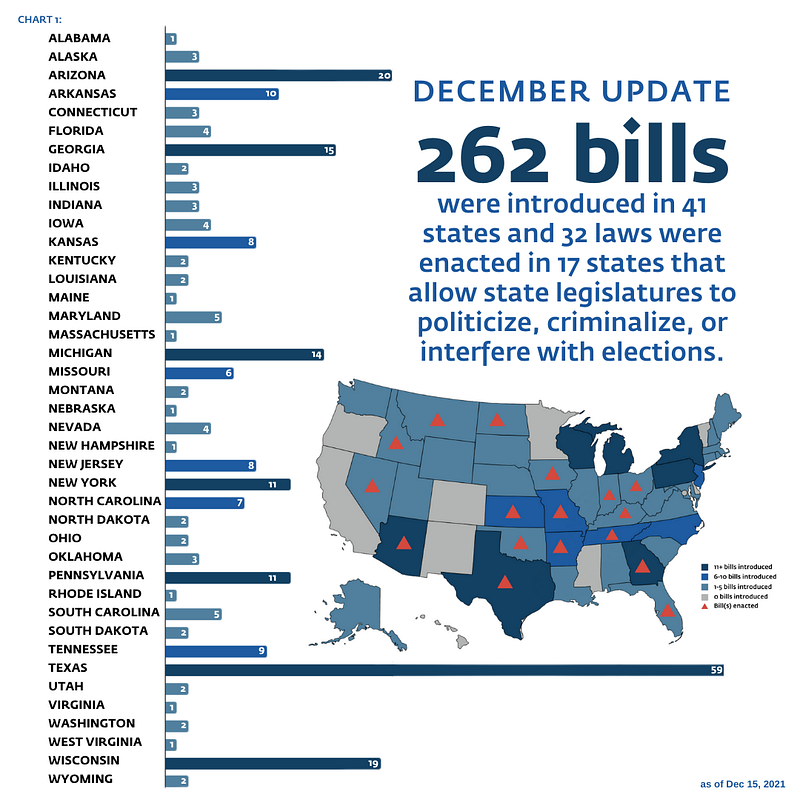
States United Democracy Center

Threatening election workers

Vile threats against election workers, even volunteers, did not end with the 2020 election. A report by ProPublica, documented that more than 20 election supervisors resigned or retired between March and August, 2021. For reasons they cited public pressure, political interference and social media disinformation.

An August Reuters report documented 102 threats of death or violence received by more than 40 election officials, workers and their relatives in eight battleground states. Many attacks targeted children and forced workers to flee from their homes. The more people who leave election positions, the more MAGA supporters can fill them.

DOJ has vowed to prosecute those who threaten election workers, but there has been no public announcement of a case. However, two Georgia election workers recently sued Trump lawyer Rudy Giuliani and right-wing website Gateway Pundit for unfairly targeting them.

Limiting judicial power

Fourteen state legislatures have passed 19 laws to limit judicial independence or increase political influence over the courts, according to Brennan Center analysis. Most election cases are heard by judges in state capitals and critics say they have been biased against the GOP.

A new law in Georgia, for example, will make it more difficult for some judges in the state to extend polling place hours to accommodate voters because of long lines or other logistical issues. New laws in Kansas, Kentucky, and Texas, also contain provisions that prohibit the judiciary or government officials from altering or suspending state election laws.

A new law in Montana permits the state’s Republican governor to fill vacancies on the state’s supreme court and trial courts without vetting by the state’s independent judicial nominating commission.

What now?

The success of these strategies may also depend on fights within the GOP as Trump and supporters seek to increase clout within the party and broaden appeal outside of it.

Also, while Trump focuses on punishing the disloyal, a civil war brews within MAGA world as high-profile supporters seek to either lead the charge or survive the House investigation into the insurrection. Yet even without focused leadership, the state-level strategies will continue to do damage.

At this point, voting-rights legislation appears blocked in a 50–50 Senate, with Democratic Sen. Kyrsten Sinema of Arizona, in particular, resistant to changes to the filibuster rule, which requires 60 votes to debate a bill. Republican Leader Mitch McConnell vows no GOP support for bills he calls a federal overreach, although Congress has the power to set election standards.

Voting-rights advocates continuet o protest, pressure and sue. Sirius-FM Radio personality Joe Madison started a hunger strike Nov. 8 to highlight the bills’ importance. He was joined for a while by Arizona State University students, seeking to pressure Sinema.

Meanwhile, 64 percent of Americans believe democracy is in crisis, based on a new NPR/Ipsos poll, mostly because two-thirds of GOP respondents believe the election lie. When a CBS poll asked people to describe what happened onJan. 6, Democrats overwhelmingly say “insurrecetion.” Republicans, however, overwhelmingly say “patriotism.”

What impact any legislation could have on such a cultural divide remains to be seen. But the current war to preserve free and fait elections — a cornerstone of U.S. democracy — needs all the weapons it can muster.

Politics
Voting Rights
Republican Party
Donald Trump
January 6 2021
Recommended from ReadMedium