
One Weird Trick for Writing a First Draft
Seriously, it’s really weird. But it’s helped me for 25 years!
Writing first drafts is hard.
Like most writers, I procrastinate like mad. When I’ve finished my research and time comes to start writing, I’ll poke around in a zillion other tasks — rearranging my desk, tackling old email, going down Wikipedia rat holes. Anything to avoid cracking down on the task at hand: Writing a first draft.
So for me, first-draft writing is all about finding ways to trick myself into avoiding procrastination.
I wrote a post a few weeks about one of those tricks, “parking downhill.” As I pointed out there …
… a big chunk of avoiding procrastination is about emotional regulation. Procrastination tends — in my case, anyway — to be ultimately about fear.
The reason I avoid sitting down to write is because I’m worried I’ll immediately get stuck. I’m terrified that the words (or concepts) won’t come; that it’ll be too hard for me; that I’ll suck at it then and the next day too and so everything will doomed for me forever. A miserable cycle of septic self-talk, as it were. (We writers love to catastrophize.)
My four rules for writing first-draft prose
So here’s another trick I’ve found to keep myself from procrastinating on a first draft.
When I’ve finally convinced myself to sit down and start writing, I write prose by following four rules. They are:
- I begin each paragraph with a hyphen.
- I lower-case the first letter of every sentence.
- I don’t put a period at the end of a sentence. (A question mark or exclamation point is fine.) Instead…
- … in lieu of a period, I end each sentence using two forward-slashes, like this //
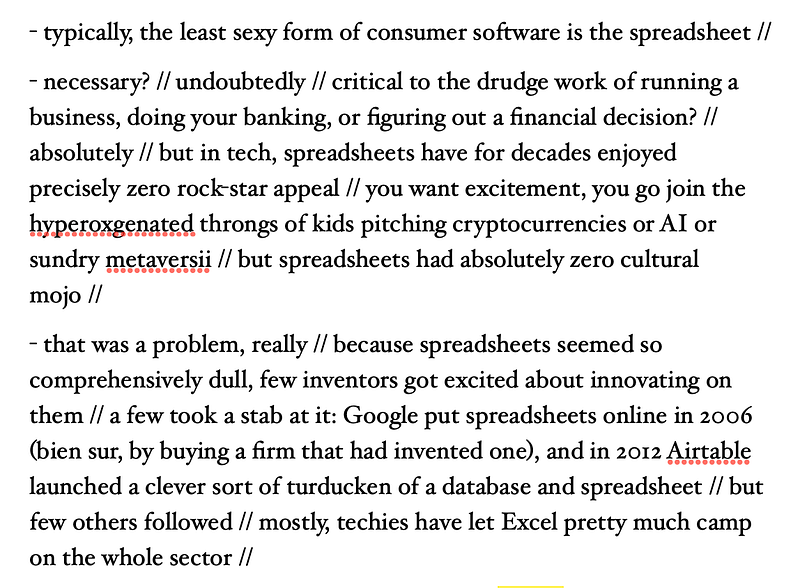
The upshot is that when I’m writing a first draft, the text looks pretty weird.
For example, a few weeks ago I wrote a column for Wired about recent innovations in spreadsheets. Here’s what the first draft looked like, in a screenshot from my copy of Scrivener…
The trick: Making your first draft look provisional
So why exactly does this help me write a first draft?
Because it makes my prose look provisional.
It makes it look like it’s not really “official” writing. And this, in turn, helps prevent me from becoming too wedded to what I’m writing. I can regard the sentences and paragraphs as a form of clay that I’m still just sort of generally shifting around into place. Every time I look at that strange-looking formatting, I mentally know, “this is still under construction.”
In contrast, if I try writing a first draft using regular, normal punctuation and capitalization, every sentence looks too “finished.” I wind up getting overly invested in the exact sentence I’ve crafted. When I look back over the draft, trying to spot how to improve it, I can’t easily distance myself and regard the words dispassionately.
But when I write in my strange style, the sentences and paragraphs just seem like jottings. They’re Lego bricks I’m combining and recombining to see what shape they might make. Words written with no proper casing and punctuation seem much easier to tear up and revise. I get less emotionally attached.
I don’t leave my draft in that format forever, of course! (Though I’d love to see the looks on my editor’s faces were I to actually hand in my draft looking like this, heh.)
I leave it in that odd format right up until the day before I’m filing a big magazine feature. Then, on the last day, I slowly go through the whole piece, transforming each sentence into the correct format.
This frees me up, on this final day, to become an obsessive about word choice on a sentence-by-sentence level. Because I’m crafting the “official” version of each sentence, I snap to attention aesthetically. I become much more attentive to tempo and phrasing.
But because the sentences are already generally there, I’m not starting from scratch. I’m shaping and perfecting what already exists. So again, it helps prevent me from getting stuck in an emotional rut.
(And now, a word from our sponsor
Oh BTW if you’re enjoying this piece, it’s part of a series of posts I’ve been doing about writing hacks. You can see ’em all here.
Now back to the piece …)
A separate hack for using this trick on Medium posts
A side note: When I use this technique for Medium posts, I have to slightly tweak my rules.
On Medium, if you try to start a paragraph with a hyphen — as my weird, gnarly system requires — Medium auto-converts it to a bullet point. So instead I start paragraphs with a tilde, the “~” character. It actually looks ever so much more fahncy, so I kind of prefer it, lol.
(Interestingly, the double-forward-slashes I put between my sentences resemble comments in computer code — in programming languages like C++ and Java and Javascript. Since I do a lot of Javascript programming, I suspect this additionally helps me view my prose as provisional. Eh, this stuff is all just comments, it won’t execute.)
Will this work for *you*?
People, I have no idea if this technique will work for you.
Hell, I have no idea if this technique will work for anyone who isn’t me! It’s so freakishly idiosyncratic that when I’ve described it to other magazine writers, their reactions have been bemused, or baffled. But none of ’em ever said oh yeah bruh I do the same thing.
Do you have a technique vaguely similar to mine? If so, let me know in the comments!
Or if you try this and it actually works for you, let me know too. Maybe I’m not alone!
Clive Thompson publishes on Medium three times a week; follow him here to get each post in your email — and if you’re not a Medium member, you can join here.
Clive is a contributing writer for the New York Times Magazine, a columnist for Wired and Smithsonian magazines, and a regular contributor to Mother Jones. He’s the author of Coders: The Making of a New Tribe and the Remaking of the World, and Smarter Than You Think: How Technology is Changing our Minds for the Better. He’s @pomeranian99 on Twitter and Instagram.


