avatarCarol Labuzzetta, MS Natural Resources, MS Nursing

Free AI web copilot to create summaries, insights and extended knowledge, download it at here

2923

Abstract

ng in the background is an interpretive reproduction. © Carol Labuzzetta, 2021.</figcaption></figure><p id="d0de">I think that this brings up an important part of travel. While most of us travel for enjoyment and entertainment, it also provides valuable educational experiences.</p><p id="1417">The site at Puerto Pueblo taught me that this was a community that formed around the natural resources that were available during a time of transition and climate change. The Pueblo adapted. They learned to farm, had water from the river, and grew their families in this community, which was most certainly different than their ancestors.</p><figure id="ae36"><img src="https://cdn-images-1.readmedium.com/v2/resize:fit:800/0*YX0VXl4hw7LpI6OT"><figcaption>Puerto Pueblo Community Ruins in Petrified Forest National Park. © Carol Labuzzetta, 2021. All Rights Reserved.</figcaption></figure><p id="0a6e">They communicated not only with their speech but also by carving in the rocks that were nearby. You can visit Newspaper Rock and see some of the petroglyphs. Zoom in below and you can see several glyphs, including a bird carrying a human form.</p><figure id="10b5"><img src="https://cdn-images-1.readmedium.com/v2/resize:fit:800/0*TeYBKAoZgWk7ctBK"><figcaption>Newspaper Rock at Puerto Pueblo. © Carol Labuzzetta, 2021.</figcaption></figure><p id="297f">As I looked at the ruins of this ancient Pueblo community, I imagined that their life was hard. The community was set in a vast plain, the river near but still distant if you needed to carry water. I imagine it got hot here in the summer, so growing crops, while possible, would be difficult at best.</p><p id="07ac">The climate continued to change and by the late 1300s, the community had moved on to find more amenable surroundings, leaving only remnants of their place here at Puerto Pueblo <a href="https://www.nps.gov/pefo/learn/historyculture/puerco-pueblo.htm">(source)</a>.</p><figure id="ff77"><img src="https://cdn-images-1.readmedium.com/v2/resize:fit:800/0*5id9p7ilr83fN5QN"><figcaption>A modern train runs by Puerto Pueblo Village today. © Carol Labuzzetta, 2021.</figcaption></figure><p id="c298">Today, a train traverses the wide, flat landscape near the remains of this ancient village. It still seems like an uninhabitable place to live.</p><p id="2472">To read more about my visits to the communities of ancient people, you can reference the following article:</p><div id="dc04" class="link-block"> <a href="https://readmedium.com/bandelier-national-monument-new-mexico-ancient-peoples-and-dwellings-55f8d394681"> <div> <div> <h2>Bandelier National Monument, New Mexico: Ancient Peoples and Dwellings</h2> <div><h3>On a trip to Santa Fe in February of 2020, we spent a day at Bandelier National Monument learning about peoples’ lives…</h3></div> <div><p>medium.com</p></d

Options

iv> </div> <div> <div style="background-image: url(https://miro.readmedium.com/v2/resize:fit:320/0*vpZanhtCNagAtZY3)"></div> </div> </div> </a> </div><p id="5d23">The Globetrotter’s May Challenge is on the ruins of the world. There are some other articles I’d recommend reading if you are traveling to learn! One is from <a href="undefined">Aaron Paulson</a> on a site in Japan that carries haunting memories.</p><div id="a482" class="link-block"> <a href="https://readmedium.com/may-challenge-ruins-of-the-world-b3ba26cc2e8b"> <div> <div> <h2>May Challenge: Ruins of the World</h2> <div><h3>Japan’s “Gunkanjima” Battleship Island</h3></div> <div><p>medium.com</p></div> </div> <div> <div style="background-image: url(https://miro.readmedium.com/v2/resize:fit:320/1*cTm16DsfEGYrQxojjUNwrA.jpeg)"></div> </div> </div> </a> </div><p id="650d">And <a href="undefined">Kerri Duncan</a> offers some drop-dead gorgeous photos of Kotor in Montenegro when she visited the area spontaneously! Her post is definitely worth a read!</p><div id="5176" class="link-block"> <a href="https://readmedium.com/earthquakes-invasions-and-2000-years-have-only-brightened-the-beauty-of-kotors-walls-2d2948df2dd4"> <div> <div> <h2>Earthquakes, Invasions, and 2000 Years Have Only Brightened the Beauty of Kotor’s Walls</h2> <div><h3>And they are equally majestic by day and at night.</h3></div> <div><p>medium.com</p></div> </div> <div> <div style="background-image: url(https://miro.readmedium.com/v2/resize:fit:320/1*MMCNPyu3NHWN_rD0-Q668w.jpeg)"></div> </div> </div> </a> </div><p id="5ecd">Thanks to the editors at<a href="https://medium.com/globetrotters"> Globetrotters </a>who continue to offer monthly challenges as well as a wide variety of travel articles from writers around the world!</p><p id="64c8"><i>You can follow me if you find this article valuable, entertaining, or inspirational. Here’s how:</i></p><p id="ce6b"><i>You can join Medium, <a href="https://carollabuzzetta.medium.com/subscribe"><b>here</b></a><b>. </b>By using my referral link, I will receive a portion of your membership subscription. You are then free to read all the Medium.com articles you want! Thanks for your consideration!</i></p><p id="57cc"><i>Would you rather get my posts via email? You can get an email subscription to my page,<b> <a href="https://carollabuzzetta.medium.com/subscribe">here</a>. </b>Whenever I post on Medium, the article will arrive in your inbox! I appreciate your interest!</i></p></article></body>

One U.S. National Park Where You Can See Ruins

We saw remnants of an ancient Pueblo community on our visit to the Petrified Forest National Park.
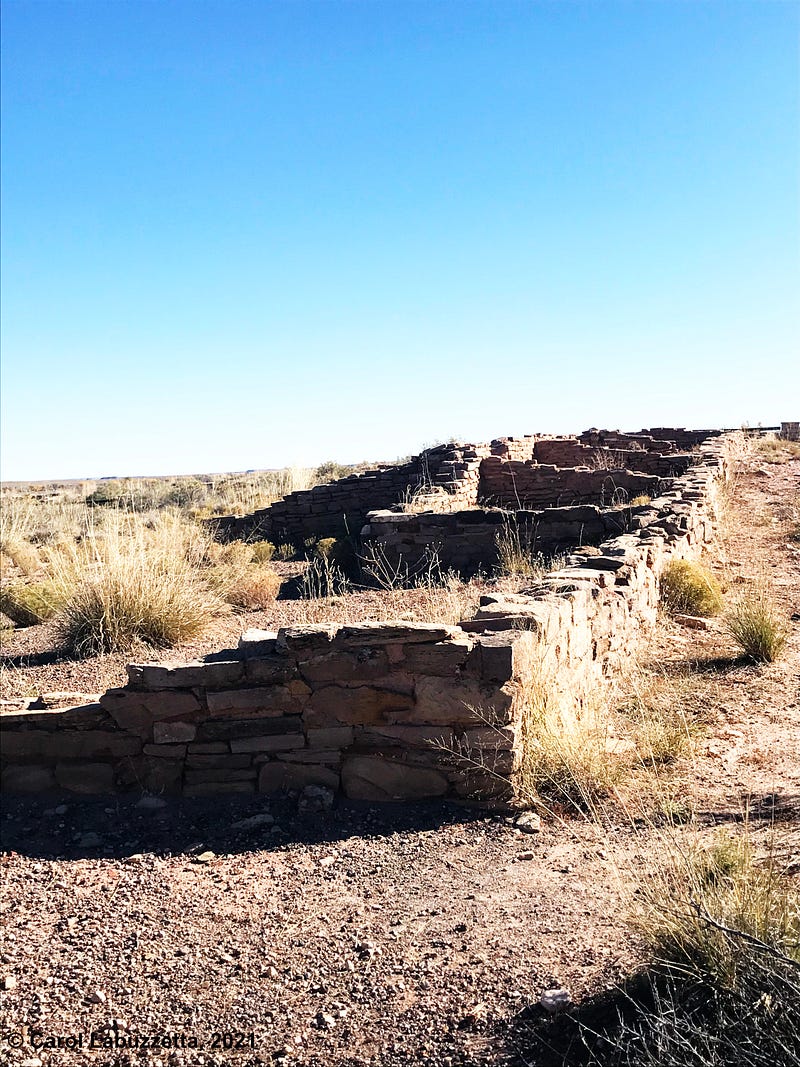
Puerco Pueblo Village Ruins in Arizona from a community of people that lived there in the 1300s. © Carol Labuzzetta, 2021. All Rights Reserved.

Throughout our travels, we’ve seen some ruins of ancient peoples. The remnants of communities and how they lived, hundreds or thousands of years ago, are always of interest to me, provoking thoughts I might never have had if I hadn’t visited the preserved site.

Such was the case in the fall of 2021 when we were making a loop of the National Parks in the Southwestern United States. Our last park on this trip was the Petrified Forest in Arizona.
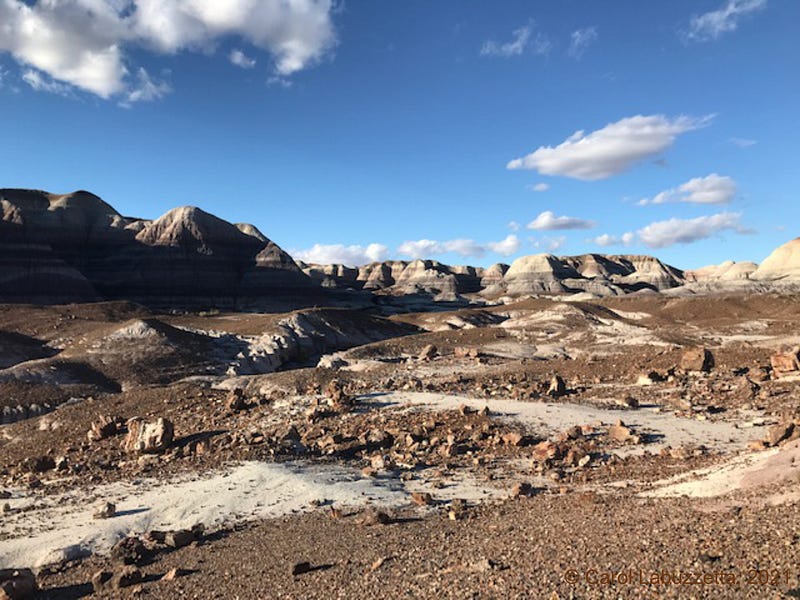
View from the Blue Mesa Trail in the Petrified Forest National Park. © Carol Labuzzetta, 2021. All Rights Reserved.

While I expected to see trees turned to rock and visible layers of time and sedimentation in the landscape, I don’t think I was prepared to see buildings left from an ancient culture.

Growing up in New York State, we learned of the Pueblo people and their lives. But, since they did not exist near where we lived, I did not retain much of the information other than that the Pueblos were nomadic and made utilitarian pottery (source).

When we visited the Petrified Forest, I learned more about these ancient people. By the time the Pueblo arrived on the Puerto Pueblo near the Puerto River in northeast Arizona, they had evolved into a farming culture, living together in settlements. The ancestral pueblos had to move to ensure their survival after a period of drought had inflicted the southwestern part of the U.S. in the 1200s.

The village that was established in what now is the Petrified Forest National Park was just that, a farming community. The Puerto River ran near the village and was a guide for other travelers — so bartering and exchange of materials was also possible for this community.

The village housed roughly one hundred people, doubling in size at its height of existence.
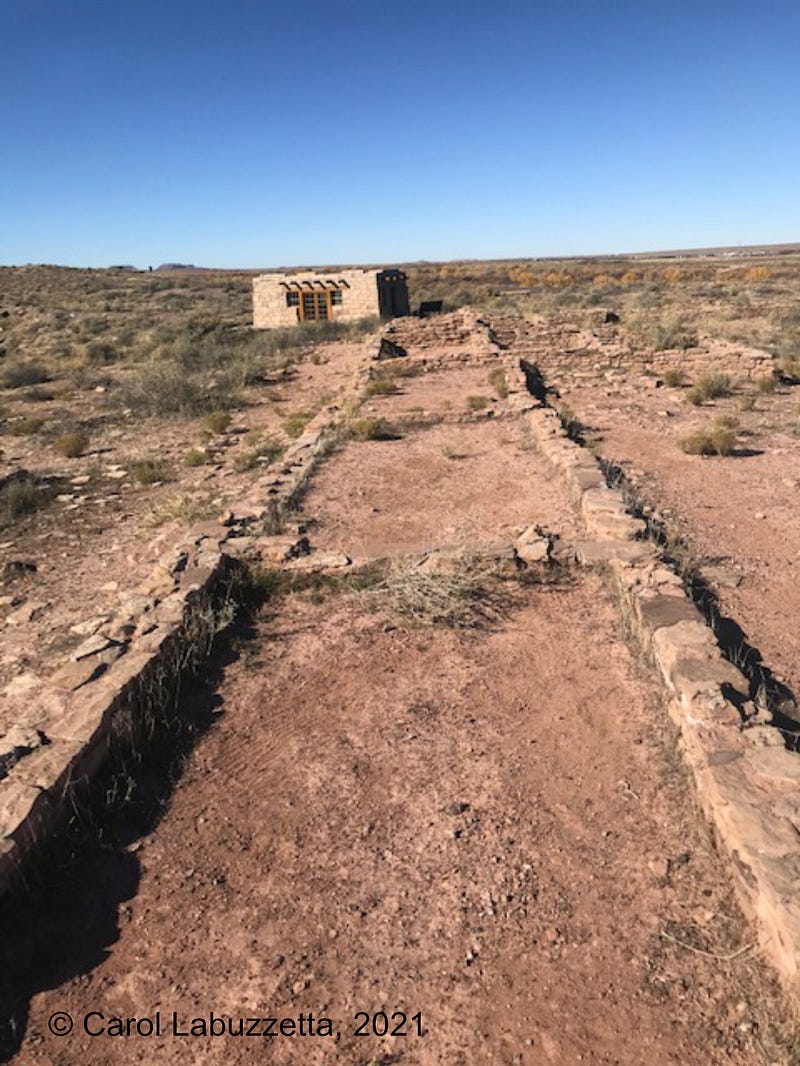
View of some of the rooms left from the Puerto Pueblo Community near the Puerto River in Arizona. The building in the background is an interpretive reproduction. © Carol Labuzzetta, 2021.

I think that this brings up an important part of travel. While most of us travel for enjoyment and entertainment, it also provides valuable educational experiences.

The site at Puerto Pueblo taught me that this was a community that formed around the natural resources that were available during a time of transition and climate change. The Pueblo adapted. They learned to farm, had water from the river, and grew their families in this community, which was most certainly different than their ancestors.
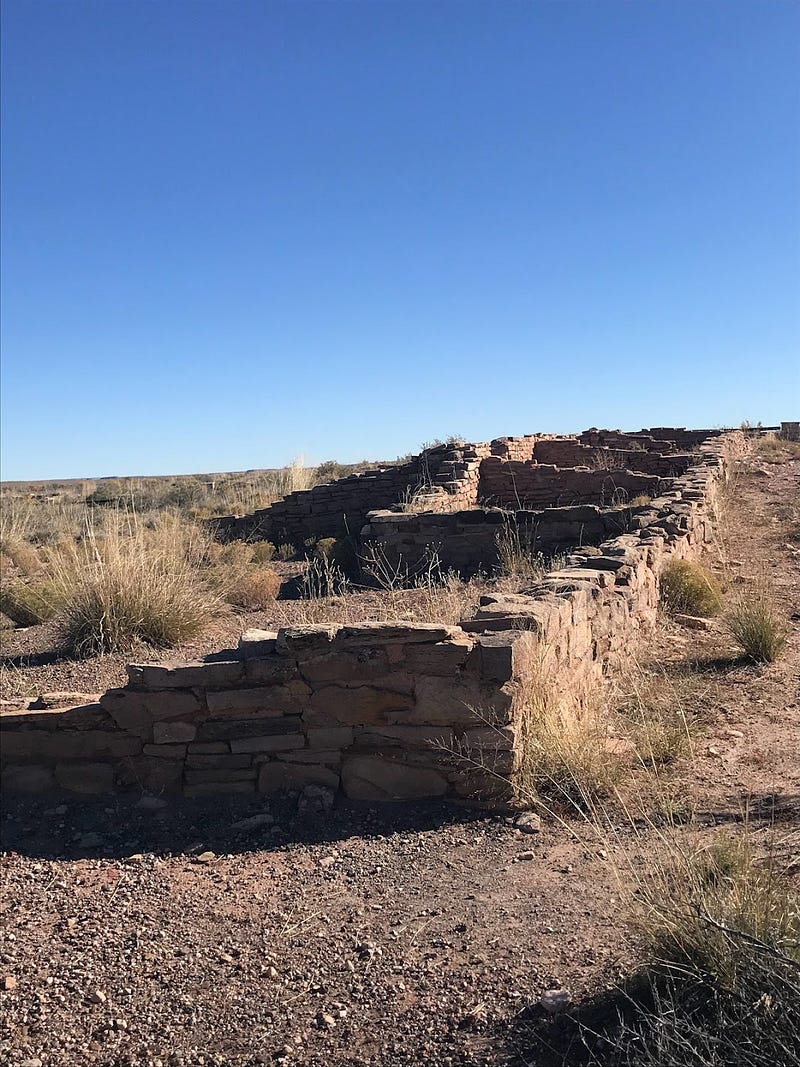
Puerto Pueblo Community Ruins in Petrified Forest National Park. © Carol Labuzzetta, 2021. All Rights Reserved.

They communicated not only with their speech but also by carving in the rocks that were nearby. You can visit Newspaper Rock and see some of the petroglyphs. Zoom in below and you can see several glyphs, including a bird carrying a human form.
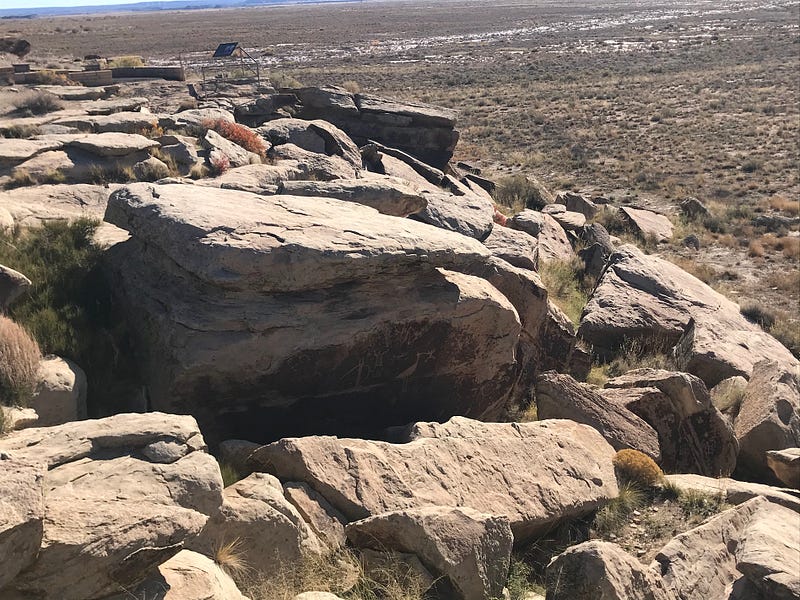
Newspaper Rock at Puerto Pueblo. © Carol Labuzzetta, 2021.

As I looked at the ruins of this ancient Pueblo community, I imagined that their life was hard. The community was set in a vast plain, the river near but still distant if you needed to carry water. I imagine it got hot here in the summer, so growing crops, while possible, would be difficult at best.

The climate continued to change and by the late 1300s, the community had moved on to find more amenable surroundings, leaving only remnants of their place here at Puerto Pueblo (source).
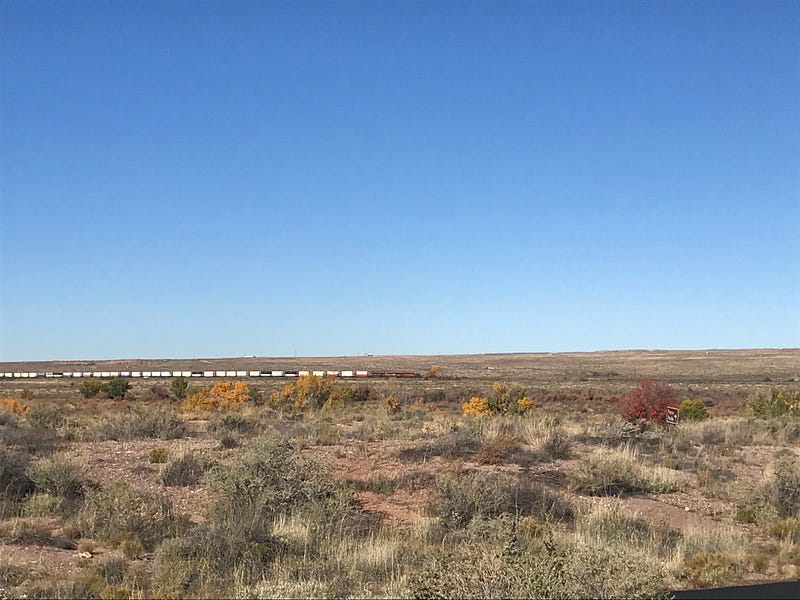
A modern train runs by Puerto Pueblo Village today. © Carol Labuzzetta, 2021.

Today, a train traverses the wide, flat landscape near the remains of this ancient village. It still seems like an uninhabitable place to live.

To read more about my visits to the communities of ancient people, you can reference the following article:

The Globetrotter’s May Challenge is on the ruins of the world. There are some other articles I’d recommend reading if you are traveling to learn! One is from Aaron Paulson on a site in Japan that carries haunting memories.

And Kerri Duncan offers some drop-dead gorgeous photos of Kotor in Montenegro when she visited the area spontaneously! Her post is definitely worth a read!

Thanks to the editors at Globetrotters who continue to offer monthly challenges as well as a wide variety of travel articles from writers around the world!

You can follow me if you find this article valuable, entertaining, or inspirational. Here’s how:

You can join Medium, here. By using my referral link, I will receive a portion of your membership subscription. You are then free to read all the Medium.com articles you want! Thanks for your consideration!

Would you rather get my posts via email? You can get an email subscription to my page, here. Whenever I post on Medium, the article will arrive in your inbox! I appreciate your interest!

Travel
Ruins
National Parks
History
Monthly Challenge
Recommended from ReadMedium