
One of the oldest planetary systems in the Milky Way has been discovered. How old is it?
A white dwarf absorbing the remains of its own planetary system has been discovered 90 light years from Earth. It may be the oldest planetary system found in our Galaxy.
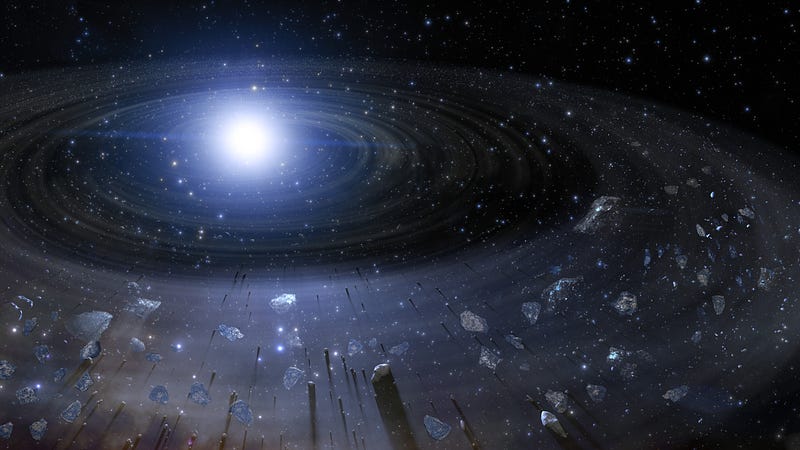
Stars can be very different, but their ultimate fate almost always looks the same. Scientists estimate that 97 percent of all stars will sooner or later turn into white dwarfs. Such a future also awaits our Sun.
White dwarfs are objects formed after thermonuclear reactions cease in stars. They glow in visible light and cool very slowly. Their existence time is counted in billions of years. That’s how long it takes for the temperature of a white dwarf to equalize with that of its surroundings.
Then, the theories assume, it will transform into a black dwarf. This is a hypothetical object, very difficult to observe. Scientists assume that no black dwarfs yet exist. This is because too little time has passed since the beginning of the Universe for them to have formed.
Types of white dwarfs
Observations of white dwarfs clarify from which stars they were born. This is indicated by their chemical composition. If a star’s mass was less than half that of the Sun, then it will leave behind a helium white dwarf. This is because it was too small to ever be in the helium “burning” stage.
Larger stars will turn into carbon or carbon-oxygen white dwarfs after thermonuclear reactions cease. This is what will happen to the Sun, where helium fusion will occur at the final stage of its life. In contrast, white dwarfs with oxygen, magnesium and neon will be born from even more massive stars.
Planets around white dwarfs
Thanks to spectroscopy, scientists can determine the composition of a space object’s atmosphere by analyzing the light it emits. Individual elements leave their specific “imprints” in it — spectral lines, thanks to which they can be identified. Hence, by observing the light coming from white dwarfs, astronomers are able to determine their composition.
In the latest issue of the scientific journal Monthly Notices of the Royal Astronomical Society, a team of scientists from the University of Warwick reports the discovery of two white dwarfs. One of them, designated WDJ2147–4035, is located 90 light-years from Earth. Scientists estimate that the star is 10.7 billion years old. In contrast, it has existed as a white dwarf for 10.2 billion years.
Although the star is reddish in color, it is formally a helium white dwarf, indicating that it formed from a relatively small star. However, it also contains the heavier elements sodium, lithium and potassium. Researchers believe it is the remains of a planetary system. These elements came from planets destroyed and absorbed by the star when it ended its life as a main sequence star.
The second white dwarf, WDJ1922+0233, is slightly younger and has a blue hue. Its chemical composition indicates that it has absorbed fragments of the mantle of an Earth-like planet.
Oldest planetary system
The explorers believe that with WDJ2147–4035 they have observed the oldest planetary system in the Milky Way. It is nearly 11 billion years old, while our Galaxy formed about 13.6 billion years ago.
According to the researchers, metal admixtures in white dwarfs also indicate that Earth is not a unique planet.
“There must be other planetary systems in space with Earth-like globes,” says Abbigail Elms, lead author of the paper. — “We found the oldest remnants of a star system in the Milky Way contaminated by remnants of Earth-type planets. Interestingly, these planets ceased to exist long before Earth was even formed,” the scientist adds.
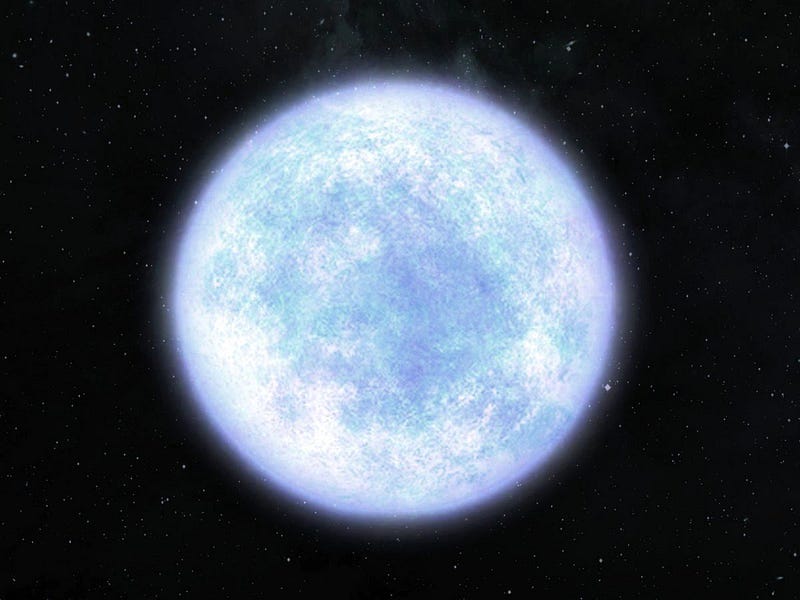
A very cold white dwarf
What did their end look like? That is not known. It is likely that the stars grew significantly in size and then absorbed the surrounding globes.
The older of the dwarfs hides additional secrets: it contains unusually high amounts of lithium and potassium. It is also already very cool. It has a temperature of about 3050 K, or only 2,700 degrees C. By comparison, the hottest white dwarfs have a temperature of about 150 thousand deg C. In contrast, the temperature of the Sun’s interior reaches millions of degrees Celsius.
“When both of these stars formed, more than 10 billion years ago, there were far fewer heavy elements in the Universe, which form in the final stages of a star’s life. Therefore, the two observed white dwarfs give us insight into the formation of planets under conditions quite different from those under which the Solar System was born,” concluded Professor Pier-Emmanuel Tremblay, co-author of the paper.
Cool that you made it to the end of this article. I will be very pleased if you appreciate the effort of creating it and leave some claps here, or maybe even start following me. It would be nice if you also left a tip! Thank you!


