
On the Social Policy Arguments Against LGBT+ Marriage Equality
What Are The Social Policy Arguments Against Allowing LGBT+ People The Right Of Marriage?
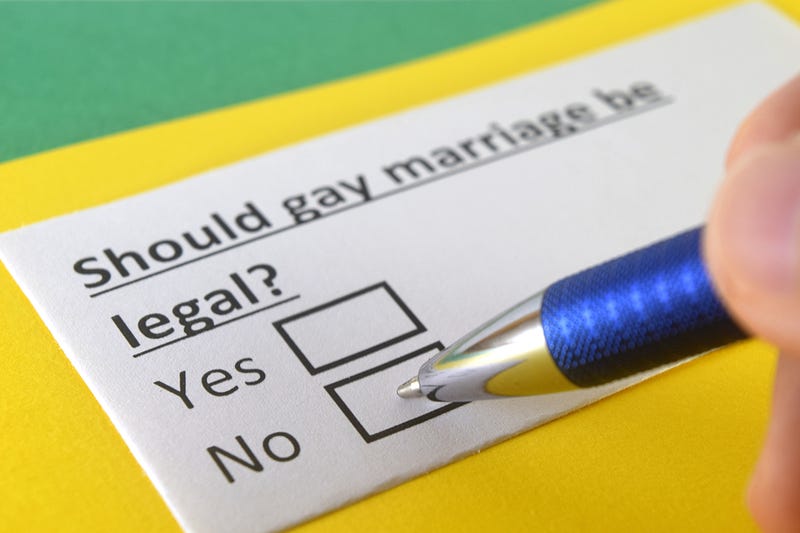
Author’s Note: This material was originally published in the author’s long, three-part answer on Quora to the question “What are all the arguments against gay marriage?”.
This is the first in a three-article series. Links to the other two may be found at the end of this article. With the coming appointment of Amy Coney Barrett to the Supreme Court, and Justice Thomas’ recent statement attacking Obergefell v Hodges, it behooves one to review the Obergefell decision and analyze Thomas’ statement for what it reveals about the future of Obergefell.
The footnotes are live hyperlinks. Click on a note number to be taken to the source authority.
Given Amy Coney Barrett’s “long-term association”¹ with The Alliance Defending Freedom (ADF), an “anti-LGBTQ hate group,”² and the recent declaration of war against marriage equality by justices Thomas and Alito,³ ⁴ ⁵ it seems reasonably certain that the Court will revisit Obergefell v. Hodges, 576 U.S. 644 (2015) (there exists a constitutional right to marry that extends to same-sex couples) at some point in the near future.
It takes only three justices to grant a writ of certiorari. Thomas, Alito, and Barrett are those three.
It is wise, then, that we revisit the social policy arguments against constitutional protection for marriage equality that Obergefell established. We need to reacquaint ourselves with the arguments of the people who opposed marriage equality in the first place and are determined to turn back LGBT+ civil rights by three-quarters of a century.
We give no rebuttal. The arguments all fall of their own weight under any reasoning analysis. There is no merit to any of them. The Obergefell majority gave them none. Neither did the dissenting justices, for that matter. Their objections to LGBT+ constitutional marriage equality were all legal arguments based in constitutional law, not in social policy.
The arguments are enumerated here only so that one may be reminded of them before proceeding to the second and third articles in this three-article series.
As of 2015, the year the Court decided Obergefell, the Defense of Marriage Acts (“DOMAs”) enacted by Congress and some 30 states explicitly defined marriage as a union between one man and one woman. In doing so, they excluded the class of same-sex couples from the institution of marriage.
These are the seven arguments against LGBT+ marriage equality that were pushed upon the Court in briefing Obergefell.
Open the floodgates
The pro-DOMA factions argued that to allow homosexuals the right to marry would be to open the floodgates to other challenges to longstanding marriage limitations, e.g., underage couples, polygamists, and incest aficionados.
Destroy marriage as we know it
That was the bald claim without reason or rationale. Allowing homosexuals to marry will “destroy marriage as we know it.”⁶ (The Economist, 21 April 2015, accessed 2020.10.14)
One of the biggest threats that same-sex “marriage” poses to marriage is that it will “probably undercut the norm of sexual fidelity in marriage.”⁷ (Family Research Council, undated, accessed 2020.10.14) (emphasis mine).
Threaten procreation
DOMAs are ”rationally related to the state’s interest in furthering procreation,” even if they are not comprehensive, and even if they permit marriages of couples lacking the will or the ability to reproduce.⁸ (The Economist, 21 April 2015, accessed 2020.10.14)
Same-sex “marriage” will further isolate marriage from its procreative purpose. Traditionally, marriage and procreation have been tightly connected. The primary purpose that marriage serves is to “secure a mother and father for each child born.”
Same-sex marriage will undercut the procreative norm associated with marriage. It will establish “that there is no necessary link between procreation and marriage.”⁹ (Family Research Council, undated, accessed 2020.10.14)
Marriages thrive when spouses specialize in gender-typical roles.
If same-sex marriage is institutionalized, our society will take yet another step down the road of ‘de-gendering’ marriage. There will be more use of gender-neutral language like “partners.” There will be more social and cultural pressures to neuter our thinking and our behaviors in marriage.¹⁰ (Family Research Council, undated, accessed 2020.10.14)
Same-sex “marriage” will further diminish the expectation of paternal commitment.
It is plausible to suspect that legal recognition of homosexual marriage will further destabilize the norm that adults should sacrifice to get and stay married for the sake of their children. Same-sex marriage will institutionalize the idea that children do not need both their mother and their father.¹¹ (Family Research Council, undated, accessed 2020.10.14)
Homosexual marriage will hurt the children.
● Evidence suggests that children raised by homosexuals are more likely to experience gender and sexual disorders.
Although the evidence on child outcomes is sketchy, it does suggest that children raised by lesbians or homosexual men are more likely to experience gender and sexual disorders.¹² (Family Research Council, undated, accessed 2020.10.14)
DOMAs are benign attempts to encourage heterosexual couples to sanctify and stabilize their relationships for the benefit of potential offspring.¹³ (The Economist, 21 April 2015, accessed 2020.10.14.)
● An intact, married family is best for children.
DOMAs increase the likelihood that the parents will identify with the child and will sacrifice for the child. DOMAs reduce the likelihood that either parent will abuse the child.¹⁴ (Family Research Council, undated, accessed 2020.10.14)
● Children hunger for their biological parents.
Homosexual couples using in vitro fertilization (IVF) or surrogate mothers deliberately create a class of children who will live apart from their mother or father.¹⁵ (Family Research Council, undated, accessed 2020.10.14)
● Children need fathers.
If same-sex marriage becomes common, most same-sex couples with children will be lesbian couples. That will mean that we will have yet more children being raised apart from fathers. Among other things, we know that fathers excel in reducing antisocial behavior and delinquency in boys and sexual activity in girls.¹⁶ (Family Research Council, undated, accessed 2020.10.14)
● Children need mothers.
Although homosexual men are less likely to have children than lesbians, homosexual men are and will be raising children. There will be even more if homosexual marriage is legalized. These households deny children a mother.¹⁷ (Family Research Council, undated, accessed 2020.10.14)
Women and marriage domesticate men.
Men who are married earn more, work harder, drink less, live longer, spend more time attending religious services, and are more sexually faithful. They also see their testosterone levels drop, especially when they have children in the home.¹⁸ (See Psychology Today, 12 April 2010, accessed 2020.10.14)
If the distinctive sexual patterns of “committed” gay couples are any indication, it is unlikely that homosexual marriage will domesticate men in the way that heterosexual marriage does. It is also extremely unlikely that the biological effects of heterosexual marriage on men will also be found in homosexual marriage.
Gay activists who argue that same-sex marriage will domesticate gay men are, in all likelihood, clinging to a foolish hope. This foolish hope does not justify yet another effort to meddle with marriage.
This is the first in a three-article series.
The second and third are
© 2020 Steve Alexander


