
Justices Declare War on Same-Sex Marriage
Perverse definitions of religious liberty threaten equality for all
It’s no secret many conservatives in the U.S. have elevated religious liberty to a high and perverse altar
Secretary of State Mike Pompeo has horrified global human rights advocates by forming a Commission on Unalienable Rights to declare US foreign policy should and will presume religious liberty to be more important than other human rights.
He stuffed the commission with radical religious believers who subscribe to a new-fangled notion that religious liberty means liberty to harm members of marginalized human minorities. Pompeo’s commission equates the human rights of women and LGBTQ people to mere “political controversy” undeserving of the label “unalienable.”
Practically all human rights leaders have rejected the U.S. position, and most of the world’s liberal democracies boycotted its presentation last month at the UN General Assembly. Pompeo’s work is supported almost exclusively by the most repressive states on the globe.
Now the Supreme Court may get in on the act
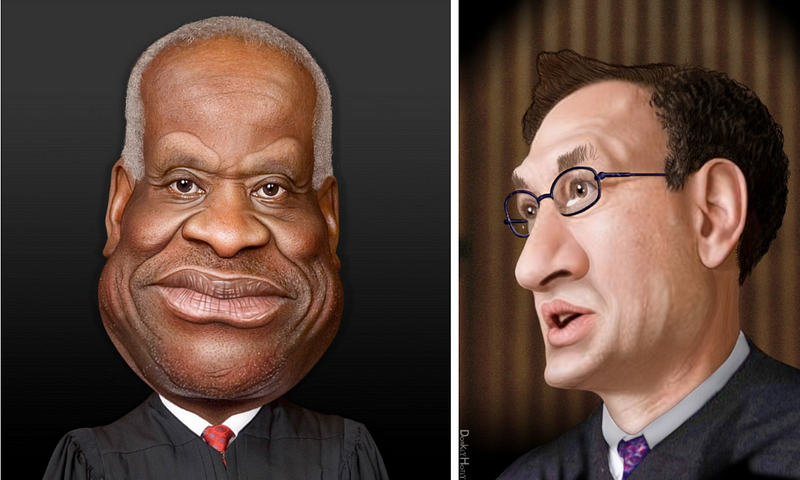
Yesterday, Supreme Court Justices Clarence Thomas and Samuel Alito declared war on Obergefell v. Hodges, the 2015 decision that found same-sex couples enjoy a fundamental right to marry under the Constitution’s 14th Amendment guarantee of equal protection of the law.
The justices cited religious liberty conflicts
Thomas wrote for himself and Alito that Obergefell, “enables courts and governments to brand religious adherents who believe that marriage is between one man and one woman as bigots, making their religious liberty concerns that much easier to dismiss.”
People should not and must not leverage their private religious beliefs to harm members of marginalized minorities.
His words came in response to a case brought by Kim Davis, a former county clerk in Kentucky who refused on religious grounds to issue marriage licenses to same-sex couples. She sued when she was briefly jailed for refusing to follow a judge’s order to perform the duties of her office.
She has since become a conservative cause célèbre.
The two justices agreed with the Court’s decision not to hear her appeal, citing procedural grounds and lack of clarity. But as noted on NPR, they “used the occasion to take a legal baseball bat to the court’s 2015 decision Obergefell v. Hodges.”
Ominously, Thomas and Alito paint Davis as one of the “victims of this court’s cavalier treatment of religion in its Obergefell decision.”
Let’s be clear: Davis is not a victim and suffered zero loss of religious liberty
I’m not a lawyer, and this column is a not a legal opinion. It’s a moral and philosophical argument. The central issue here is plain. People should not and must not leverage their private religious beliefs to harm members of marginalized minorities.
Agents of the State who refuse for private religious reasons to obey neutral civil laws are always free to stop being agents of the State. No harm, no foul.
Davis’s right to practice her religion was never infringed, not even slightly. She is and always has been free to worship openly, to participate in any religious rite or ritual she chooses, to speak publicly about her religious beliefs, and to urge her neighbors to share her beliefs if they so choose.
Those rights are and ought to be sacrosect in any free society.
In the United States, marriage has never been a religious institution
Marriage in the U.S. has literally nothing to do with religion, and it never has. Marriage is a civil contract, an agreement entered into by two people with the assistance of the various states, or in a general sense, the State.
The State, seeing a benefit of stability and prosperity, has traditionally offered certain privileges to couples who legally join their lives. Centuries of legislation and legal traditions nail down certain benefits and responsibilities of marriage, giving legal clarity as to how marriages may be initiated or ended — if that becomes necessary or desirable.
Marriage exists outside any religious framework
People of all religious traditions — and no religious traditions — marry, carry out the responsibilities of marriage, and end their marriages under exactly the same legal conditions.
A citizen of Kentucky follows the same marriage laws as every other citizen of Kentucky, regardless of religious belief or lack of belief. Ditto a citizen of New York, California, Montana, or any other state.
Sometimes religious ministers perform wedding ceremonies, sometimes in churches, but that’s an optional custom with no legal meaning, force, or substance. People often marry one another with no religious involvement at all.
Kim Davis tried to force her religion on others
The justices’ assertion that Davis’s religious liberty interests were violated is absurd on its face. When she refused to issue Kentucky marriage licenses to same-sex couples she was, as an agent of the State, denying them equal protection of the law.
The justices claim her beliefs were violated. But that doesn’t even pass the smell test. What beliefs? Did she believe the law doesn’t grant same-sex couples the right to marry? It does. That’s a fact, not a matter of religious belief.
Does she believe the law allows religious institutions to grant or deny the right to marry?It does not. Again, that’s a matter of fact, not of religious belief.
Granted, she likely believes the law OUGHT to give religious institutions the power to grant or deny marriage. But that’s NOT a religious belief; it’s a political opinion about how Church and State ought to be structured in the U.S.
It’s a personal political position that cannot enjoy privileged faith status.
People are always free to advance their political beliefs on the public stage and to urge others to adhere to them, but they are not free to break the law in so doing, not outside the arena of civil disobedience, in which participants intentionally break the law and willingly accept the legal consequences.
Davis is already perfectly free
Kim Davis believes people of her religious faith ought to marry only people of the opposite sex. That’s fine. She is free, and always has been free, to marry a partner of the opposite sex instead of a partner of the same sex. Her church is free, and always has been free, to conduct wedding ceremonies only for opposite-sex couples.
They enjoy absolute and perfect freedom to practice their religion as they choose.
But Davis and her congregation are not, and must never be, free to impose their religion on people who don’t share it. They certainly don’t have the right to elevate their religious beliefs above the law.
The Supreme Court has no business enabling such a perverse elevation
The United States was founded (however imperfectly) as a secular state in which people of all faiths and no faith enjoy equal liberty. Our founders believed religion must never be used to deprive people of liberty.
I would add that using religious faith to deprive marginalized minorities of liberty is a particularly perverse attack on American values. Yet such thinking is more and more popular in conservative political and legal circles.
Justices Roberts, Gorsuch, Kavanaugh and (soon-to-be-Justice) Barrett are all staunch supporters of religious rights that de-emphasize separation of church and state while emphasizing the importance of the free exercise of religion in such a way as to harm minorities.
All of them have been lifelong proponents of interpreting religious liberty to enable institutions of faith to essentially force religious practice on people of different or no faith.
The coming Supreme Court term will present a critical liberty test
In November, the justices will test a law that applies generally and neutrally to all without respect to faith. The case concerns Philadelphia’s denial of a contract to Catholic Social Services, because Catholic Social Service refuses to certify qualified same-sex couples as adoptive or foster parents.
Like Davis, Catholic Social Services is demanding the “religious liberty” right to act as an agent of the State while harming people who don’t share their private religious beliefs. They wish to deny services to same-sex couples for reasons that have everything to do with religion and nothing to do with the law or the proper functioning of civil society.
They wish to force their faith on others while they spend the State’s money in the interest of the State, as agents of the State.
At least four justices apparently believe religious liberty means the right to impose belief. With Barrett on the bench, this November case may spell an end to much liberty for LGBTQ people. If Thomas and Alito prevail, we’ll live in a land where our basic human rights are subject the whims of individual people and institutions of faith.
Thomas and Alito are wrong. This is not liberty. It’s tyranny exercised by people of faith who are already perfectly free.
James Finn is a former Air Force intelligence analyst, long-time LGBTQ activist, an alumnus of Queer Nation and Act Up NY, an essayist occasionally published in queer news outlets, and an “agented” novelist. Send questions, comments, and story ideas to [email protected].


