
On Muses and Writing Rituals
Nine (sometimes quirky) ways I find focus and inspiration
Writers are renowned for being eccentric creatures, and one of the aspects that shows our curious caprices are the things we do in order to write. Our inexplicable superstitions to ward off the dour fog of writer’s block. Our instinctive little rituals to centre ourselves, to call forth inspiration.
Summoning Muses: A time-honoured artist’s tradition
As we move forward on the page (or screen) with blind intuition or the vaguest sense of an idea; a metaphorical finger held up to sense from which direction the winds of creativity are blowing, we hope to invoke the Muse — or Muses — as artists have done for centuries. Traditionally, an invocation occurred near the beginning of a piece; an entreaty to the Muse to bestow inspiration, as Shakespeare writes in his opening lines of the prologue to The Life of Henry the Fifth:
“ O for a muse of fire, that would ascend The brightest heaven of invention …”
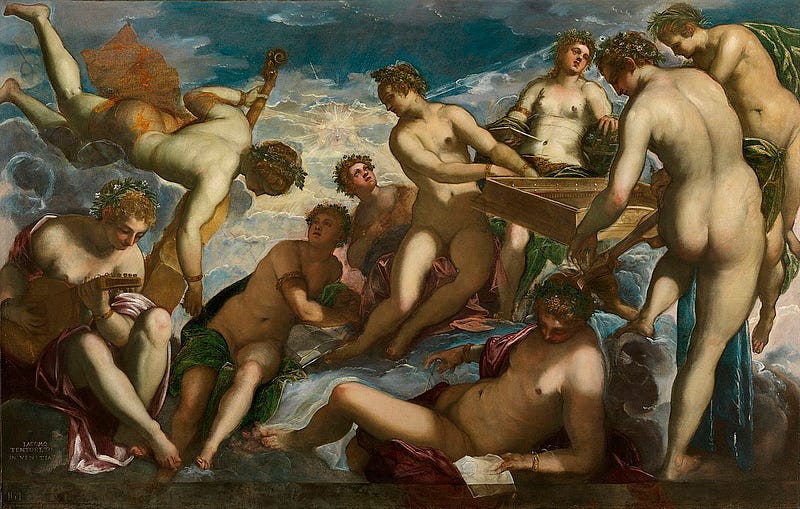
According to Classical Greek mythology, Zeus and Mnemosyne (Titan goddess of memory) had nine gracious daughters known as The Muses, each embodying her own unique field of inspiration, art or endeavour. My favourites would be Melpomene, the muse of Tragedy, Terpsichore the Muse of Dance, Erato, the Muse of love poetry and Polyrhymnia, presiding over sacred poetry.
It’s curious how contemporary ideas about inspiration have reduced these nine individual muses to merely one. Perhaps our creative ideas would manifest faster if we were more precise about who we were invoking — calling in the right Muse for our medium of creative endeavour.
So, in honour of this original concept, here are my nine writing rituals — one for each of the Muses.
Nine writing rituals: Calling down the Muses
1. The necessity of the pen on the page
To capture the first ideas for a piece, the pen on the page is my essential dowsing rod — never fingers on a keyboard. A recent study focused on long-hand writing, and how this has significant qualitative effects on the early stages of the creative process. Connections between “fluid arm movements” (such as those hand-writing necessitates) and creativity in a 2012 study were shown to lead to enhanced creativity in three domains: “creative generation, cognitive flexibility, and remote associations”.
Some additional benefits of drafting by hand are the power saved by switching your lap-top off, harnessing concentration by removing those countless electronic distractions, and giving your eyes a break from the glare of the screen, reducing eye-strain.
2. Aesthetically pleasing notebooks
To embrace and keep warm my fledgling ideas, beautiful notebooks with eye-catching, colourful covers make my inner child happy. Plain ones do not say “play with me”. As the musician, author, and creativity expert Stephen Nachmanovitch says:
“The most potent muse of all is our own inner child.”
I like to have an A5 notebook, as it fits in my handbag or laptop bag, to jot down notes, ideas for articles or short poems when I’m out and about, and an A4 size for my longer articles and research notes.
3. The perfect pen
Blue pens remind me of school days, blue-lined exercise books full of maths equations, and shopping lists. It may sound precocious, but I cannot write creatively with a blue pen. It must be black ink.
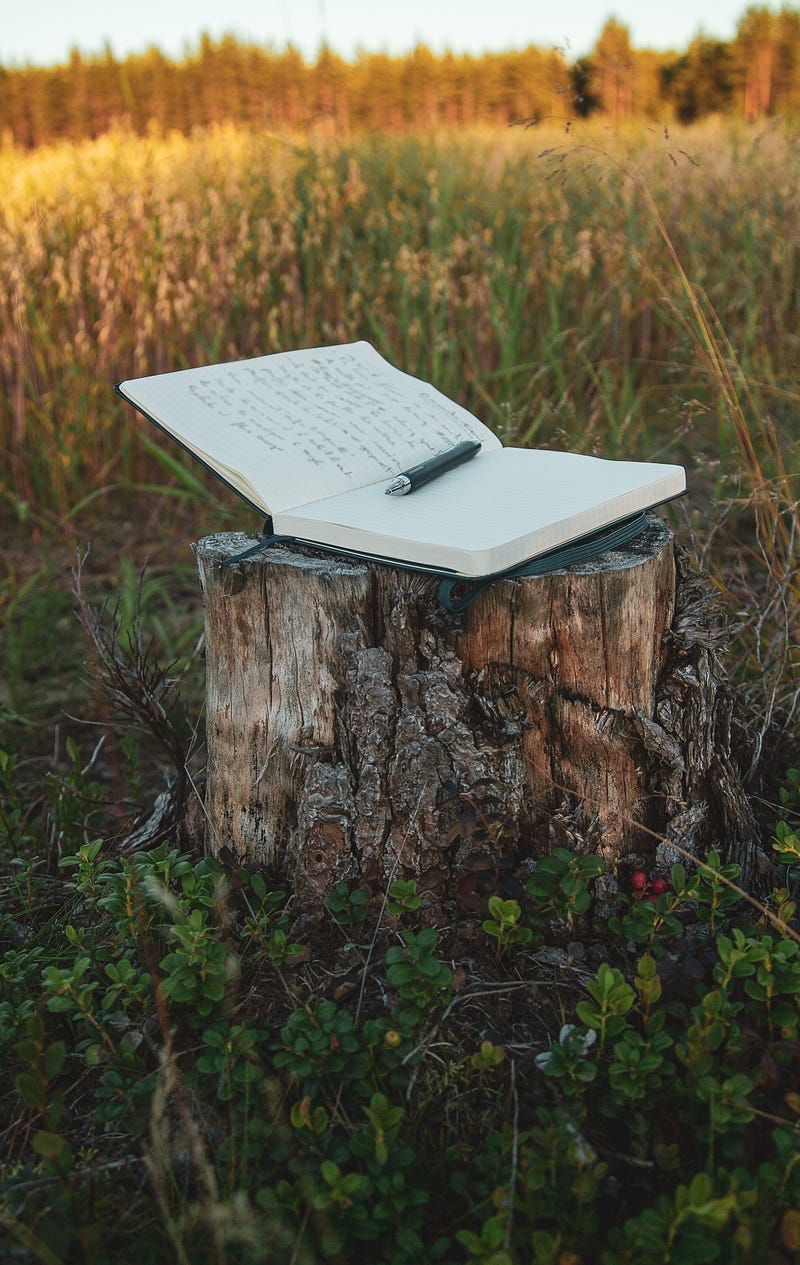
My current favourite, discovered in a job where I was responsible for stationery orders, is the Jetstream uniball 1.0 in black. (In fact, coincidentally, I think it’s the pen featured in this image.) It’s a little bit elegant, the perfect size for my petite hands and glides smoothly on the page — just in case you were looking for a recommendation.
4. Nothing says “time to write” like a pot of tea
We all have our favourite choice concoction to accompany our writing, don’t we? For my first writing session of the day, I love black vanilla tea; savouring the ritual of warming my white teapot, measuring out the tea, pouring milk into a little crystal jug, and setting it on a tray with one of my collection of antique china tea-cups.
This preparation, I believe, readies my mind for writing. The sweet, slightly earthy fragrance of vanilla tea is both comforting and uplifting, set apart from my more everyday tea choices, reminding me my writing time is sacred and nurturing. Recently, I discovered that vanilla is an aphrodisiac — so perhaps this is how I seduce myself to the page.
5. Ambient background music
A life-long appreciator of many kinds of music, I like ambient sounds floating through my space while I write. Over the years, I‘ve compiled my “mental list” of artists I listen to when I’m writing. I find instrumental or world music, or music where lyrics don’t predominate are most conducive to concentration.
It must feel “background” — listening through headphones would intrude too much on my mental focus, and would interfere with the emerging rhythms of my sentences, particularly when writing poetry, but also prose.
To concentrate, I occasionally need silence, and rarer still, I might find an artist or song that perfectly complements the piece I’m working on. I wrote a story listening only to Bonobos’ album “The North Borders” and in particular the song “Cirrus” recently. My story was set on a train, and the beats in this song reminded me of the rhythm and clatter of a speeding train. At university, I wrote a play about witchcraft listening to Berlioz’ “Symphonie Fantastique” and “The Hounds of Love” by Kate Bush (both had witchcraft themes).
Every writer seems to need something different in terms of background noise vs silence. So experiment and find what works for you.
6. Journalling: Clearing the mind
Journal-writing is something I’ve done since I was around eight years old. There are many ways you can use personal journalling as a powerful companion to your writing for publication.
Sometimes ideas for articles or stories will emerge in a journal entry. Other times, if I stall in the middle of drafting, or if I’m having trouble, settling my mind to begin work on something, writing a stream-of-consciousness entry clears my mind of personal concerns and clutter.
When drafting creative non-fiction, if I’m searching for a relevant life-anecdote to illustrate a theme or idea, my older journals can reveal gems of memoir. Writer Anais Nin was a prolific journal-writer all her life, publishing seven volumes, spanning some forty-three years of her fascinating life. Like Nin, I believe journalling is the foundation of a writing life, a writing mind.
“We write to taste life twice, in the moment and in retrospection.” - Anais Nin
7. Ideal writing environments
If you live with family or other people, finding one or two spaces in your home to call your own for writing is important — even if it’s on your bed with extra pillows or a nook with a desk under the stairs. Furnish it with what you need and get to it.
As far as the writing life is concerned, I’m fortunate to live alone. The peaceful solitude of my living room, balcony door open in summer, draped in a blanket on my couch in winter, is one of my preferred writing environments.
The light-filled space, clutter-free tables and soothing background hubbub of a favourite local cafe is my other ideal writing environment. In Writing down the Bones, Natalie Goldberg advocates writing practice in cafes; immersing yourself in the hither-thither flow of humanity and the enlivening scent of coffee can foster a different level of concentration, a different source of inspiration.
8. Rewarding my writer-self for accomplishments
When I get a poem or story published in a literary journal or an anthology or achieve other significant milestones or writing goals, I always reward my writer-self in some way: a bunch of flowers, a vintage teacup, a new notebook or a writing-date with coffee and cake at a favourite cafe. If I’ve received a publication fee, I always use a portion of it to contribute to something inspiring or useful for my writing life, such as a new book on writing craft, a subscription, or a writing workshop.
Writing-oriented treats affirm your hard work and achievement and create a moment of celebration and rest, where you can appreciate your progress. As writers and creators, we need creative and intellectual stimulation; gifts to your writer-self that contribute to your growth keep the well of creativity free of weeds and algae, and the water from becoming stagnant.
9. Movement practices: Out of the chair and into the body
Society makes us very aware of the dangers of an overly sedentary life. As writers, we are highly prone to these negative health consequences, and should consciously adapt a movement practice or exercise schedule. For some, it’s yoga or pilates. For others, it’s jogging. Walking and dancing are the two movement practices that work for me; allowing me to take the world in for inspiration, and to hear the stories my body wants to tell.
Easily inserted into any writing regime, I would walk almost every day when I need a break, or to mull over a piece I’m working on. I live in a bay-side area, full of small parks and tree-lined streets. A canal with walking tracks on either side leads down to the beach. In Walking in this World, author and creativity expert Julia Cameron reminds us that “we live as we move, a step at a time”. This is also how we create.
Recently, I’ve returned to a creative dance class, which is also a spiritual movement practice. The 2-hour class is on a Sunday, around sunset, in a room above my local beach, with a huge glass window overlooking the ocean. I find it an incredible source of release, inspiration and integration; to move through the emotions and stories stored in my body as the sun descends into the ocean and to use this space as a ritual to re-set and recharge for the week ahead.
Defining your writing rituals, seducing your Muses
So there, laid bare, are my petits rituels. They’re how I remind myself that writing time is sacred time, magic time. These rituals and gestures demarcate my writing time from everyday reality, allowing me to fall deeply into the creative dimension, that mysterious place where time and space can stretch or shrink. Where clocks stop as if it’s the last day of the world. Or melt, like in a Dali painting.
And you emerge from that place, like Alice from Wonderland, not quite yourself, and yet more yourself.
“Curiouser and curiouser …”
What are your writing rituals? The magic spells you perform to summon your Muse(s), to enter your own write-time? Practice them regularly. Commit them to the page. Let them be your own Book of Spells.
Melissa Coffey is an Australian writer, editor, poet & performer. She is a series of expanding possibilities. Her short stories, creative essays & poetry are published in various international & Australian anthologies (sometimes incognito).
Follow Melissa Coffey for thoughtful essays and provocative poetry & fiction. Not a Medium member? Join with my referral link for just $5 a month to access all my stories & so much more. Find your voice & others you’ll want to hear.
Read more from this Writer: