
Omnium
Just in time for the Olympics… the Spelling Bee rejects this word!
Today’s New York Times Spelling Bee letters:
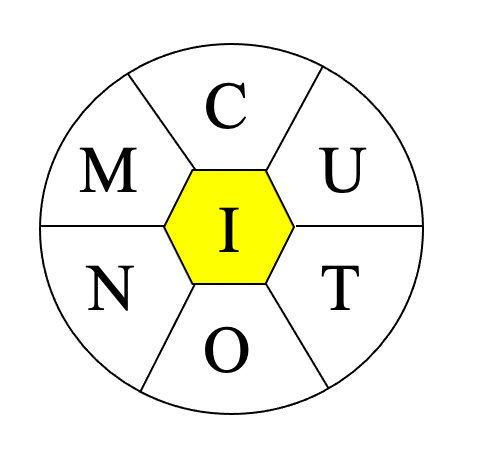
C, M, N, O, T, U, and center I (all words must include I)
Merriam-Webster says…
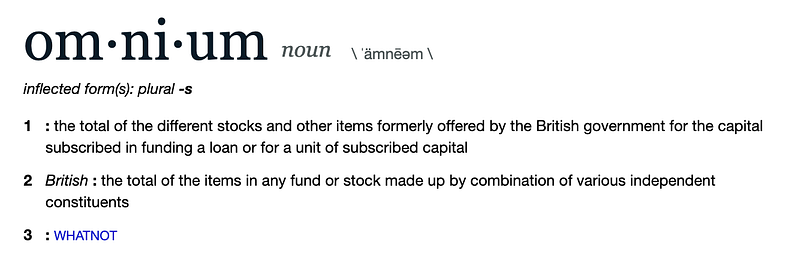
Silly little dictionary! Don’t you know omnium can’t possibly be a word if the New York Times says it ain’t?
For further fascinating facts, check out the Spelling Bee Master.
What’s your favorite dord* from today’s puzzle?
My Two Cents
This is one of those rare cases in which the dictionary does not show the meaning I’m looking for, although it at least supports this column’s endeavor of proving that omnium is a word.
No worries… the official website of the Tokyo 2020 Olympics (not being held in 2020) has my back!
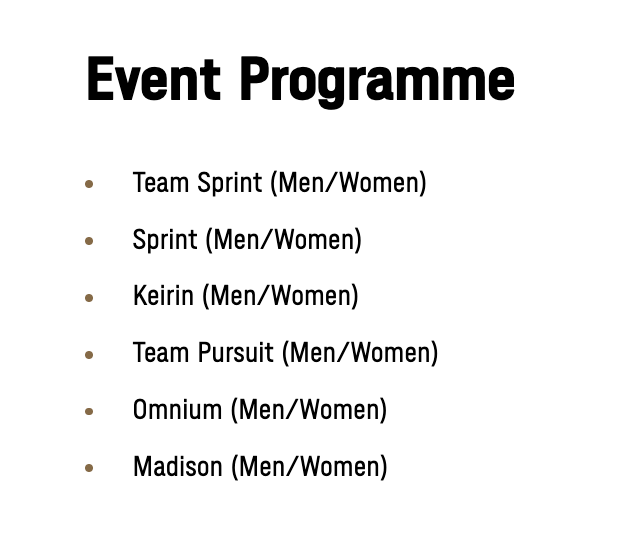
See that next-to-last entry? That’s none other than our daily dord*, omnium!
So what the Spelling Bee is telling us is that an event that millions of people may witness on August 5th and August 8th… does not exist. The hubris!
Pedal, Forrest, pedal!
The word omnium came to English via the genitive plural of the Latin word omnis, meaning “all”. Surely you’ve heard or seen the prefix omni- words such as omniscient and omnipotent. (The latter is a word that, when I was a kid, I thought was pronounced omniPOtent.)
So, the omnium in cycling contains “all” different types of events run as one competition. This is currently done in track cycling only, not outdoors. Except for 1912, track cycling has been part of the Olympic Games since the first modern edition in 1896 at Athens.
The world federation in charge of cycling is the Union Cycliste Internationale (International Union of Cycling), known as the UCI. As they explain on their website:
The Omnium is made up of 4 bunch events raced on the same day: scratch race, tempo race, elimination and points race. The final classification is established as follows: the points accumulated by the riders over the first 3 events, on the basis of the points scale in force, are added up. During the 4th and final race, this total may increase or decrease according to the points won or lost by the rider in the specific points race. The winner is the rider who has the highest total of points at the end of the 4th event.
The four races in the event are as follows:
- Scratch race: 10 km (6 miles) for men and 7.5 km (4.7 miles) for women; the winner is the first to cross the finish line.
- Tempo race: Same distances as before: 10 km for men and 7.5 km for women. However, after the first 5 laps, 1 point is given to the first rider crossing the line on each lap. Riders can also earn 20 points by lapping the field. The winner is the rider with the most points.
- Elimination race: a bunch race during which the last-place rider in each intermediate sprint (every 2 laps) is eliminated.
- Points race: Men cover 25 km (15.6 miles) and women cover 20 km (12.5 miles). The final standing gets decided through points accumulated by the riders in intermediate sprints or by laps gained on the main field.
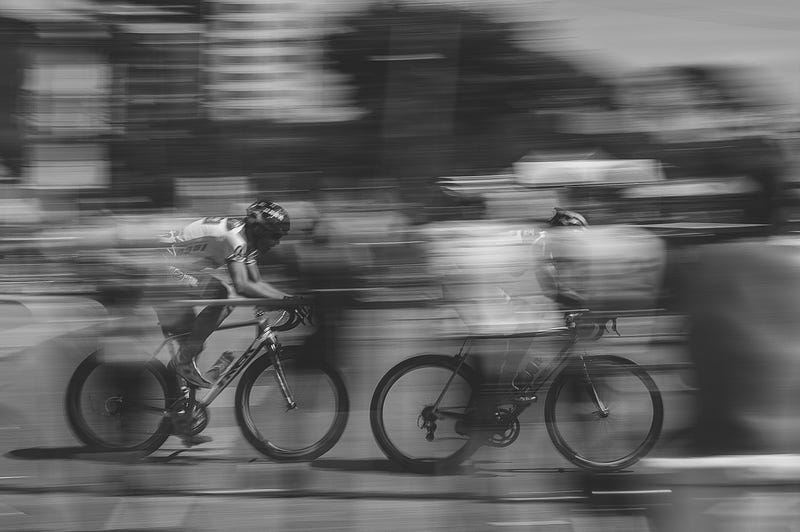
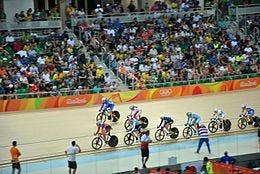
Here is a photo of an omnium scratch at the previous Olympics (Rio de Janeiro, Brazil).
The omnium had fallen out of favor as an event in the 1960s and 70s, and was resurrected with the UCI’s 2006 decision to bring it back to the Track Cycling World Championships — as a five-race event. The next year the competition was held in Spain and the omnium was part of the men’s events; women joined starting with the 2009 edition.
The 2008 Olympic Games in Beijing did not include the omnium, however, but four years later it became an event in London. The omnium replaced the individual pursuit, the points race, and the individual time trial. At that point the UCI had organized it into 6 events over two days, adding the time trial and flying lap (against the clock) events, with the individual pursuit instead of the Tempo race.
Although it’s not yet an Olympic event, road racing also has a version of the omnium, consisting of a time trial, a criterium (several laps around a closed circuit), and a mass-start road race (like a leg of the Tour de France).
Other Omniums
There are a few other omniums, although most of them have a capital “O”, which makes them invalid as word entries in the Spelling Bee game.
Omnium II lived more than a century ago as a thoroughbred horse in France. He won several important French races and was known as a great long-distance horse. In 1896 he won 6,200-meter (3.875-mile) Prix Gladiateur and another endurance test, the Prix Rainbow. He died very young — aged 9 — but sired a successful progeny. No idea what happened to Omnium I, although I assume he was much less successful, or else he too would have a Wikipedia entry.
The Òmnium Cultural is a Catalan association based in Barcelona, Spain, founded in the 1960s to promote the Catalan language and culture.
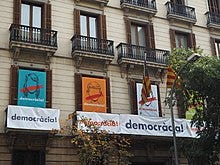
If you’re ever strolling through Barcelona and see this building, you’ve found the Òmnium Cultural! Please go inside and say hi to them from me.
Omnium is also the name of one of the two CDs produced by Teatro ZinZanni, a circus dinner theater that began in the neighborhood of Lower Queen Anne in Seattle, Washington, and now boasts another location on the waterfront at Pier 29 on The Embarcadero in San Francisco, California.
The “Great Stock Exchange Fraud of 1814” in England was a hoax related to government-based securities known as omniums. The fake news of Napoleon I’s death made those omnium bonds soar; when the truth was revealed, they plummeted. During that time, several people sold their government stocks and profited, among them including Lord Cochrane, a Radical member of Parliament and well-known naval hero.
Here is the schedule for the men’s and women’s omniums in this year’s Olympic Games:

As you’re watching or following these races, keep in mind that it’s all an illusion, a figment of your imagination. And that’s because the editors of the Spelling Bee still decided that omnium is a dord*.
You can check out my previous entry on another dord* here:
*What the heck is a dord, you ask? Here’s the answer: