
Deictic
I is deictic, you is deictic, we are all deictic
Today’s New York Times Spelling Bee letters:
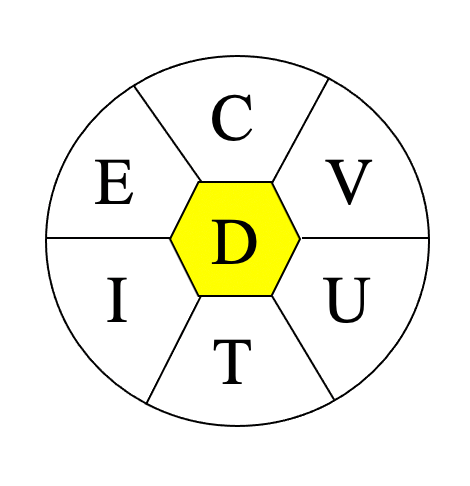
C, E, I, T, U, V, and center D (all words must include D)
Merriam-Webster says…
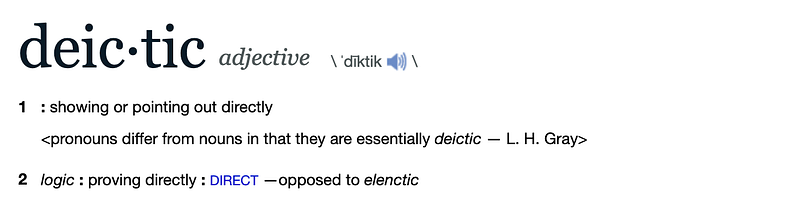
Silly little dictionary! Don’t you know deictic can’t possibly be a word if the New York Times says it ain’t?
For further fascinating facts, check out the Spelling Bee Master.
What’s your favorite dord* from today’s puzzle?
My Two Cents
The dictionary explains that the word deictic comes from the Greek deiktikos, from deiktos, meaning “capable of proof” (verbal for of deiknynai, “to show”) +the suffix -ikos (-ic). And that it’s related to the word diction.
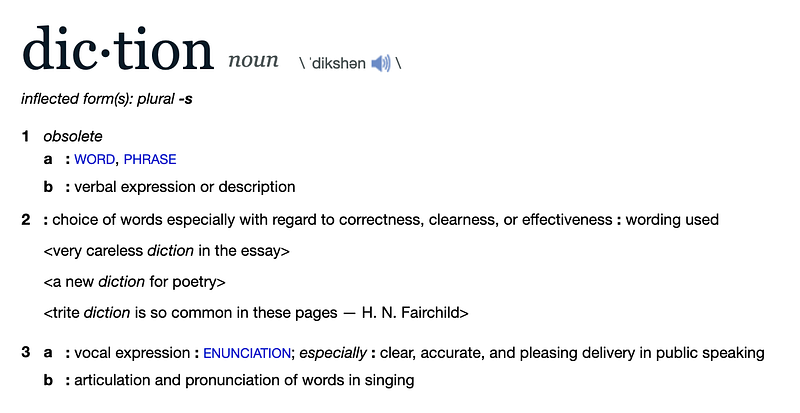
I would guess the second definition of diction is probably the one most connected to our daily dord.*
In favor of nouns?
Deictic is an adjective used in linguistics to describe those words and phrases that refer to specific things within a specific context. These specific things are usually people, but there are deictic words related to time and place, too.
One of the key characteristics of deictic words is that their semantic meaning is always the same, but they can denote different things depending on the person, time, and place.
English pronouns are one of the best examples of deictic words. Let’s discuss the pronoun I. When I say “I”, you will always know that it refers to the person who is talking. But that person can vary. In the same conversation, when I say “I” I am referring to myself, but when you say “I” you are referring to yourself. In the same conversation, the opposite would actually happen with the pronoun you.
As you can see, the “pure” meaning of the pronoun “I” is “the one who is speaking or writing”, but because “I” is deictic, the denoted meaning changes every time the speaker or writer does.
The same happens with other words, like today, yesterday, that, this, etc.
Wikipedia has this handy graph that I’m including so that this article has at least one other image than the photo at the top.
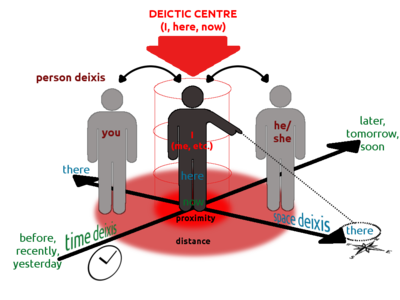
The general deictic categories are:
- Personal: refers to people (1) directly involved (the speaker and the addressee, as in the earlier example with “I” and “you”), (2) those not directly involved (those who hear what is being spoken but who are not being directly addressed), and (3) those mentioned in the utterance.
- Spatial: the locations may be either those of the speaker and addressee or those of persons or objects being referred to. The best-known English examples are the adverbs here and there; and the demonstratives this, these, that, and those,
- Temporal: deals with the various times involved in and referred to in an utterance. This includes time adverbs like “now”, “then”, and “soon”, as well as different verbal tenses.
- Discourse: Discourse diectics are a bit meta. The terms are used within an utterance to refer to parts of the discourse that contain the utterance, including the utterance itself. For example, when you want to regale someone with a good yarn, you might say, “This is a great story.” This changes from a spatial deictic word to a discourse one.
Modern pronouns
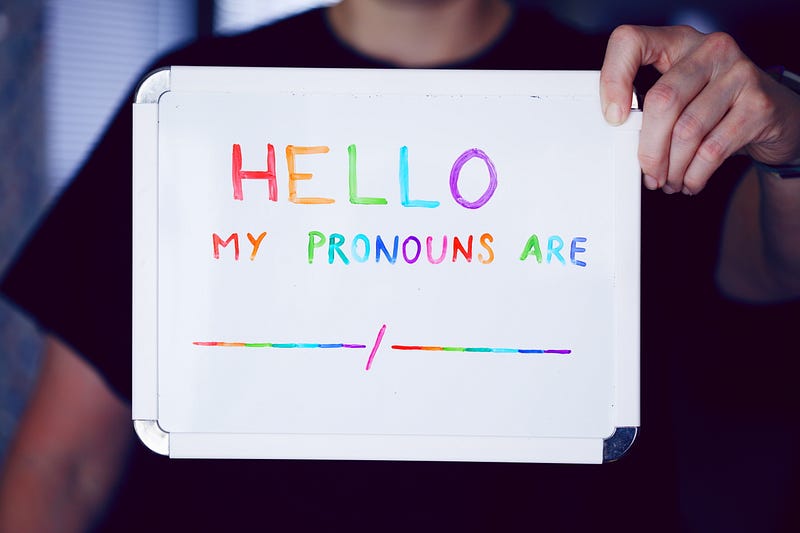
There has been a lot of brouhaha going about the use of pronouns and how their use is being changed by the newer generation.
As far as I can tell, the two biggest points of discussion are (1) the singular denotation of “they” and (2) the different pronouns different people want others to remember and use with them.
As far as point (1), we should remember that “they” has been used with a singular meaning by literary greats for centuries. In an 1881 letter, Emily Dickinson wrote “Almost anyone under the circumstances would have doubted if [the letter] were theirs, or indeed if they were themself — but to us it was clear.” Shakespeare (or one of his alter-egos) penned this line in Hamlet: ’Tis meet that some more audience than a mother, since nature makes them partial, should o’erhear the speech.”
So there.
And regarding point (2), I think what we most need at this moment is a calm and respectful attitude on both sides. We need to respect people’s wishes to be addressed as they see fit. It’s as simple as that, though it may require some extra work on our part. And those who wish to be addressed either as “they” or with a pronoun that is either new (xie/xyr/xyrs/xyrself) or may not immediately or apparently match how they present need to understand that most of us want to and try to respect their wishes, but that we may sometimes make mistakes. Mistakes that should not be penalized legally or give cause for social ostracizing, or “cancel culture” as it is known now.
So there.
In regards, to our daily dord*, despite its clear grammatical importance, the editors of the Spelling Bee still decided that deictic is a dord*.
You can check out my previous entry on another dord* here:
*What the heck is a dord, you ask? Here’s the answer: