
Morrissey and the Red-State Music of My Youth
As race politics evolves, how do I listen to the songs that shaped me?
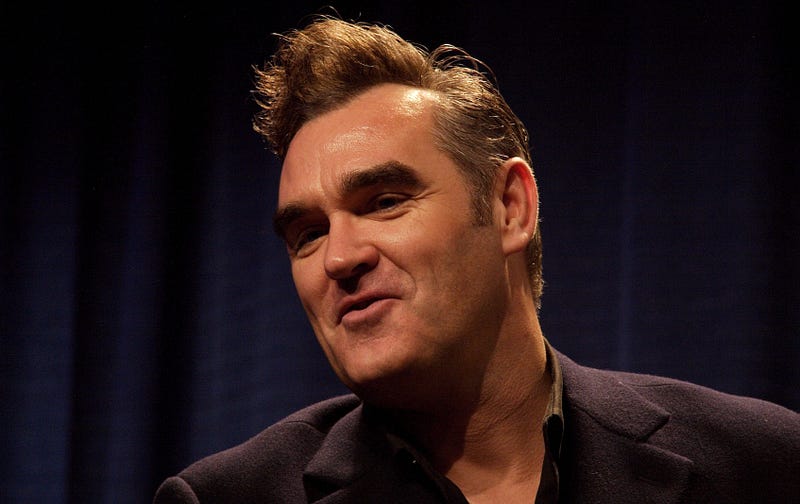
Oh, Morrissey. What am I going to do with him? More importantly, what am I going to do with his songs?
The Smiths, the iconic post-punk group that Morrissey led from 1982 to 1987, has been my all-time favorite band since the year they split, which, by extension, makes Morrissey one of my all-time favorite male singers. Lately, though, it’s become increasingly harder for me to listen to him — on and off the records.
The clumsy, racist (yes, Mozz, they’re racist) things that recently have come out of the 60-year-old’s mouth make me wonder if this charmless man possibly can be the same person who once wrote such eloquently morbid lines as “In a river the color of lead/Immerse the baby’s head/Wrap her up in the News of the World/Dump her on a doorstep, girl” (in The Smiths’ “This Night Has Opened My Eyes”) and “I had a really bad dream/It lasted twenty years, seven months, and twenty-seven days” (in The Smiths’ “Never Had No One Ever”).
What he said
A sampler of Morrissey’s recent utterances that are making me rethink more than three decades of fandom (thanks to The Week for putting them in one place):
“The modern loony Left seem to forget that Hitler was left wing! But of course, we are all called racist now, and the word is actually meaningless.
“When someone calls you racist, what they are saying is ‘Hmm, you actually have a point, and I don’t know how to answer it, so perhaps if I distract you by calling you a bigot, we’ll both forget how enlightened your comment was.’”
“London is second only to Bangladesh for acid attacks. All of the attacks are non-white, and so they cannot be truthfully addressed by the British government or the Met Police or the BBC because of political correctness.”
“Both [Labour and Conservative] parties support halal slaughter, which, as we all know, is evil. Furthermore, halal slaughter requires certification that can only be given by supporters of ISIS, and yet, in England, we have halal meat served in hospitals and schools.”
“London is debased. The Mayor of London tells us about ‘Neighborhood policin’ — what is ‘policin’? He tells us London is an ‘amazin’ city. What is ‘amazin’? This is the Mayor of London! And he cannot talk properly!
“I saw an interview where he was discussing mental health, and he repeatedly said ‘men’el’ … he could not say the words ‘mental health.’ The Mayor of London! Civilisation is over!”
“Racism is at its most abhorrent in relation to eating animals. If you eat animals, isn’t it a display of hatred for a certain species? And what gives you the right to eat another species or race? Would you eat people from Sri Lanka?”
“Racism is at its most abhorrent in relation to eating animals. If you eat animals, isn’t it a display of hatred for a certain species? And what gives you the right to eat another species or race? Would you eat people from Sri Lanka?”
Do these sound like the words of a “King,” as The Killers’ frontman Brandon Flowers controversially deemed Morrissey during an NME interview before The Killers’ June 29 Glastonbury set, or a barking mad racist? The most recent declaration of the so-called “King,” in defense of his support of the anti-Muslim group For Britain (made in an echo-chamber April interview with his 35-year-old nephew, which the singer posted last month on his Morrissey Central website):
“Everyone ultimately prefers their own race — does this make everyone racist? … Diversity can’t possibly be a strength if everyone has ideas that will never correspond.”
Is it 2019 or 1954?
Spoken like a segregationist bigot in 1950s America — or a member of the Ku Klux Klan. “To each his or her own” is the very foundation of racism, and 1954’s Brown v. Board of Education was such a pivotal moment in civil-rights history because it was the first U.S. Supreme Court ruling to challenge Jim Crow tradition. How dare Morrissey pin the narrow-minded thinking that used to relegate blacks and whites to supposedly “separate but equal” bathrooms on “everyone”!
By his twisted logic, when my white, Asian, Muslim, Jewish, Catholic, or anything other than black friends hang out with me, they’re secretly wishing I were white, Asian, Muslim, Jewish, Catholic, or anything other than black. How does Morrissey explain the growing number of interracial marriages and relationships? How does he explain interracial friendships?
Just because he would prefer an “England for the English” (to borrow lyrics from “The National Front Disco,” from his 1992 album, Your Arsenal), a white world where everyone looks like him and nobody listens to R&B and rap, doesn’t mean every other white person on the planet wants the same thing.
He may have a lot in common with the whites who made blacks sit in the back of the bus where they didn’t have to be seen in the 1950s U.S. Deep South, but he has nothing in common with the white people I call my friends. They’d rather be around someone who’s black like me than people who are white like Morrissey.
To “cancel” or not to “cancel”
OK, so Morrissey would rather hold court with white fans than black ones. Where does that leave his music and me? Is it time to banish him from my Spotify playlists and from my life?
I’m not a fan of “cancel” culture, where we play moral police, tying performers’ artistic and historic merit to their personal conduct. If we applied our high standards to all creative people, past and present, we’d have precious little music to listen to, TV and movies to watch, and art to admire. Some of us might even have to boycott ourselves.
If we applied our high moral standards to all creative people, past and present, we’d have precious little music to listen to, TV and movies to watch, and art to admire. Some of us might even have to boycott ourselves.
In the age of #MeToo, when every word, every social media post, every breathlessly delivered celebrity story is held up to a microscope, it’s become increasingly hard to separate art and artist, but I try. It’s important to understand that Kevin Spacey’s alleged sexual misconduct doesn’t make his performances in Seven, The Usual Suspects, and American Beauty any less brilliant.
As much as I loathe #MeToo violations, though, it’s harder for me to draw a line between fact and fiction when the indiscretions involve racism and homophobia, two offenses that hit me in my home — where it hurts most.
So how do I listen to Morrissey and The Smiths now? How do I listen to The Rolling Stones’ “Brown Sugar,” with its merging of “jungle fever” and slavery imagery? Should I immediately drop it as my karaoke go-to? How do I listen to the country music on which I was raised? It’s a quintessentially American genre that has long extolled pro-Southern — and occasionally pro-Confederacy — values and staples, from the rebel flag to redneck girls.
Is there a place for any of it on the soundtrack of my life today?
A lifetime of excuses
I overlooked a lot of questionable lyrical content when I was younger because I lacked consciousness and awareness. I knew there was something not quite black-friendly about the the lines “I’m a grandson of the Southland, an heir to the Confederacy” in The Bellamy Brothers’ “You Ain’t Just A Whistlin’ Dixie” and the staunch Southern pride of Don Williams’s “Good Ole Boys Like Me,” Alabama’s “Dixieland Delight,” and Hank Williams Jr.’s “Dixie on My Mind,” but it barely registered while I was singing along.
I was growing up in Kissimmee, Florida, a redneck town where staunch Southern pride was a fact of everyday life and the N-word was an accepted part of the local lexicon. (Two successive Democratic governors in the ’70s and ’80s, Reubin Askew and Bob Graham, did little to mitigate the red-state vibe.) Confederate flags and stickers popped up everywhere — on front lawns, storefronts, and car windows. I passed by old plantations every day and was forced to sing “Dixie” in music class. Over the course of 14 years, I became desensitized to slavery imagery.
Time and experience haven’t changed the music I listened to back then (at least not literally), but they’ve changed the way I listen to it. As a middle-aged gay and black activist, when I hear the aforementioned Bellamy Brothers song today, I can’t help but wonder about the subtext. Did they consider themselves not only heirs to the Confederacy but heirs to Confederacy thinking, too? Do they now? How do I keep their music playing?
It’s now impossible for me to listen to the Morrissey and The Smiths songs I’ve loved for decades and not think about the man Morrissey has become — or the one he’s been all along. When I do, I’m always searching for clues and hints of racism and xenophobia in his lyrics, something I may have missed back when I was blissfully unaware of the singer-songwriter’s ideological inclinations.
Creative listening
It helps when I think of my beloved Morrissey and Smiths songs as being frozen in a time when he wasn’t constantly making such egregiously offensive statements in public, back when I could pretend he might be a pretty decent guy in person. It’s a good thing I haven’t listened to any of his new music since 2006, because my retro appreciation makes it easier for me to focus on the nostalgic value and not on his current political stance.
Justifying some of the other songs on the soundtrack of my youth requires more creative effort. Take “Brown Sugar” by The Rolling Stones. Back in the day, I focused only on the choruses and thought of it as a pretty straightforward homage to black beauties. It’s only been within the last few years that I’ve zeroed in on the verses, which include lines like “Scarred old slaver knows he’s doin’ all right/Hear him whip the women just around midnight.”
I’m not sure what Mick Jagger was thinking when he decided to parallel his lust for black women to slavemasters whipping and raping their female property in the heat of the night. He’s said he’s not really sure in interviews, presumably to distance himself from lyrics that went down a lot easier in 1971 than they would if the song were being released for the first time today.
Since he can’t recall what he was thinking, I opt to put the words right into his head in order to make “Brown Sugar” as palatable lyrically as it is musically. I think of it as a bit of irony, a lampoon of jungle fever rather than a celebration of it.
Pro-Confederacy country is trickier. Old South imagery and standards can just be too painful to handle. It’s like that 1992 episode of The Golden Palace (the short-lived The Golden Girls spin-off) in which Blanche decided to host a Daughters of the Traditional South gathering in her Miami hotel, complete with a Confederate flag in the lobby, over the objections of her black manager, played by a young Don Cheadle.
He perfectly captured my sentiments when he said, “This flag, Mrs. Devereaux, is not about college football games or quilting bees or fried chicken on Sunday. It’s about colleges that won’t let me in. It’s about companies that won’t hire me. It is about crosses being burnt on people’s lawns today, not in the evil past, Blanche, today.”
So I struggle with some of the songs of my youth, but I haven’t given them up completely. I treat the Confederacy line in “You Ain’t Just Whistlin’ Dixie” the way I treat the N-word in rap music. It’s no longer among my favorite Bellamy Brothers hits, but if I don’t skip it, I just bleep out the C-word in my head and let the music play. Rather than discard my history with The Bellamy Brothers because of two lines in their 1979 hit, I move on to better, less-loaded hits like “Dancing Cowboys” and “For All the Wrong Reasons.”
Thankfully, I don’t have to do anything about Stonewall Jackson, the ’50s and ’60s country-music star whose parents actually named him after the eccentric Confederate general. I never listened to his music anyway. And who needs The Charlie Daniels Band’s love-it-or-leave-it 1980 hit “In America” when we can listen to “The Devil Went Down to Georgia,” from 1979?
I try to remember that there was so much more to Johnny Cash than his 1982 single “The General Lee” (his final solo Top 40 country hit, inspired by The Dukes of Hazzard and another legendary Confederate leader) and how lovely he was to me when I met him at an event in the early ’90s. I think about how Hank Williams Jr.’s Southern friend country rock was a staple of my ’80s diet, decades before he started ranting about the evils of President Barack Obama.
I try to remember that there was so much more to Johnny Cash than his 1982 single “The General Lee” and how lovely he was to me when I met him at an event in the early ’90s.
And if all else fails, I can take Nick Cave’s advice to a Morrissey fan who was struggling to reconcile his love of Morrissey’s body of work with his hatred of his politics.
“Generally, is it possible to separate the latter-day artist from his earlier art?” the conflicted fan asked Cave, via his The Red Hand Files website. “More specifically, what are your views on Morrissey, both early days and his newer more ugly persona?”
Cave’s response: “I think perhaps it would be helpful to you if you saw the proprietorship of a song in a different way. Personally, when I write a song and release it to the public, I feel it stops being my song. It has been offered up to my audience and they, if they care to, take possession of that song and become its custodian. The integrity of the song now rests not with the artist, but with the listener.”
Perfectly put. No matter what Morrissey says today or tomorrow, he once sang, “I am human and I need to be loved, just like everybody else does” on The Smiths classic “How Soon Is Now.” Those words now belong to all of us. They still speak to me and for me, even if the man who wrote them is sounding less like a loveable human every day.


