
Should Black Women Hate ‘Brown Sugar’?
The Rolling Stones hit launched countless debates and sleepless nights.
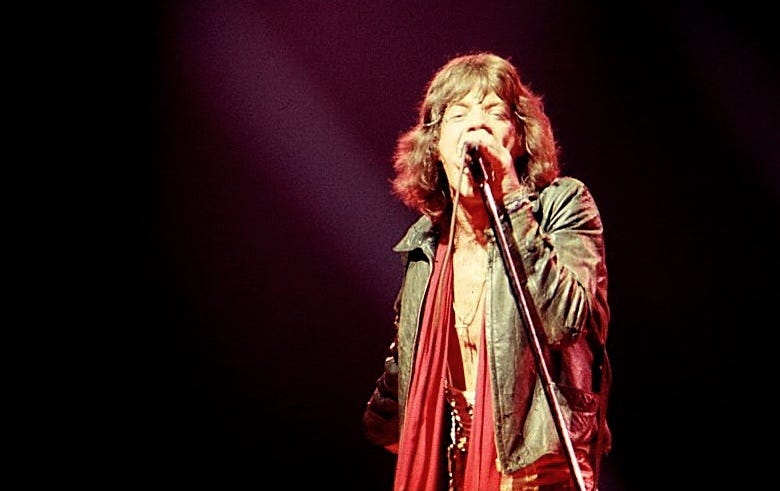
As the Aretha Franklin tributes pour in over the coming weeks, two of her singles that probably won’t be mentioned in any of the best-of lists are covers of top-five ’60s hits by The Rolling Stones: “(I Can’t Get No) Satisfaction” (from 1967’s Aretha Arrives, which also includes her equally-stunning reconstruction of ? and the Mysterians’ “96 Tears”) and “Jumpin’ Jack Flash” (from 1986’s Aretha).
Now that The Queen is gone, we’ll never know what an Aretha Franklin duet with Mick Jagger would have sounded like (Is there one out there that I’m not aware of?), or what she thought of The Rolling Stones’ 1971 number-one single “Brown Sugar”
Scarred old slaver knows he’s doin’ all right Hear him whip the women just around midnight — “Brown Sugar,” The Rolling Stones One read of those lyrics from the first verse, and it should be pretty clear why this is a song that has contributed to a number of debates and (for me) sleepless nights. Sometimes I feel seriously guilt-ridden over its status as my favorite of all the Stones’ American Top 40 hits. It’s hard to listen to a lyric like the one above and not think of Michael Fassbender’s Edwin Epps and Lupita Nyong’o’s Patsey in 12 Years a Slave. Some insist that Mick sang “with” and not “whip,” but with or without a whip, the image is still a heinous one. First off, let me emphasize that I do not believe Mick Jagger, who wrote the lyrics, is racist. The Rolling Stones did more for the mainstreaming of American blues music (and by extension, blues musicians, who were mostly black) than any other British Invasion band. And when it came to girlfriends, Mick certainly didn’t seem to have any color limitations. He even fathered a daughter by Marsha Hunt, a black actress who appeared in the original London production of Hair.
But if you look past the Stones’ incredible musicianship (no doubt admired by members of Foreigner, whose “Hot Blooded” would open with pretty much the same guitar riff later in the ’70s) and Mick’s intoxicating vocals on “Brown Sugar,” you’ll realize how brutal the lyrics are. It’s amazing that this song was a huge number-one hit in 1971, at the height of “Black Power” and just a few years after the Civil Rights Movement was in full swing. If it were released today, I can’t imagine that the PC brigade would even allow “Brown Sugar” to be played on the radio. I like to think Mick’s heart was in the right place, even if his head wasn’t. The Stones’ “Brown Sugar,” like the different song with the identical name that would provide the title of D’Angelo’s debut album 24 years later, is first and foremost a celebration of black female sexuality. But what should we make of its first two verses, which are set on a plantation during slavery times? And what about the rockin’ tempo? It’s not the mournful dirge that a slavery-referencing song probably should be (hear “Nobody Knows the Trouble I’ve Seen” and “Swing Low, Sweet Chariot,” both appropriately solemn), but a rollicking party song.
I don’t know what Mick’s true intentions were, and if I ever get to interview him, that will be the first thing I ask. Second question: Does he really think the rape of black female slaves by their white masters was the good time that “Brown Sugar” makes those midnight sessions out to be?
By juxtaposing the rape of black female slaves by their white masters with the third verse’s modern boy lusting after a black girl (while fantasizing about her mother!), “Brown Sugar” makes a direct link between old-school racism and jungle fever (an offensive phrase that suggests black people are animals, which is even worse than likening us to food). This is a crucial connection, and I’d give kudos to Mick if his intention was to get listeners thinking as well as rocking. According to him, there was no real method to the madness that is “Brown Sugar.” The lyrics are practically a stream of consciousness.
“God knows what I’m on about in that song,” he told Rolling Stone magazine in 1995, adding that it was a “very instant thing.”
The white-on-black sentiment was clearly based on reality, and whether white people are brave enough to admit it or not, being attracted to black people sexually doesn’t automatically absolve a white person of racist impulses. There can certainly be a racist element to white-on-black attraction, particularly when it ventures into the realm of fetishism and objectification, when blacks cease being multi-dimensional individuals and exist only as a collective sexual entity. Can I enjoy “Brown Sugar” without guilt by pretending it’s commenting on this misguidedness and not celebrating it? The track’s raucous spirit suggests the latter, but my knowledge of the Stones’ history with black music/musicians makes me hope for more. The big neon glittering question mark hanging over “Brown Sugar” is why I kind of despise myself for loving it as much as I do.
In my book Is It True What They Say About Black Men?, I tell the story of Alvaro, a guy in Buenos Aires who reacted horribly when I rejected him. He didn’t stop at hurling the N-word at me. He also threw in some vivid slave imagery, announcing that I should be picking cotton on a plantation in Alabama! I wonder if he was listening to “Brown Sugar” the entire time he was courting me and totally identifying with that “scarred old slaver.” Mick is said to have written the song for either Marsha Hunt or Claudia Lennear, who was a member of Ike and Tina Turner’s Ikettes. Even if he didn’t, I imagine both black women must have heard it. As much as I’d love to know what Mick was thinking when he wrote “Brown Sugar,” I’m dying even more to know what they were thinking when they listened to it for the first time. Brown Sugar, how come you taste so good Brown Sugar, just like a black girl should It sounds like high praise indeed, but nothing compared to what’s showered on the object of the Stones’ affection (either a girl, presumably white, or heroin) four U.S. singles later in “Angie.” “Brown Sugar” gets the rough sex. “Angie” gets the tough (as in durable) love. Her song may be the tearjerker and, in my opinion, the lesser of the two, but I’d rather have what she’s having.


