
Odontoid
This bone part can be a pain in the neck
Today’s New York Times Spelling Bee letters:
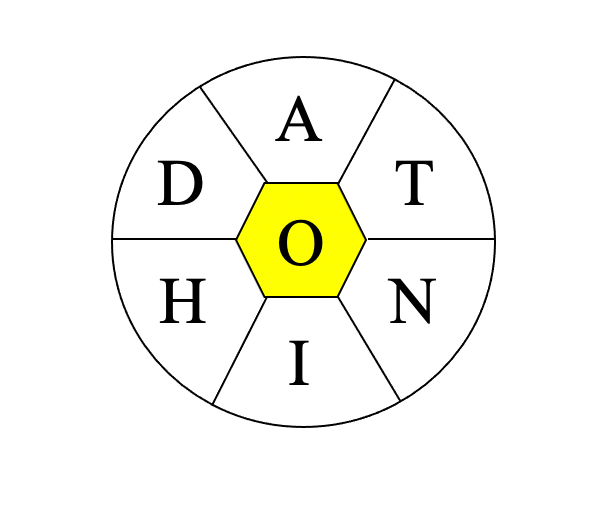
A, D, H, I, N, T, and center O (all words must include O)
Merriam-Webster says…
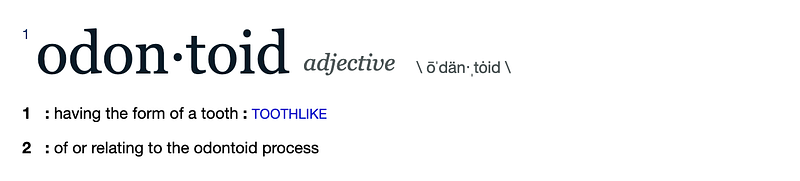
Silly little dictionary! Don’t you know odontoid can’t possibly be a word if the New York Times says it ain’t?
For further fascinating facts, check out the Spelling Bee Master.
What’s your favorite dord* from today’s puzzle?
My Two Cents
The word odontoid as an adjective may be used in the term odontoid process or the term odontoid ligament. Each case uses a different definition, as shown above.
When we say odontoid process, we refer to the “toothlike process projecting from the anterior end of the centrum of the axis vertebra on which the atlas vertebra rotates”. Here, process means “part of the mass of an organism or organic structure that projects outward from the main mass”. (Keep that in mind for later on.) It’s clear that the odontoid process is toothlike–-the definition even uses that word! — so it corresponds to definition 1 of odontoid: having the form of a tooth.
When we mention the odontoid ligament, we are not talking about a ligament that is shaped like a tooth, but rather that is connected to the process we mentioned before. So here the word odontoid is used in sense 2: related to…
I’m glad we did that completely unnecessary clarification before we moved on.
Second in line
If you want to use the universal gesture of shaking your head to indicate no, you’ll be very glad to have your odontoid in working order. Just be careful when you visit Bulgaria and Albania (among other places) because in those countries shaking your head means “yes”.
Why do most cultures use the head shake to indicate “no”? Experts aren’t sure, but one theory posits that babies decline their mother’s milk by turning their heads to the side.
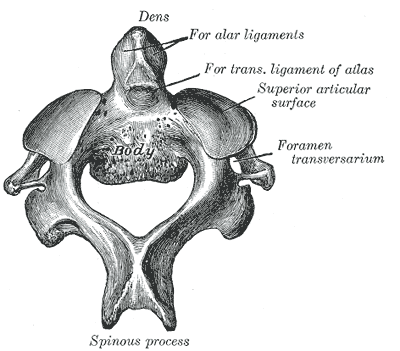
That is an illustration of your axis bone. Well, not yours in particular! You know what I mean… stop clowning around.
That protrusion at the top center? The one that looks sort of like a tooth? You guessed it! It’s the odontoid process, also known as the dens, another ancient word used for “tooth”.
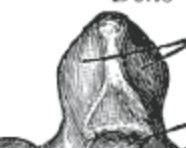
The 1911 edition of Encyclopedia Britannica explains this:
The odontoid process of the axis fits into a pivot joint formed by the anterior arch of the atlas in front and the transverse ligament behind; it is attached to the basioccipital bone by two strong lateral check ligaments, and, in the mid line, by a feebler middle check ligament which is regarded morphologically as containing the remains of the notochord.
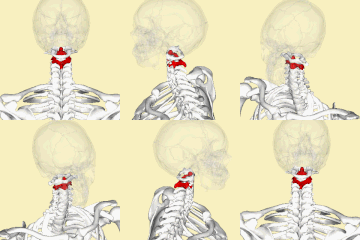
Yeah, I think this cool animation might help you better picture the relationship between the odontoid (in red) and the atlas, or first neck vertebra, into which it fits.
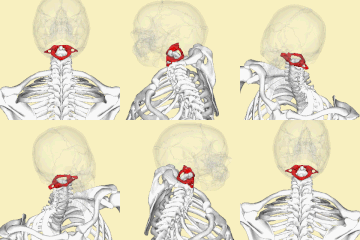
And this animation shows the atlas in red and the axis in white:
Is today’s article giving you motion sickness…?
Okay, no more animations.
The first vertebra shrugged
The atlas is the neck bone that supports the entire head. Remember how your mom always said that if your head wasn’t attached to your body, you’d be losing it all the time. Well, that attachment is due mostly to the muscles, tendons, and ligaments around the neck. I mean, the atlas is there, but bones can’t really attach to each other by themselves.
The atlas and the axis are specialized vertebrae that together form the joint that connects the skull and the spine. Because of their special shapes, these two neck bones help you nod and rotate your head. So you can silently indicate your approval or disgust in all the countries you visit.
Why is the first vertebra called atlas?
Well, just as the Greek god names Atlas held up the globe, so does that first bone hold up your head.
Did you detect anything wrong in the previous sentence? If so, I’m proud of you!
Atlas holding up the world is a common misconception. He actually lived on the western edge of the Earth and held up the celestial heavens.
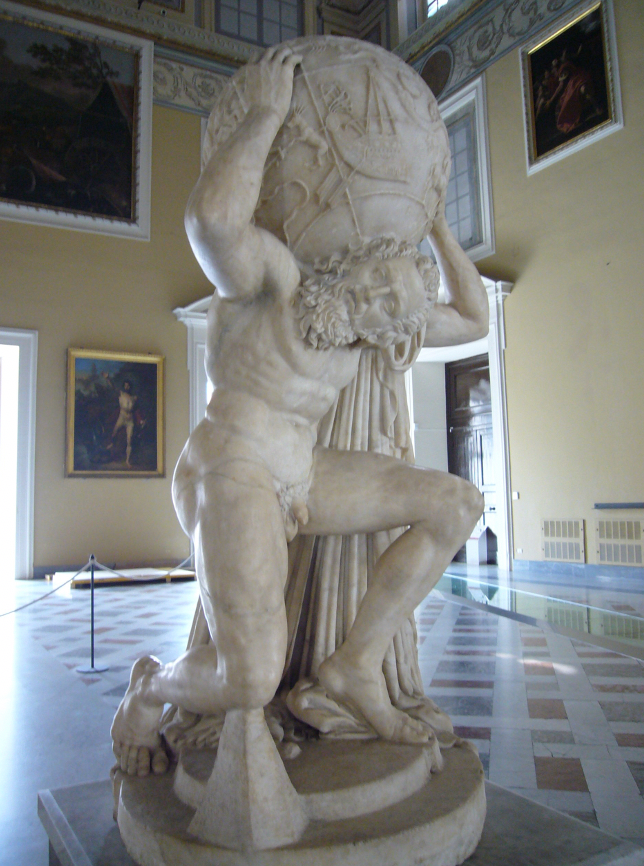
That first bone in the neck is not the only thing named after the Greek god. I’m sure you’ve heard of the word atlas being used to refer to a book of maps. We can thank Flemish cartographer Gerardus Mercator for that. He dedicated his “atlas” specifically to honor the Titan, whom Mercator considered the first great geographer… although they never actually met.
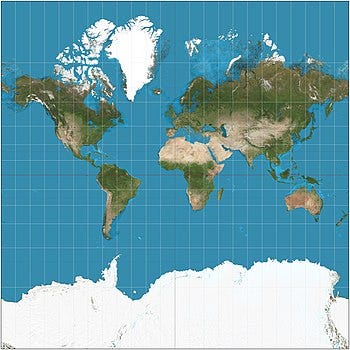
Mercator is best know for taking our round globe and projecting it flatly in such a way that it represented north as up and south as down everywhere while at the same time preserving local directions and shapes. The Mercator projection is still used today, and is the one to blame for making people think that Greenland is larger than Africa.
In popular culture, Atlas is also associated with Ayn Rand, a writer who developed the Objectivist philosophy… and the modern Republican Party, somehow. In 1957 she published her best-known work, a gazillion-page novel called Atlas Shrugged. In it, she compares Atlas holding up the entire world on his back to the capitalist and intellectual class (her heroes), the “modern Atlases” who hold up our world at great expense to themselves.
Oh, boohoo…
You still got the Atlas concept wrong, Ayn! Take that objectively!
Despite its obvious importance in helping you say no (or yes, in Bulgaria), the editors of the Spelling Bee said no to the word odontoid and called it a dord*.
You can check out my previous entry on another dord* here:
*What the heck is a dord, you ask? Here’s the answer:


