
Ocean Acidification and Thank you for the Fish
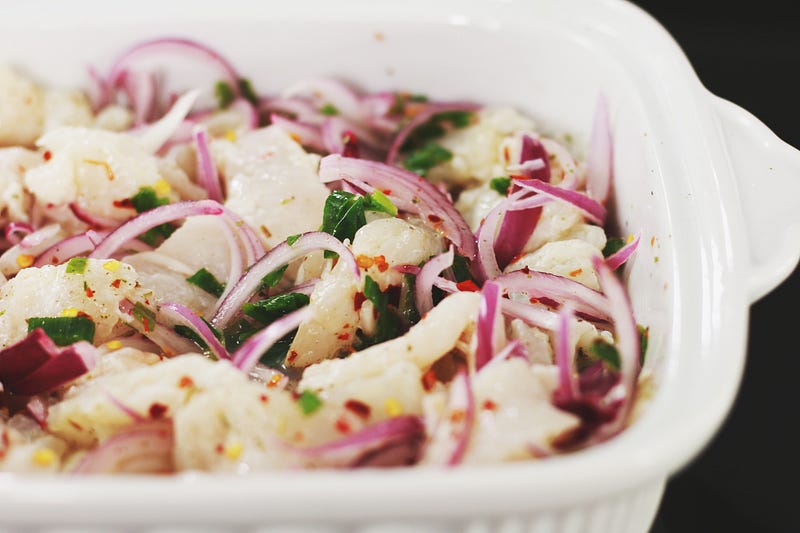
Have you tried the ceviche? It’s a dish made of shrimps, squid, cucumber, tomatoes, etc… This dish is not really cooked because the shrimps and squid are simply put into lemon juice for the acidity to slowly “cook” them. It’s a slow process which can take several hours. This dish is fresh, delicious and perfect on a hot day.
Acidity is powerful and can “cook” fish, but what if the ocean becomes acid? Probably not as acid as lemon juice which has a pH of 2, but more acid than now.
Thanks to the increase of CO2 in the atmosphere and the Henry’s law — stating that a dissolved gas is in equilibrium to its partial pressure in the gas phase — the oceans are becoming more acid. In other words, more CO2 is in the atmosphere and more CO2 is in the ocean, making them more acid.
When the CO2 reacts with H2O, it produces carbonic acid. The latter is directly responsible for the acidification of the ocean.
The change in pH is not impressive. It just moves from 8.3 to 8.2. However, the pH scale we use to measure acidity is logarithmic on base ten which means that a decrease of one in pH equals to a tenfold decrease in acidity. So even if it’s not much on the pH scale, it’s actually much more in the ocean.
Are fishes being cooked by the acidity? Probably not. But this change may have consequences for all the living beings in the sea and also to us humans.
Many organisms in the sea rely on carbonate to live and protect themselves. Carbonate is also the main component of eggshell and chalk. Try to pour vinegar or lemon juice on a chalk or dip a complete egg into those fluids and you will see how fast they are dissolved.
The most famous organism using carbonate as a shelter is the coral. It really looks like a rock. In a more acid ocean, corals will struggle to create carbonate and build their shell. They may disappear and various fish species with them. Thousand of species of fish rely on corals as a nursery for their offspring where they can grow up safely. No more corals, no more fish, no more fish and chips…
Other less famous but very important organisms using carbonate to build shell are the plankton. Have you ever been on the coast of England or Normandy in France? The calcareous cliffs are beautiful! Tall, white and sculpted by centuries of water and wind erosion. Wonderful!
In fact these cliffs are made of very tiny organisms which were living million years ago. These plankton such as coccolithophore, foraminifera, are still existing today. They are abundant in the ocean and compose the base of various food chains. If the plankton community disappears or slightly changes, all the marine food web will be affected.
At the end, it’s probably the beloved fish and chips and delicious ceviche which will have to change its recipe.
Thank you for reading and thank you for the fish.