
Buying Half a Dozen Mangroves
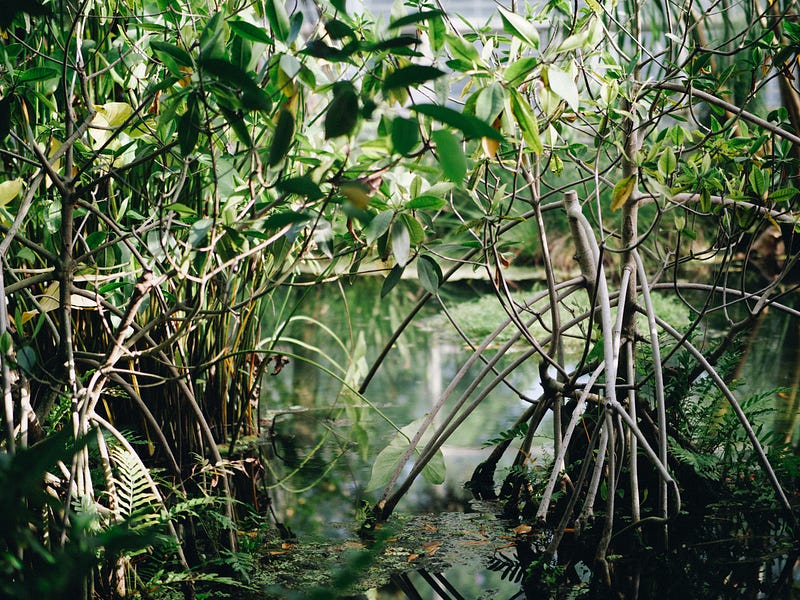
He went down his apartment where a taxi cab was already waiting for him.
“To the Earth market,” he said.
The rich man was not heading to a popular market. He would never mingle with the plebs or listen to the arguments between butchers and fishmongers. Moreover, he was not looking for common goods, but rather scarce and expensive things. There was only one place where he could find what he was looking for.
In 1997, a team of scientists estimated the value of all the services natural ecosystems were providing to human beings. The amount of money gained or saved thanks to Nature was astonishing: 33 trillion US$ per year, twice as much as the global gross national product. The news made a big stir in the media, people started to watch nature differently.
In the subsequent years, hundreds of scientists, ecologists and economists developed the theory further and identified what human beings were earning from nature. In 2005 the Millenium Ecosystem Assessment was published describing the cultural, regulatory and provisioning services provided by the Earth ecosystem. For example, forests were described as filters cleaning water and enriching soils, and biodiversity as a pool of potential drugs.
Few years later, investors saw an opportunity to grow their wealth thanks to Nature. After all if Nature was worth all this money, there should be a way to get a piece of the cake. Wild species and forests were put on the stock market where speculators were able to bet on the disappearance of one species or another. Supporters of this scheme were saying that the economy was finally able to compensate negative externalities and incentivize corporates to conserve biodiversity. Detractors were arguing that nature was priceless and had an intrinsic value, although nobody took them seriously.
In 2020, the threat of climate change started to worry the world. Half the world population had to migrate because of flooding, sea rise and drought. The world was at its worth state: inequalities had changed into war and hunger. Hopefully for the rich man, scientists and engineers found a way to rebuild lost natural ecosystems. There were able to grow forest patches, raise coral reefs and cultivate grasslands. All in an impressively short time. These micro-ecosystems could be sold to any person wealthy enough to buy them. The Earth market was born.
Only the wealthiest human beings were able to reach the Earth market and buy its products. This man was one of them. He has built an island in the middle of the Pacific, isolating himself and his family from the horde of homeless migrants wandering the continent. On his island, he was safe. At least for some time.
The taxi reached its point. The man transferred few bitcoin to the driver before living the cab and walked to the market’s entrance. An attendant greeted him and handed him a tablet.
“Please, have a look to our new products,” she suggested politely “the lift will be ready soon.”
The man browsed quickly on the tablet but handed it back as he got bored, “I’ll see there directly. Are you bringing me to the marine area? I am looking for something precise and I don’t want to waste my time window-shopping.”
“Of course, we know your time is precious,” she said before adding “the lift is ready, please follow me.”
They walked in and the lift went down, after few seconds it stopped and the door opened.
“Please, have a look to our last designed coastal ecosystems,” she said graciously showing the mangrove forests, coral reefs and salt marshes.
After few stepped, she continued “For your sea rising problem, I recommend you the mangroves. They look nice, the tree roots protect the ground from erosion and they prevent the salty water to contaminate freshwater streams. This ecosystem even comes with a pack of biodiversity free of dangerous animals and mosquitoes,” she explained.
The man stopped a moment and looked more closely to the mangrove. This was a large green patch with several species of Avicennia and Rhizophora. The roots were growing upward to get oxygen and the leaves had white spots of salt exudation.
“How strong are these trees?” queried the man, “I want an ecosystem to protect the island from typhoons and bad weather. It has been very violent recently.”
“Of course they are” ensured the lady, “and if any harm happens to the mangrove, we replace the damaged tree patches free of charge.”
Not convinced the man questioned the lady about the coral reefs, “have you found a way to prevent coral bleaching?”
“It was hard but after several breeding, the coral became resistant to temperature rise,” lowering the voice, she continued, “but to be honest with you, we don’t know how hot the climate is going to become, neither how acid the ocean are going to be… We replace any dead or damaged patch though,” she assured him.
The man thought a moment and finally chose, “I’ll take the mangrove.”
“Good choice. Coral reefs would have been very expensive to put on your island since the water is very deep and not a fit for such light demanding animals.”
“Give me half a dozen.”


