
Obsidian for making sense of things
I recently discovered the note-taking app Obsidian! Having used Confluence and Jira for a number of years, I was pretty familiar with the idea of knowledge management. But Obsidian seemed to offer something else. Like those pretty graphs!
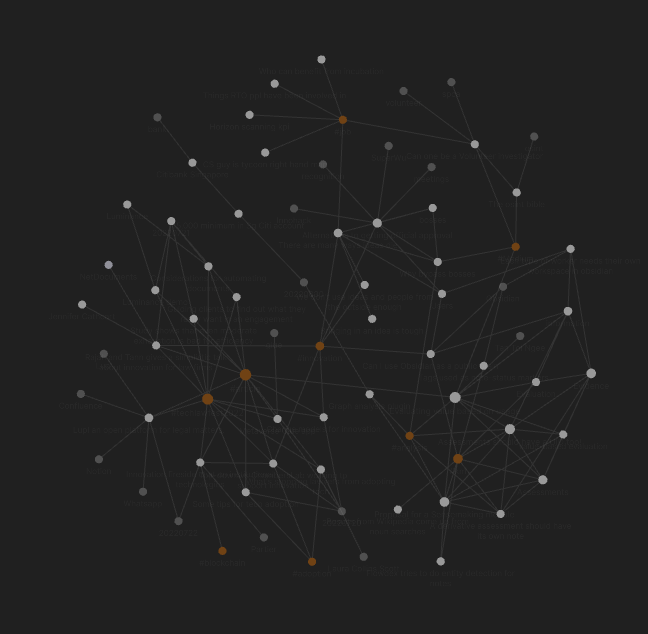
But I steadily got more disappointed when trying to learn how most other people use Obsidian. When you search online, you’ll get many videos showing you how to use Obsidian for:
- Daily note-taking: Obsidian has a core plugin for daily notes, but my brain doesn’t always generate note-worthy insights every day. To note daily trends in Obsidian (like weight, water drunk etc) is possible, but any number of health apps already do that.
- Task management: Yet again, many other apps exist that offer Kanban, task lists and the like. I’d say this isn’t the unique selling point of Obsidian, even though many adopters get sucked into using it for task management.
- Record-keeping of info with clear taxonomies (like PhD notes, D&D Dungeon Master info): This was closer to what I was hoping for when I started exploring Obsidian. But yet again there was a problem — most of those examples assume that you can slice up the world neatly into orthographic chunks and each note can fit into one of those chunks.
That’s not how the world works for me. In my world:
The value of a piece of information changes. Did you have a favourite book that you’ve read many times, and each time you read it, you found new angles to think about? (for me, it’s Frank Herbert’s Dune!) Similarly, the value of a piece of information isn’t always evident at first, and will change over time.
Older information will get lost in the pile. How many note-taking apps or physical journals have you filled out in your life? How often have you gone back to older notes and discovered something valuable? If you’re anything like me, not often.
You will forget where your ideas come from. Was it because of new information? A new way of looking at old information? Or simply just many iterations of refining your original idea? It’s often useful to know just how you came to your best ideas.
I think Obsidian can help with these three points. So here is how I intend to use Obsidian.
I’ll create a new note for information that I think could be useful. They could be whole articles, short messages, anything. I’ll link all the proper nouns (names, dates, companies, countries) I see, and tag these notes #info. The point is to keep these info notes atomic and create links that might help me discover new insights.
I’ll also create a new note for each new idea I have. These will be tagged #idea. Each idea note must refer to an earlier #info note, or #idea note, using the breadcrumbs plugin to designate the parent info or idea. Each idea note should also be as distinct as possible, I will only include the specific new thought that I have in that new note. I will also note down whether an #idea note(s) reflects my current thinking on an issue.
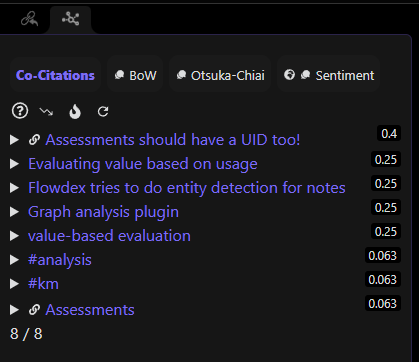
I’ll use the Graph Analysis Plugin to discover hidden links between notes by analysing their structure or the actual words in the notes.
I’ll use the Dataview plugin to automatically generate compilations for the names, dates, companies and so on, that are mentioned in my notes.
In this way, I think I will be able to:
- Discover the most influential pieces of information I have by finding out which info notes have the most child idea notes).
- Understand what info I’ve relied on to come to my current thinking about something by seeing the info notes linked to the series of idea notes that make up my current position.
- Quickly find my current thinking on an issue and being able to review the ideas that I’ve considered but discarded by looking at the idea notes that are and are not part of my current position.
- Understand how my thinking/options have evolved by chronologically sorting idea notes linked by parent-child relationships.
Take a look at the rest of my articles on Obsidian:
- When you should consider switching to Obsidian
- Obsidian’s Graph Analysis plugin
- Using Obsidian’s Graph View for real
- Using Obsidian for group KM
- Obsidian for making sense of things
What do you think? Let me know!


