
Obsessed: Getting Things Done (GTD)
The Mayday Project, Day 60—Organizing Actionable Tasks in Context


The book Getting Things Done: The Art of Stress-Free Productivity by David Allen was first published in 2001 and revised in 2015 for changes in technology. Abbreviated as GTD, this methodology is a way to unclutter the mind, determine what tasks are actionable and focusing on the now rather than worrying about everything that isn’t done.
I briefly discussed my implementation in my article You’ve Gotta Keep ’Em Separated from a few weeks ago. That article has a lot of information on how to implement GTD in your every day life, but this is more of a primer for those who have never heard of the methodology.
I am obsessed with GTD, implementing it in my life, the different ways it can be implemented and how to improve it. In general, the principles are very sound and only working on actionable items based on context is very appealing. Some have criticized this process as too much planning and not enough doing. The ideas around it and reviewing your strategy often can be very useful, even if it’s not implemented formally as described.
The major steps of the Getting Things Done methodology are:
- Capture
- Clarify
- Organize
- Reflect
- Engage
Capture
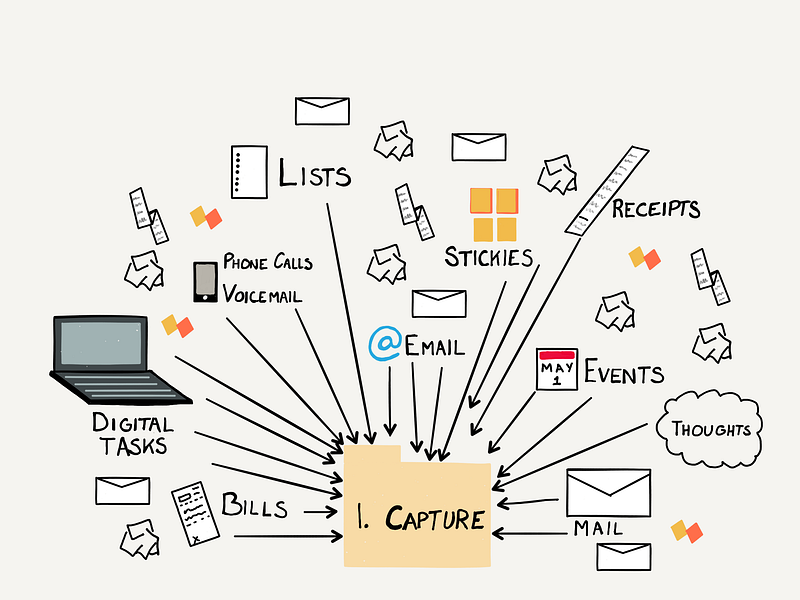
For the first step of the GTD process, you collect everything, and David Allen means everything. Since GTD came out before smart phones, there was still a lot of paper floating around in our lives. This came out one year after I graduated from college and I still had paper address books, calendars and journals. Much has been consolidated into our smart phones, but when capturing, you want to cast a wide net. Think of receipts, sticky notes, bills, papers, articles, books and place them all in a pile. It might be helpful to make a list of all the items in digital calendars, reminders, task managers, emails, etc. to review.
Clarify
This step starts with a simple question: is it actionable? If no, there are three options: throw it away, put it in a someday/maybe folder, put it in a reference folder. Must the task be done by you or is the next action with you? If someone else can do it, consider delegating the task. If the next action is not with you, but someone else, then put it in a Waiting For folder. Next, can it be done in two minutes or less? If yes, then complete the task immediately. If not, these remaining tasks are ready for organization.
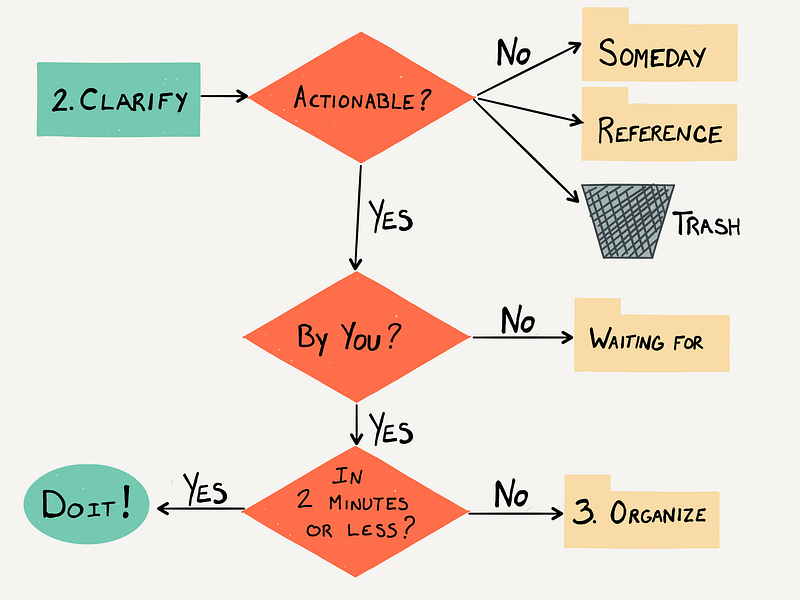
Folder can mean a digital folder or a virtual folder. It’s important to have a reference system for important documents, bills, records and anything to keep, but doesn’t need action. This could include wills, deeds, contracts or even photos, report cards, children’s drawings. Likewise, a reference folder for email can be useful to easily find important emails. A reference folder on your computer is helpful too to sort what is actionable and what isn’t. A powerful tool in the GTD tool box is the someday/maybe folder or the “tickler” file. This is a folder that is reviewed every month to see if any task has now become actionable, more relevant or should be moved to the active folders. Getting this items out of your head and into one space can create mental space and confidence it’s captured.
Organize
Tasks often have time or location based dependencies and by organizing the tasks, it lessens the burden or stress on the activity. The real joy of the GTD process, is only working on actionable tasks and not worrying about the rest. Let’s say you have a project to hang a painting in your living room. It’s important, but not urgent, so you don’t need to rush out and complete it right away. It also has several steps that must be completed in order, and can’t be completed quickly. If you need to go to the store to buy nails, but it’s not a rush, you want to remember this the next time you’re out running errands, but you don’t need to worry about it the rest of the time. Similarly, you can only hang the painting while at home. You don’t need to worry about this task at work, running errands, on vacation, or anywhere other than at home. These are called contexts in GTD and are extremely useful in the organization process. Take all of the tasks to be completed and organize by context. Many contexts are possible, but should be tailored to your individual situation. Maybe you work at home, or you travel for business often, or you make a lot of phone calls from a landline. You might have a “home office” context or “travel” context or “phone” context. Every time you sort these tasks, you remove the overwhelming stress of having to do everything at once. If you just focus on the “office” tasks at the office, you will feel less pressure, a less nagging sensation.
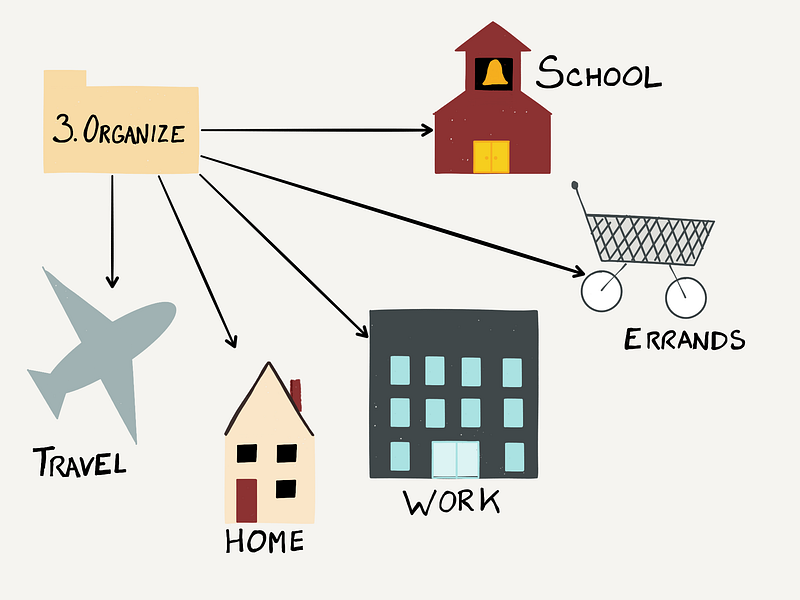
Also, some tasks are time based, like “pick up a birthday cake from the baker at 3:30pm on Wednesday.” Any time based task should be placed on a calendar, paper or electronic, since it can only be done at a certain time, and once the window is gone, it’s gone. By placing all time based tasks on the same calendar or in the same app, it’s easy to see at a glance your day and what can be done.
Since this methodology came out before smart phones, and even before everyone had a cell phone, the lines between contexts and calendars has blurred. Now it’s easier to work from home, do tasks like shopping and paying bills online from anywhere. Still these contexts can be useful to enforce certain habits like not shopping at the office, or only using social media at home. Contexts are powerful and require a lot of thought. Some tweaking may be required to perfect this, but it’s worth the effort.
Reflect
In the forth step, you reflect on your lists and folders and tasks. An important and often ignored step in the GTD methodology is the reflection and review portion, not just on the individual tasks, but on process.
A weekly review, scheduled at the end of the week or beginning of the next, reveals tasks to complete, events to attend and the ability to sort out what is not actionable. In this review, read emails, sort papers, acknowledge calendar events, review the someday, waiting for and tickler folders. Evaluate any projects for next steps and actions. Write down all tasks that come to mind to be completed over the next week.
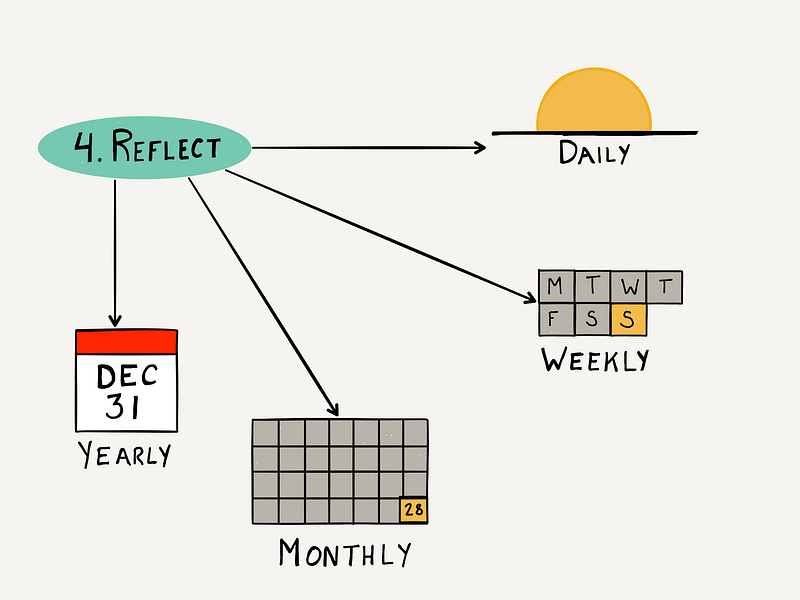
A monthly review is not part of the GTD review process, but has been added by many as an additional review at the end of the month. It makes the most sense to me to combine the monthly and weekly reviews to save time, so if the last of the month is a Wednesday, push the review to the next Sunday or whenever you have your weekly review. At the monthly review, many people review the overall process, what’s working and what isn’t. Is a paper calendar needed by a digital task list or vice versa? Are all of the papers reviewed and processed quickly or what is falling through the cracks? These types of reviews keep honing your practice until it’s quick and efficient.
43 Folders is a site that hasn’t been updated in a number of years, but has some great GTD ideas. The name from the site came from 43 folders for the GTD method, twelve for the months, and thirty-one for the days of the month. In the month of June, the numbered folders would represent a day in June. Anything for future months, would be placed in the other month folders. The idea is that you review the folder that corresponds to the current day. At the end of the month, you take the next month and sort all of the items into the numbered folders for organization.
An annual review is also vital to the practice and this review focuses on the bigger items, like goals one year, two years or five years from now. Taking a step back and looking at the 50,000 foot view can really give you an idea of how far you’ve come and where are you going.
Engage
The final step is to engage, and this is doing the tasks that have been organized. It may seem like you’ve already done so much work, wouldn’t it be easier to just jump to the engage step? Proper reflection will reveal all of the non-actionable emails, tasks that are delegated, items that are time and location sensitive. The purpose of this methodology is not to make doing these tasks easier, but to take these tasks, put them in their proper context or folder and not worry about them until they are actionable. So much time is spent worrying about getting things done, draining energy and time away from doing the real work, so you can enjoy life. With GTD, you can trust the methodology, stress less, and have more time to have fun and get more done.
Summary
This is just scratching the surface of Getting Things Done. I recommend reading David Allen’s book but other resources are available for free like podcasts, blogs, articles and essays. This process is well honed and tried by thousands of people, who have all taken this basic framework and made it work for them. I recommend exploring this process for everyone who feels like they are too busy, have too much to do, or feel like they are always forgetting important tasks and events.▪️
The Mayday Project is a personal, total wellness plan. These essays will track my progress and development of the plan. Please follow for tips, ideas, inspiration and what not to do when you’re changing your life.
If you liked this, please click the 💚to encourage others to read it.
Sign up at Tiny Letter to have This Charming Rant delivered directly to your inbox.


