
Obscure Quirks about This Platform You Might Not Be Familiar with until You Stumble upon Them
Sharing my rookie mistakes, so you don’t make them too.
I’m a content creator. Writing on Medium for over a year and a half. This is a great place to be a writer. Creators can build an audience quickly with quality writing, like I have, with no professional experience, using consistent publishing and staying true to your voice as a writer.
But still,
I’m learning.
Which is a good thing.
Because I get to pass those lessons on to you. So, if you’re new here, you can learn these things faster than I did.
The number one thing you need for success.
Let’s quickly talk about how to be successful here. And it isn’t easy to do — be consistent. The name of the game is quantity plus quality. No one article is more important than the amount of writing you produce, I promise. Your last article will never write your next. Your last viral article won’t make your next viral article easier to write. There isn’t one formula to follow to write a viral piece, and anyone saying there is, is trying to take your money.
You have a higher chance of increasing views and reads if you create a name for yourself in your space. When people see your name while scrolling and that name evokes a feeling of, I like that writer, it makes them stop scrolling and read your work. That is what you want. You get there through writing consistent quality pieces.
The tortoise wins the race. Even on Medium.
What is guaranteed.
Each morning you wake and think about writing, there will be resistance; dishes in the sink to wash, notifications screaming red at you, emails to delete, and ideas to think of. All these things are true if you want to be a writer. Know that all writers, famous and not, face resistance. The successful ones who make a living out of writing have a way to deal with it and it usually includes that dirty word, a “schedule.”
Find yours, the faster you do, the more successful you’ll be.
Now, here are a few things I recently learned about Medium after writing here for a while.
People love to point out typos. And I don’t fix them for a reason.
Readers love to point out typos. The more successful you are here, the more this will happen. I make errors, and thank you, dear readers, for pointing them out.
Here is why I make typos, and I might have to change my system to avoid making so many. I write in Word. I then transfer my work to Grammarly to do a quick spell-check. Then I move it into Medium, format it, and put on the final touches; add links, quotes, bold, italics, numbers, bullets, etc. (all formatting options).
Occasionally I’ll add a sentence or two or rewrite a few sentences or paragraphs that need improvement. I inevitably make a typo.
Here’s the thing, I don’t always fix the typo a reader points out because then Medium deletes the highlights from readers who highlighted that sentence or paragraph with said typo — everybody who highlighted that particular part loses those highlights. Something to be aware of.
I stumbled on this Medium quirk recently. I fixed a word in a paragraph that was a top highlight. Multiple people had highlighted that paragraph, those highlights vanished.
*OH! Sh*t.*
From here on out, I’ll fix the typo right away before a lot of people have a chance to read the piece, or I won’t fix it at all.
I have been on Medium for almost two years, and I just recently figured this out.
But please, don’t stop mentioning my errors. I really do appreciate it.
Highlights are gold to content creators searching for inspiration.
On the topic of highlights: it’s important to pay attention to those highlights that readers like and respond to. This is intel. The sentences/paragraphs that have the most highlights are gold.
Look back at your past articles and pay attention to the top highlights. This is like mining for gold in content you’ve already created. It’s like giving your audience a questionnaire asking what they’d like to read about, and them actually filling it out.
The top highlights can serve you in a lot of ways. It gives you headline ideas for your next article. Those sentences can become tweets. You can elaborate on the most highlighted paragraph or sentence and structure an entire blog post around it. It clearly spoke to people, so use it.
When you come across a top highlight on your post that is valuable data, you hit on something that speaks to many readers, and it might be worthwhile to take a second look at that or use it somewhere else, as in a Twitter thread or a caption to an Instagram post.
The private note feature.
Most people don’t know about the private note feature on Medium’s pop-up editor tool.
When you hit the Medium editor, up pops a black box. To the far right in the black box is a little lock, hit that, and you can send a private message to the writer.
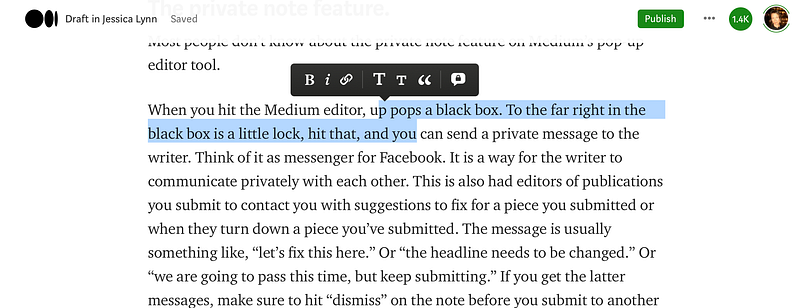
Think of it as messenger for Facebook. It is a way for writers to communicate privately with each other. This took me a while to find.
This is also how editors of publications you submit your work to contact you with suggestions to fix a piece you submitted or when they turn down a piece you’ve submitted.
The message is usually something like, “let’s fix this here,” or “the headline needs to be changed.” Or, “we are going to pass this time, but can’t wait to read your next piece. Please keep sending.”
Dismiss the note before submitting to another publication.
If you get the latter message, “we are going to pass this time, thanks,” make sure to hit “dismiss” on the note before you submit to another publication. That way, the editors of the next publication don’t see the previous notes from the last editor. The note gets dismissed, and no one can see it.
It might not matter if the next editor views the previous notes, but dismissing it doesn’t hurt and probably will help you get into another publication with a fresh start.
Not all writers will see a private note left on one of their posts from a reader.
Don’t take it personally when you leave a note for the writer and the writer doesn’t respond. For me, I just didn’t see it. I usually respond to private notes on Medium, but many of them get missed. I rarely go back and review my old posts, and most of the time, I get so many emails from comments and highlights on my posts, I can’t keep up with them.
Highlights on other people’s stories.
When reading other people’s stories, you will only see the highlights from the writers you follow with their names next to their highlights. You won’t see the highlights of writers you don’t follow. I learned this only recently.
Personally, I never pay attention to this anyway. I follow the writer’s I follow because I love their work. What they highlight isn’t really important to me, but it’s interesting to know. If you are spending a lot of time on Medium as a writer, knowing the platform well to serve your audience is valuable.
I highlight stuff that speaks to me, and so does everyone else. It’s individual.
The “Thanks to…” at the bottom of a post.
Thanks to…
Whenever you ask another writer with a Medium account to edit your article through a draft link, by sharing it with them, they can edit the story by leaving a note next to a highlighted line while the post is still in the draft mode. The writer who helped you edit your story will get a mention at the end of the post. Thanks to…
So readers will see the name of the editor.
Editing a friend’s post is another way to get your name in front of people on Medium.
If you, as the reader, get to the end of a post from a writer you like and follow, it’s logical to think you might pay attention to the writer who helped edit it. It adds to that person’s name recognition, at the very least.
“Shift” + “Enter”
I just learned this from Tim Denning’s Medium course, Medium Bad-Assery.
If you press “shift” + “enter,” you keep two lines together without creating a large space between the two lines. The space is smaller than had you just hit “return.”
I’m really into formatting. I love to format posts. I’m almost giddy when it is time to format. I’m not sure if that is because I know I’m nearly ready to hit “Publish,” or I just like to format things. It’s a bit of both.
Over formatting.
I’ve only realized recently that at the beginning of my Medium journey, I was over formatting.
People come to Medium to read. Keep this in mind. Don’t make the same mistake I did when I began.
Here are some things to avoid:
- Don’t use too many pictures. If you use too many images, it’s not a good reading experience. Images start to look like ads among the text if you use too many. I used to do this because I’m a visual person. I get stuck on Unsplash for hours looking at photography.
- For a post on Medium, use a maximum of two photos. Unless it is a post like this one, where an image makes sense — when the explanation of some thing benefits from an image, like, “here is where you find the private note to communicate with writers. See below image.” All other posts should have no more than two images, and preferably one.
- Less is more when it comes to images. Don’t use a full-screen image in the body of the article. It makes it look like the story is at its end. And you don’t want that, if you want readers to keep reading.
- Don’t use left-aligned images. Medium pros say this. I break this rule all the time. I love left-aligned images and occasionally use them. But it does break up the readability of a post.
- Don’t overuse bold and italics. Use these sparingly. They can get annoying for the reader and make them click away.
- Use the Medium quotation properly. Here is something I wrote on that.
- Don’t add another of your Medium articles right in the middle of a post with just the link. Add the link on a word and not a separate line. It looks too much like an ad, and readers skip right over them anyway. It is a waste and could make the reader click away.
- Credit all images.
- Medium publications like the smallest image (the image second from the left in the Medium editor). I use the largest or medium size, they look best, in my opinion.
Medium is a reading experience, not necessarily a visual one. If you keep that in mind, you will succeed here.
Jessica is a writer, an online entrepreneur, and a recovering type-A personality. She lives in Los Angeles with her extrovert daughter, two dogs, and two cats.