
ONLINE BUSINESS
Now Is the Time to Discuss Order Fulfilment
Will online retail consume offline? If so, what about fulfilment?
COVID-19 caused the global pandemic that led to supply chain disruption at a scale never witnessed before. A once in a lifetime event that brought hardship for offline retailers, but a silver lining too as many pivoted, accelerating their eCommerce channel strategy.
Third-party logistics companies are front line workers that stepped up to keep the gears of commerce turning. They are the silent outsourcing partners that help brands, from startups to established players in the online retailing space, to scale and cope during this pandemic.
This article is about the new oil in the decade ahead — order fulfilment.
What is Order fulfilment?
Order fulfilment is the process of receiving and storing inventory to be sold online to consumers or B2B clients, during which orders are processed and delivered to each customer.
The process starts when a customer places an order and concludes once they receive it by post or courier.
What is the order fulfilment process?
Here’s an overview of the steps involved in order fulfilment:
- Receiving inbound inventory — You send your stock to a fulfilment warehouse
- Storage of inventory — Your stock is stored awaiting online orders
- Order processing — this includes: Pick and pack / Kitting or light assembly of hampers or gift sets
- Shipping — At the carrier station each order is packed and despatched to your customer via an integrated courier partner
- Returns management — Orders are returned to a fulfilment centre location. So if a buyer wants to return a product, a 3PL partner manages the return transaction as well as quality, stock update or disposal
These are the five key order fulfilment steps that ensure same-day fulfilment and outbound shipping to enhance your customer’s experience.
Can order fulfilment companies integrate with my website?
Yes. Any Warehouse Management Software (WMS), order fulfilment technology, is the bridge between your eCommerce platform and a fulfilment partner. Features include:
- Inventory management
- Order management
- Shipping tracking management
- Reporting functionality
Most WMS can integrate with off-the-shelf versions of leading eCommerce platforms such as:
- Shopify
- Shopify Plus
- Magento
- Squarespace
- EKM
- WooCommerce
- BigCommerce
- Linnworks
Other integrations include:
If you choose to outsource, you can integrate from a vast selection of ‘off-the-shelf’ eCommerce platforms, which can be done in a few clicks with no technical experience.
Alternatively, a self-service solution means that you can import your orders through a client portal.
How does the Order fulfilment Goods-in process work?
A unique WMS account is created for every online retailing client. In doing so, your Third-Party-Logistic (3PL) partner can integrate and check-in barcoded products more efficiently, typically within 24–72 hours depending on seasonal demand.
Once your stock is received, a barcode scanner identifies the correct product and storage location. This process ensures a fast, accurate and efficient order fulfilment process going forward once onboarded.
How does the Order fulfilment storage process work?
Each product is allocated a unique location in a 3PL warehouse with fast-moving products stored in easy to access bays and slower-moving goods on pallets or upper levels. The data collected during the goods-in process can automate and optimise space utilization, order picking efficiency in addition to batch tracing.
Also, a WMS customer portal empowers online retailers to view stock, order status and tracking in real-time. The WMS pushes all data to your preferred eCommerce platform, like Shopify, WooCommerce or Magento.
How does the Pick and Pack process work?
The pick and pack process is a vital step in the order fulfilment process.
Every day operatives print out order sheets within minutes of your customer placing an order online. Each order sheet contains the following information:
- Account — Your business and relevant customer shipping address
- Order details — Each product purchased, quantity and variant
- Location — The associated floor, isle and bay number for your products
Experienced 3PL teams with WMS know-how can pick and pack with a 99.9% accuracy. Also, your inventory and order status is automatically updated once each order is picked, validated and shipped.
How does the light assembly / kitting process work?
Many online retailers sell hampers, subscription boxes or gift sets. As such 3PLs pre-assemble complex SKUs — a selection of simple SKUs — to create a new SKU, a bundle.
A scheduled assembly process is planned by 3PLs with online retailing clients to meet seasonal demand, ranging from 200 to 25,000 kits a month. This enhances your value proposition by selling product-bundles at a reduced cost, due to fulfilment efficiencies, enhancing conversion as a result.
How does the Order Fulfilment Shipping process work?
Most 3PLs are integrated with carriers to automate the shipping process.
When you convert a customer, orders are picked and validated, after which the shipping team owns the next step, to pack and despatch via a carrier network. At the shipping station, each order is allocated the most cost-effective and timely shipping service based on your requirements.
A lean 3PL process ensures that 99.9% of orders are shipped the same day, traceable, affordable and fast. A good 3PL service provider can enhance your customer satisfaction, leading to loyalty and repeat online purchases.
How does the returns process work?
Reverse logistics can have an impact on your business. In fact, industry reports indicate that over 90% of online consumers become repeat buyers if returns are easy to do. Returns management is important and looks like this:
- Inbound — Evaluate goods for quality or damage before checking-in
- Evaluate — Restock or quarantine
- Action —Update stock or dispose
Upon receipt, 3PL service providers notify clients about products that are unsuitable for re-sale, mitigating the risk of future returns.
Some brands simply absorb all return costs and credit customers in good faith regardless of the dispute.
What countries can my 3PL partner send my orders?
Anywhere. Global shipping channels are available to all 3PLs.
How much does an Order Fulfilment services cost?
There are five cost points for order fulfilment, as follows:
- Inbound — To check-in, unpack and put-away goods
- Storage — The associated warehousing cost
- Pick and Pack — For fulfilment and/or kitting assembly
- Materials — This includes box, tape, label and filler
- Shipping — Need I say more?
From a budget perspective, each cost point might look like this:
- Inbound — €20 to €30 per pallet
- Storage — €20 to €50 per bay per month depending on storage type
- Pick and Pack — The first pick tends to be €1.20 to €1.40 with each additional pick costing €0.60 to €0.70
- Materials — Can range from €0.25 for an envelope or €0.70 to €1.00 or more for a box
- Shipping — Starting from €4 or €5 for domestic tracked and signed delivery
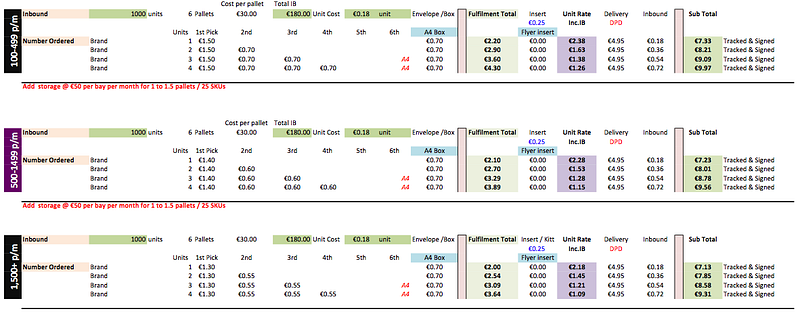
As a rule of thumb, your order fulfilment should look this:
- Domestic — €6 to €8 per order (higher for international)
- Financial — Anywhere between 8%–12% of revenue
While there are various 3PL pricing models out there, they all tend to aggregate between the upper and lower limits above.
Final Thoughts
Ecommerce growth has accelerated more in 2020 than in the previous two decades. Companies are being forced into action by circumstance, especially those who didn’t sell online a year ago. Today every brand is either online or planning to be online soon.
We are facing unprecedented demand.
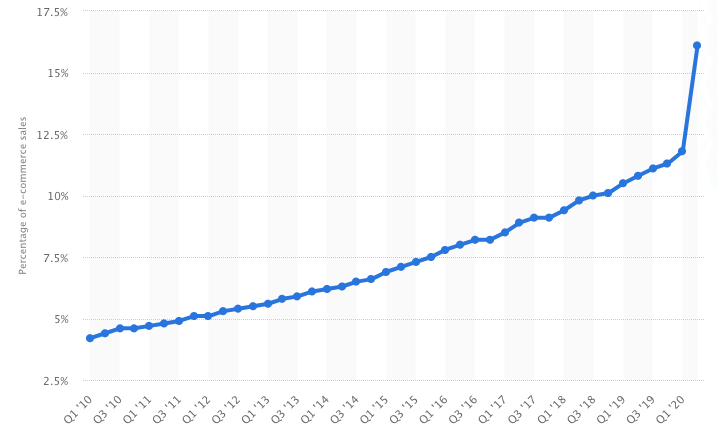
According to Ecommerce360.com, this year “U.S. e-commerce sales will grow 40.3% to reach $839.02 billion in sales.”
Takeaways
Swathes of consumers have switched to online shopping of late, making frequent purchases and spending more per transaction than ever before, compounding the demand for 3PL services.
So to recap, here are 3 takeaways:
№1 — Cost
Order fulfilment cost-points are as follows:
- Inbound
- Storage
- Pick and Pack
- Materials
- Shipping
№2 — Action
There are many drivers for action, but here are 3 to chew on:
- Demand — 3PLs are inundated with enquiries
- Space — Warehouse space is dwindling and costs are rising
- Resources — 3PLs need time to find, train and retain workers; so forward planning is essential
№3 — Insights
My final takeaway is a snapshot into the types of businesses that are turning to online retailing for expansion, or survival. So take note:
- Restaurant — Selling crockery: 300 orders a month
- Craft brewing — Selling beer: 400 orders a month
- Fitness trainer — Selling branded products: 500 orders a month
- Life Coach — Selling diary planners: 2k orders a month
- Entertainment — Selling virtual events (party-kits): 3k orders a month
- Beauty influencers — Selling branded cosmetics: 4k orders a month
As businesses grapple with the new post-pandemic world, eCommerce offers consistency, a channel with 24–7 access to consumers.
The role of 3PL fulfilment partnerships are at the forefront of trade today, but there’s a tipping point ahead, a breaking point rather, when demand outstrips supply. This will happen, and soon.
Warehouse armageddon is on the horizon.
Early 3PL adopters will continue to surf the online retailing wave in 2021, but if you’re planning to sell products online, its time to wax your board!


