
Now And Then #3: Yes
Are Yes still on the Roundabout, or are they Close to the Edge?
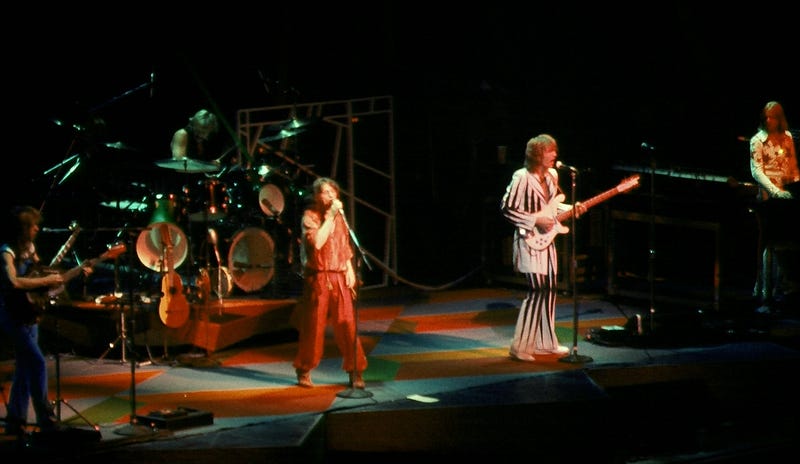

This is #3 in an ongoing series. Check out other part here
There are few bands with such a varied and lengthy history than prog-rock legends — Yes.
Formed in London in 1968–54 years ago, astonishingly — they have featured no less than 19 different musicians in a revolving door line-up that we need an encyclopaedia-length article to map out here.
There aren’t any original members left, albeit guitarist Steve Howe (first joined in 1971) and drummer Alan White (first joined in 1973) have certainly paid their dues with the band.
If you recall Yes from their progressive rock heyday in the 1970s or their smoother, radio-friendly 1980s chart hits, it might surprise you to learn they are still active today.
But the band IS still together — indeed, only the other day I had a Spotify notification telling me they are playing live in York, about 30 miles from my home, in June of this year.
Their latest release is The Quest, released in September 2021 — but for this edition of Then and Now, we will start by scrolling back fifty years to 1971.
These days rock acts will space out album releases — producing an album each year seems beyond most contemporary rock bands.
And we wait MUCH longer than that most of the time.
So it might amaze you to discover that Yes released two full-length albums in the calendar year of 1971.
The unimaginatively titled, The Yes Album, released on February 19th, 1971, was the first to feature Steve Howe after he replaced original guitarist Peter Banks. This was the third album from the band and marked their commercial breakthrough, charting at Number 4 in the UK and Number 40 in the States.
Kicking off with the 10-minute anti-war epic, Yours is no Disgrace, The Yes Album is a confident, even strident album by a band. Shaking off their early attempts to find a direction, it feels like that had hit their straps and settled into their musical sweet spot. Following Steve Howe’s guitar instrumental solo piece, The Clap, side 1 closes out with another lengthy epic destined to be a long-time live favourite. Starship Trooper is a 9-minute journey of constantly changing moods, rhythms, tempos, and styles.
I’ve seen all Good People — another perennial live favourite — starts the second side. Again, we find a dazzling array of key shifts, tempo changes, and different moods. The short, piano-driven Jon Anderson song, A Venture, leads into the last track on the album. Perpetual Change is another epic 9-minute slab of prog rock goodness — all dissonant rhythms and progressive shifts.
Immediately following the release, Yes embarked on a lengthy tour — firstly in the UK and Europe and then over to the States, where they supported Jethro Tull.
During this tour, friction arose with keyboard player Tony Kaye and the band replaced him with Rick Wakeman by the time the band went back into the studio in August. By the end of November, the band had composed, recorded, mixed, and released their fourth album, Fragile, an astonishing rate of work.
Yes had evolved into their most potent and creative lineup — the classically-trained Wakeman adding textures and style way beyond those offered by the limited Kaye.
Having said that, Fragile is a curate’s egg. Only Atlantic Records could answer the question of why Yes needed to produce a second album within 10 months — especially when they had only recently taken on a brand new keyboard player.
But, for whatever reason, the band had to work at breakneck speed to get the album in the can.
The result is four group compositions together with five shorter pieces written by individual members of the band. Looking back, some of the individual pieces are for curiosity value only, but the band compositions are exceptional.
Roundabout opens up the album — the full version clocking in at over 8 minutes, although a 3 minute 27-second edit was later to reach Number 13 in the Billboard charts. After two of the shorter individual tracks, the sound of howling wind and a thunder-strike heralds the heavier, riff-dominated South side of the sky.
The second side features the Chris Squire-dominated Long Distance Runaround, together with the wonderful Heart of the Sunrise, replete with multiple time signature shifts and plaintive Anderson vocals.
Yes produced two classic prog albums in 1971 — but both came in at less than 40 minutes, and both had throwaway tracks better suited to a bonus disk or extended edition. If the record company had been less greedy, one could rejig these two albums into one album of around one hour that would absolutely stand up as one of THE great albums of all time.
The band continued their hectic recording schedule, producing Close to Edge in 1972, the double-album Tales from the Topographic Oceans in 1973 — before tensions surfaced within the band and Wakeman departed for the first time. This heralded a period of changes in personnel and the shift away from progressive rock to a more AOR/pop sound.
Fast forward to 2020 and we find the current lineup of the band exchanging ideas for new material over the internet during the lockdown. These snippets provided the raw material for the writing of the band’s 23rd album, The Quest, released in October 2021 — almost exactly 50 years on from the release of Fragile.
The current line-up still features Howe on guitar and White on drums. Billy Sherwood replaced Chris Squire on bass after the latter’s death in 2015, and ex-Asia member Geoff Downes occupies the keyboard seat. Completing the lineup is Jon Davison, formerly the lead singer in Glass Hammer, often perceived as Yes-imitators. Davidson’s similarity to Jon Anderson made him an obvious choice for the vocalist slot.
Dissatisfied with previous producers, Steve Howe put himself forward as the producer for this recording — an offer accepted by the band, and the album went on to garner positive reviews for the production.
So can Yes still cut it after all these years?
Well, yes — and no.
Anyone wanting the band to recapture the raw, naked genius of the 1971 era is most likely going to end up disappointed.
But then we are talking about guys in the twilight of their careers. Steve Howe is 74 years old, for heaven’s sake.
What I can confirm is that The Quest — with its signature Roger Dean cover — is miles ahead of their 2014 album Heaven or Earth or 2011 release Fly from here. Opinions will vary, of course, but this might just be their best material since the 1980s.
Again, as with Styx, who we looked at in the first part of this series, the enforced break from the constant touring schedule appears to have engendered a burst of creative songwriting not seen for many years.
The album kicks off with The Ice Bridge, a 7-minute 3-section song that harks back right to the classic era. Dare to Know follows up with its 80s feel vocal harmonies and keyboards.
It’s a great start and even though the quality of the songwriting slightly tails off as the album progresses, there is still much to enjoy here. Music to my ears is a particular favourite of mine — a lovely mid-tempo song with soaring vocals and keyboard runs.
It’s refreshing to see that Yes has charted their own unique way forward. Those who gave up on Yes after the underwhelming mess that was Heaven & Earth should give them another chance.
Long-time fans should know that Steve Howe grabbing hold of the production controls returns the band to a more muscular and traditional Yes sound — a welcome shift in tone at this late stage of their career.
And whilst you should not expect the classic Yes of 50 years ago, this is something much more than ‘good enough’. Sharp melodies, progressive overtones, and impeccable production values all hang together in an impressive balance on The Quest.
If Yes comes your way in these sunset years of the band, I’d recommend grabbing tickets.
I know I will when they come my way in June.
Medium is an amazing platform for writers. For a small monthly fee you can read unlimited articles each month as well as write your own. If you decide to join, would you please do so via my link?
It won’t cost you anything extra and I earn a small commission which helps support me and encourages my writing.
Come find me on Medium and find out a bit more about me
Want to fuel my writing by indulging my coffee habit? Consider buying me a Mocha on the Ko-Fi app. Thanks for reading!