
“Nothing is more sad than the death of an illusion.”
The Ghost in Modern Machines: Exploring Arthur Koestler’s Influence on Artificial Intelligence
Arthur Koestler lived a life of drama. He sought meaning in movements like Zionism and Communism, only to become disillusioned. His book “The Ghost in the Machine” examines the conflict between our rational brains and primal urges.
Reading it today reveals clues to issues with modern artificial intelligence.
Recapture Lost Moments: Invoke the New Method
“The Ghost in the Machine” is a 1967 book by Arthur Koestler that explores philosophical psychology. The title is derived from a phrase coined by Oxford philosopher Gilbert Ryle to describe the Cartesian dualist account of the mind-body relationship. Koestler, like Ryle, rejects the idea that the mind of a person is an independent non-material entity temporarily inhabiting and governing the body.
Koestler saw the mind as an uneasy blend of new and old. Our rational neocortex struggles to control more ancient structures like the limbic system. He compared this to a modern jet carrying the ghost of an old biplane within it.
One of the central concepts in the book is the idea that as the human triune brain has evolved, it has retained and built upon earlier, more primitive brain structures. These primitive layers, referred to as the “ghost in the machine,” have the potential for conflict due to poor, inadequate connections. Koestler argues that these structures can overpower rational logic, leading to emotions such as hate and anger.
The “ghost” represents aggressive, illogical tendencies that defy our higher reason. Koestler felt these forces caused much human suffering. His own life illustrated how smart people can be misled by ideology and emotion.
Now, it seems Koestler’s ghost has found a new home — in AI. Systems like deep learning neural networks act with almost human intelligence. But their alien reasoning contains potential for unexpected errors.
The Potential Perils of Unchecked Artificial Intelligence
AI algorithms have their own “ghosts” — biases from training data reflecting outdated assumptions. An AI could repeat those biases even if humans wouldn’t. The excitement around AI has fueled an illusion that technology will solve everything.
But Koestler’s work suggests a more cautious view. Ghosts of the past lurk in present machines. Our irrational urges can corrupt even good intentions for progress.
The Sadness of Lost Illusions: A Lesson for the AI Era
By admitting this, we can build tech aligned with human values. Koestler would likely be fascinated yet wary of today’s thinking machines. Nothing is sadder than losing an illusion, except forgetting it was ever there. As Koestler showed, clear vision reveals wisdom’s path.
A Tragic End: Arthur Koestler’s Stance on Euthanasia and His Final Act
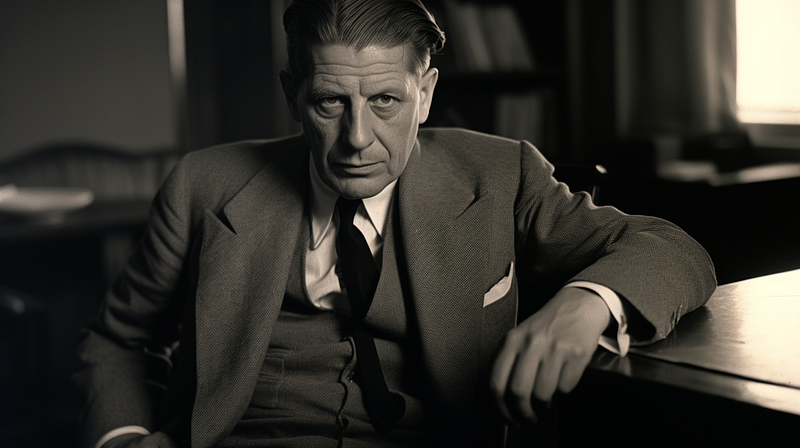
Arthur Koestler, born September 5, 1905, in Budapest, was a renowned novelist and journalist who documented many of the 20th century’s major events. His early life was marked by affluence, education, and a strong connection to Zionism. During his career, Koestler wrote for major newspapers, joined the Communist Party, covered the Spanish civil war, and faced imprisonment. His experiences often informed his writing, with his most famous novel being “Darkness at Noon” (1941), critiquing Soviet Communism. Later, his interests shifted from politics to science and mysticism, with works like “The Ghost in the Machine” (1967) and “The Lotus and the Robot” (1960). In “The Thirteenth Tribe” (1976), he controversially claimed Ashkenazi Jews descended from the Khazars, not ancient Israelites, but this theory was discredited. Diagnosed with Parkinson’s and leukemia, he advocated for euthanasia, eventually taking his life in a suicide pact with his wife, Cynthia, on March 1, 1983.