
Dear White People:
Racial Discomfort is Not a Permanent Residence
Discomfort with discussions of race relations is a stage to pass across, not a fixed point to stay in
Talking to White Fragility
Recently I’ve had an interesting conversation with a fellow about white privilege. As a white man, he had a strong response to the phenomenon’s name, “white privilege,” and insisted that folks should change the name. He had a long argument in an attempt to have me agree with removing the white part from its name.
In most cases, I don’t even bother with white supremacy defenders in the comment section. I figured this guy was different, though. Different, as in, not exactly a troll. Intellectually honest in his discomfort. So I gave him my time.
Talking to this man gave me an epiphany because it was bizarre to see a fellow, presumably a grown-ass man, argue so hard on feelings. His argument was an argument on feelings (appeal to emotion) based on the fact that he figured that white people’s feelings (emotions) would get in the way if one were to continue to call white privilege “white privilege.”
One of the parts that I missed when I wrote my piece on white privilege is its definition or essence. In short, let’s put it like this: white privilege is the examination of how whites benefit from white supremacist power dynamics, social norms, and institutions. As racism is the examination of how white supremacist power dynamics harm non-whites, social norms, and institutions. The observation of racism has existed for nearly over a century; the analysis of white privilege — how whites benefit from racism — is a notably younger study.
White privilege is the examination of how whites benefit from white supremacist power dynamics, social norms and institutions.
With all this being said, I can see why the white racial discomfort (i.e., white privilege or white flammability) shows up and how it is a more significant issue when white privilege is mentioned. For starters, it’s a younger study and analysis. People have observed and documented racism — how non-whites are harmed — for a very long time. It’s only been since the 1990s when white privilege — how whites BENEFIT from racism — has been documented. More profound studies on white privilege are being investigated (via the scientific method) and registered as we speak. Being a younger study, folks are not used to the conversation on it. We always talk about who white supremacy harms, but never who benefits. Not until now.
Only recently have theorists begun to speculate about the harmful consequences of racism on the perpetuators of racism, which include the absence of a positive white racial identity. ~ “4 / Toward a Model of White Racial Identity Development.” Black and White Racial Identity: Theory, Research, and Practice, by Janet E. Helms, Praeger, 1993, p. 50.
Second is the fact that it’s easier to talk about nonwhites being systemically harmed by racism than it is to talk about white privilege. A white person can infinitely deflect when racism — the harm inflicted upon nonwhites — is the topic. White folks can (and do) go:
“I didn’t do it.”
“I never owned slaves.”
“I have a Black friend!”
White people cannot exactly deflect when white privilege is the topic because instead of examining the harm inflicted upon Black people, for example, the discussion requires self-reflectance on their part as white people on how they benefit from white supremacist institutions, behaviors, governmental protocol, and social norms. You don’t have to commit direct action of harm; you don’t have to own slaves. All you have to do is exist within thoroughly white supremacist institutions/social norms, and you have white privilege.
“Exist? All I have to do is exist!? This sounds like racism against white people!”
And I sound like a freaking New Yorker with my strange, 20-year military career-made far-away-from-home, region-conglomerate dialect. Still, I’m definitely not a New Yorker despite sometimes sounding like one. In the same way I may sound like a New Yorker but not, observation of your white existence within white supremacist power structures is not racist. The part you do not understand is the white supremacy and white supremacist institutions/social norms.
J.M. Jones (1972, 1981) has identified three types of racism: (a) individual, that is, personal attitudes, beliefs, and behaviors designed to convince oneself of the superiority of whites and the inferiority of non-white racial groups; (b) institutional, meaning social policies, laws, and regulations whose purpose is to maintain the economic and social advantages of whites over non-whites; and cultural, that is, societal beliefs and customs that promote the assumption that the products of white culture (e.g., language, traditions, appearance) are superior to those of non-white cultures. ~ “4 / Toward a Model of White Racial Identity Development.” Black and White Racial Identity: Theory, Research, and Practice, by Janet E. Helms, Praeger, 1993, pp. 49–50.
White supremacy, is NOT a person. White supremacy is NOT “white people.” So — white folk — please stop conflating white supremacy with white people when grown folks are talking. Would you mind stopping acting like you as a person are critiqued when white supremacy is the thing that’s being critiqued? When you act like you see yourself when we talk about white supremacy and act out as if we are talking about you as a single person, you say more than what you think you’re saying. In the South they say, “A hit dog hollers,” meaning that you’re only crying because, in this case, you actually identify with white supremacy and cultures of racism more than you think. Stop doing that; stop telling on yourself.
White supremacy, is NOT a person. White supremacy, is NOT “white people.” So — white folk — please stop conflating white supremacy with white people when grown folks are talking.
You see, when it comes to white privilege, your white discomfort stems from the notion that your white skin is the subject; It is not. When it comes to white privilege, your skin color is not the subject; white supremacy — white supremacist institutions and social norms — IS the subject, not white people or white persons.
Sure, your behavior can be nested in white privilege (and it often is). But that’s not you as a person or your skin color, that’s your BEHAVIOR that’s being observed. Do you follow? Sure you don’t want to, that racial discomfort is kicking in, I know, I know. Take a smoke break or have a soda.
White Racial Discomfort = Wall of your White Privilege
Terry (1981) commented, “To be white in America is to not have to think about it. Except for hardcore racial supremacists, the meaning of being white is having the choice of attending or ignoring one’s own whiteness” (p. 120) ~ “4 / Toward a Model of White Racial Identity Development.” Black and White Racial Identity: Theory, Research, and Practice, by Janet E. Helms, Praeger, 1993, p. 50.
Your racial discomfort is the walls of your white privilege being banged on, shattered, being circumvented. In short, you by way of white privilege:
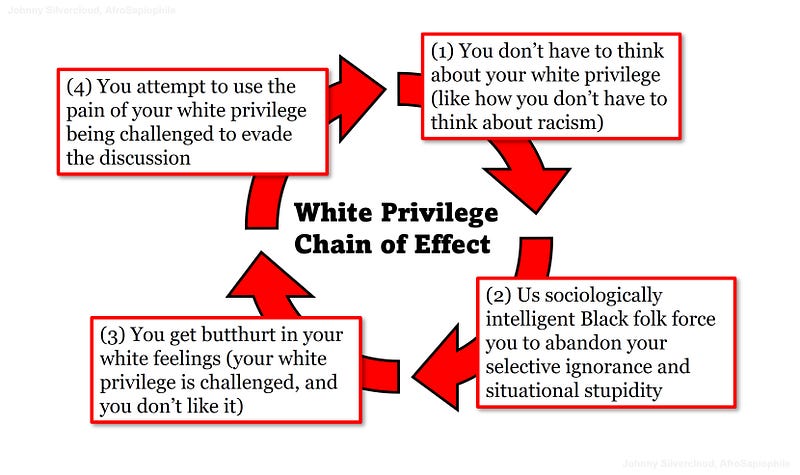
This graphic, is pretty much it. On the fourth step, all of you do many things, and the behaviors, actions, decisions, and all will vary, but the goal is common: duck and dodge the conversation on race relations (e.g., racism and white privilege). You don’t want an honest discussion on racism. You don’t want to hear our stories and experiences. You don’t want athletes shining a light on our experiences either, and I got it.
But you really don’t want to talk about white privilege. If I were to make an assessment, I’d argue that you hate talking about white privilege more than you hate the person (that’s Black persons) leading the conversation on civil rights and social justice as a whole.
I think y’all white folks hate talking about white privilege more than you hate talking about racism.
Looking at your Argument
When this fellow kept talking as if he talked for all white people, I kept reminding him that there are far too many white people who get it and move on. There’s just too many white people who understand white privilege now to make an emotion-based, “coddle white fragility” argument against names of terms and other semantic nonsense. This isn’t the 1960’s; despite your attempts to time travel there via 45th presidential votes and a coup attempt. Sure there’s not enough white folk who understand this in the grand scheme of things, but too many for the “please dance around white feelings” argument. Too many white people get it and move on. You should join them, listen to them on how they made that journey because, for starters, they were also in the position you are currently trying to hold down.
Which brings me to the crux of this lecture: white folk’s racial discomfort is a stage to pass through, not a permanent position to hold.
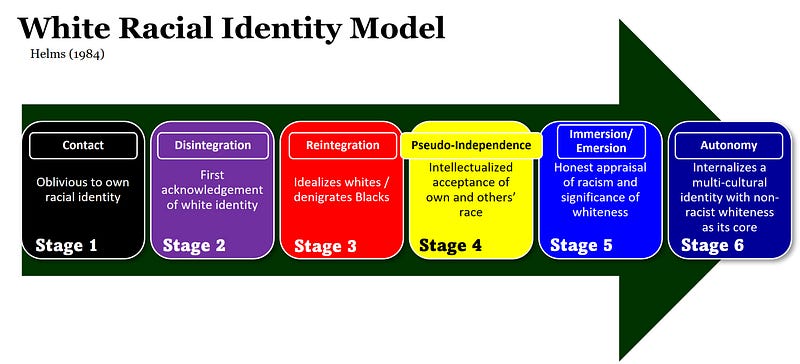
There’s definitely a lot to these studies and findings, and I recommend that you read the books and other peer-reviewed American Psychological Association documents. For the most part, what I want to focus on is that your white racial discomfort is not a permanent residence from which you demand all Black people (or anyone else) to conform to your feelings on the topic of racism, white privilege, white supremacy. It is a white privilege flex in and of itself to even have the temerity to even try to bank a conversation which is already difficult, off of the feelings of the privileged power-group.
So no, the name of white privilege isn’t changing, and yes we are going to still examine and observe this socio-political phenomenon and seek to dismantle it. Yes, we are still going to talk about it, as it exists, and yes you are invited to that table. Let’s take another look:
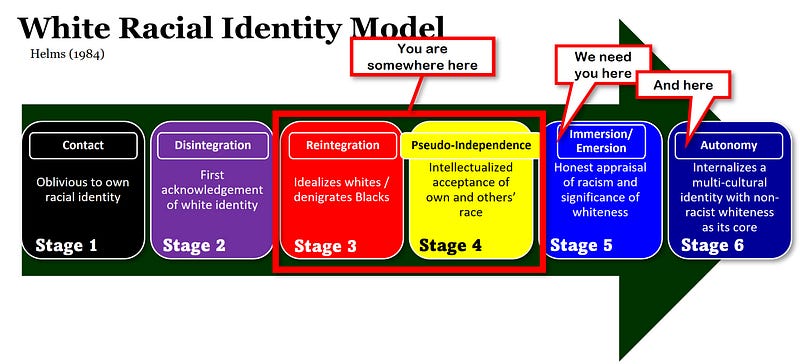
If you want the long form, you can read the books; that’s what referencing and citations are for. Long story short, you (white supremacy defenders, white privilege deniers) are somewhere between stage 3 (the very explicitly racist stage) and stage 4 (the passive-aggressive implicitly racist stage). We need you to move the fuck on. We need you to move the fuck forward. Not backward, not stationary, but forward. We need that nakedly honest self-reflection to kick in.
White folk’s racial discomfort is a stage, not a permanent position to hold.
Because I know these things already (and you don’t) telling me all about white rage doesn’t move me. Your white rage is a stage to pass through, not a permanent position to defend. Your (or other folks) white rage isn’t a valid position, therefore your appeal to emotion argument against honest discussions on white privilege are invalid.
Looking at the fact that I know you and your white rage exists on a spectrum of stages and you don’t, fascinates me. Because I know your argument is not a valid fixed, permanent position (as feelings are seldom permanent) I and my word occupy a different temporal space than yours. In understanding stages of racial identity and attitudes while you argue your discomforted feelings in the moment, I see you for where you can be, while you only see yourself as where you currently are. I can see a better, future you while you only can see yourself butthurt over shit in the now.
Your anger, frustration and discomfort on discussions on race is merely a temporary condition.
Your argument to appeal to white rage on this topic is technically horrendously racist to white people because it requires the underlying premise of a threshold or limit to white folk’s empathy and understanding of non-white people. As if it’s impossible for a white person to understand and empathize with non-whites and self-reflect on their own privilege in America. This argument of appealing to white rage is bonkers.
This discussion cannot happen without you and at the same time you need to know if you are invited at this table to examine these things, you don’t get to check out the door just because you are uncomfortable. If a black person can navigate life with your police having a license to kill us even when no crime is committed, then you can sit your ass down at the table here and listen with open, intellectually honest engagement on the topic of white privilege.
Johnny Silvercloud is a U.S. Army vet turned civil rights/conflict photographer and anti-racism/sexism writer. Not a fan of intentional stupidity or passive-aggressive racism supporters, which tends to overlap. You can subscribe to Johnny here, and get his street photography, here. Twitter, here. Instagram, here. Facebook fan page, here. His publication of like-minded educational activists, here