
It’s not White Fragility, it’s White Flammability
Synonyms for flammable: combustible, incendiary, unstable, ignitable
On the morning of November 15, 2015, white Minneapolis police officers Mark Ringgenberg and Jason Schwartze shot to death Jamar Clark, an unarmed Black man they had on the ground.
On March 30, 2016, Hennepin County Attorney Mike Freeman, a white man, announced he would not bring charges against the officers.
My fourth book, an anthology of sixteen essays by Native writers and writers of color on racism in Minnesota, would come out two weeks after. In the introduction to A Good Time for the Truth: Race in Minnesota (Minnesota Historical Society Press, April 2016) I recommend that white people look up and read Robin Di Angelo’s work on white fragility. Her book White Fragility: Why It’s So Hard for White People to Talk About Racism wouldn’t come out for more than two years, on June 26, 2018.
I read her book when it came out, and appreciated it, and hope it’s helpful to the millions (?) of white (and non-white) people who have made it a New York Times bestseller.
I’ve been thinking about her term “white fragility” since I read it in an article by her, probably in 2015. It’s never sat comfortably for me and I haven’t used it much.
Yes, most white people’s egos, their senses of themselves as deserving — having earned — everything they have or their ancestors had, are extremely fragile when accused of even the minutest act of racism, or even receiving benefits gotten through direct or indirect exploitation of non-white people.
But is “white fragility” the best term?
As it’s become more and more popular, especially with white women, I wanted to spend more time pondering it.
Whiteness itself anything but fragile.
Whiteness is an extremely durable substance. An ideology. A set of practices and policies across all sectors of American society, ever adapting to each and every attempt at equality and justice made by non-white people.
Whiteness is a force.
Simone Weil wrote a long essay, published in 1939, titled “The Iliad, or The Poem of Force" (L'Iliade ou le poème de la force). It is about the nature of force as it pertains to human affairs, as examined through the ancient epic about the Trojan war.
When I think about whiteness, about the power white people, even one white person has over me, I think about force, “strength or energy as an attribute of physical action or movement.” How throughout my life in America, it has almost always been a white person, surrounded by white peers, who reported to another white person, who reported to another white person, etc. who has held power over me, over the progression of my ballet, art, piano, swimming lessons as a child, over the nature of my worship at the Roman Catholic church tradition in which I was raised, over my academic career, over my athletic involvement, over my participation in chorus and choirs, over my college admission, over all my jobs except one (and there have been so many), over the courts of law, over the legislation affecting my fate, etc. etc. etc.
Those with physical proximity to me have been both men and women. Those with the ability to determine in some manner my movement around the country and globe are white. Mostly white men. Those with institutional authority. “Hard” power. Force. Invisible as wind. You can only see what the wind is blowing around, what a tornado is carrying and destroying. Force is invisible. It’s a law of physics, not a thing. Even a gun is a just a maker of movement. The bullet kills because it’s moving, not when it’s inert.
I think of the scene in Steve McQueen’s 12 Years a Slave when Edwin Epps is forcing his slaves to dance inside his house. May Epps’ jealous wife loses her temper in a fit of enraged jealousy at the attention Epps pays to Patsey, and she grabs a glass and throws it into Patsey’s face. Of course, despite her beautiful brown skin, and Mary’s pale skin of a body fed by slaves and made possible by slaves, and white dresses bought for with the labor and blood and suffering and death of slaves, in her white house, no doubt built by slaves and kept upright and functioning by slaves, it is Patsey, the “dark” one, who is innocent. (I have a feminist reading of the film that is for another post.) The film makes that abundantly clear.
Yet ask any woman of color who works at a mostly-white office, perhaps especially at a non-profit possibly filled with its own self-righteousness and savior mentality if any of her white women colleagues would see herself in Mary Epps, and whether any of her white male colleagues would see himself in Edwin Epps.
Glass is fragile. It’s actually a very slow liquid, but it breaks, and it breaks into sharp pieces, and it cuts flesh, and it can kill a person.
Of all the countless encounters I’ve had with white fragility, I may have thought, no matter what I say, this white person is going to react with anger and accusations and exclamations of their own innocence and my wrongness for attacking them, and nothing good will come of it. I never thought, this white person is fragile, this white person’s whiteness is fragile, or even this white person’s idea of themselves is fragile.
I thought, and felt in my body, this white person is dangerous. Because they don’t know they’re white. They don’t know they are not an individual. They think they’re an original. They think what they’re about to say is something they came up with, that came to them as a person, not as a white person. They are living a script, they are in a play, and I am caught in it with them.
In the past year or two I’ve come to think of “flammability” as a replacement for fragility. As a poet I was looking to keep the basic sound and structure of the word. I also have had a minor lifelong obsession with the fact that flammable and inflammable mean the same thing: easily set on fire.
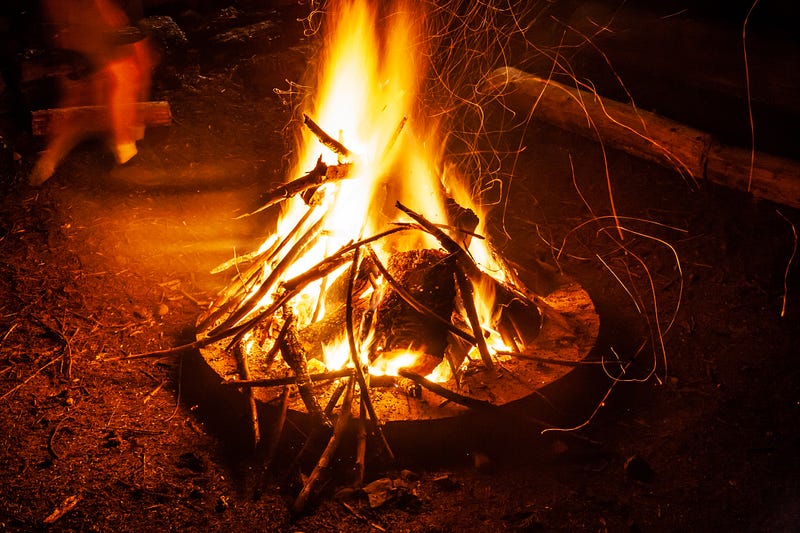
White people’s anger, however, is not lit from without. It is not truly non-white people or conversation throwing a lit match onto a gasoline soaked pile of kindling. The fire is already there, dormant, waiting to catch info flames at the slightest provocation. It’s a danger that carries the means of destruction within itself — centuries of racist programming. White supremacist programming.
White supremacy is violence and like a virus, it needs hosts to carry out its programming. It needs bodies and minds and hands and most importantly imaginations to continue its force.
It behaves almost elementally because this country could not exist without it. And all the people who are white people in it would be something else.
White flammability. Often there is nothing non-white people can do to prevent being burned, too often to death. It seems like no matter what we do, whiteness just needs oxygen to catch fire.