
Noria
The wheel on the river goes round and round

Today’s New York Times Spelling Bee letters:
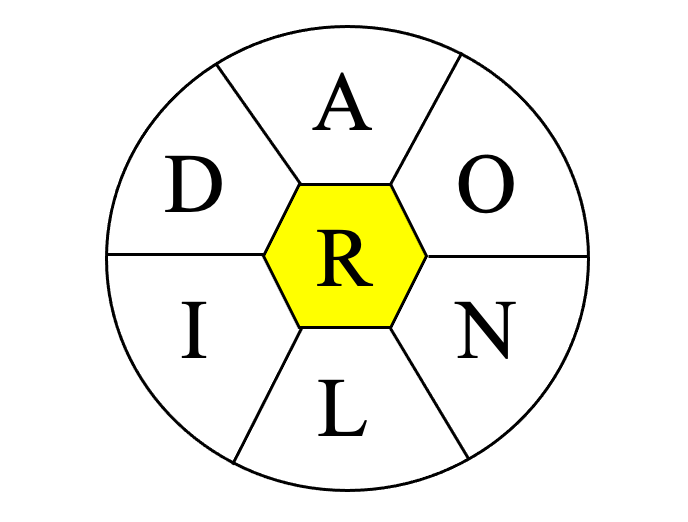
A, D, I, L, N, O, and center R (all words must include R)
Merriam-Webster says…
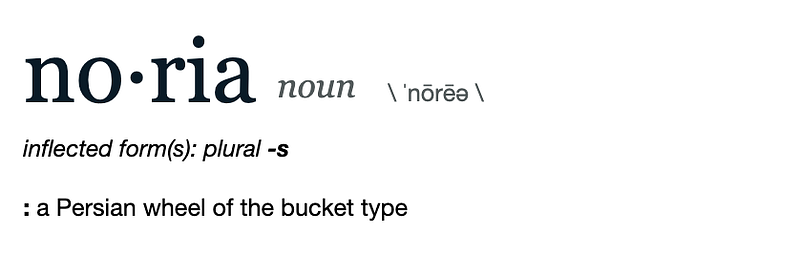
Silly little dictionary! Don’t you know that noria can’t possibly be a word if The New York Times says it ain’t?
For a complete list of rejected words, check out the Spelling Bee Master.
What’s your favorite dord* from today’s puzzle?
My Two Cents
Those of us who speak more than language or work as translators and interpreters are aware that there are many words that are sound similar and have the same meaning across different languages. Such words are usually known as cognates, although technically-speaking the term refers to words in different languages that share a common etymological root, whether or not they sound alike or mean the same thing today.
English was originally a West Germanic belonging to the Indo-European family, and it developed in what is today England over the course of the early Middle Ages (5th to 11th centuries) but was heavily influenced by the invasion of the Normans, who brought with them French and Latin-derived vocabulary. This explains why today many words in French and other romance languages (Spanish, Portuguese, Italian, and even Romanian) may sound familiar to English speakers.
Some “perfect cognates” in English and Spanish are actor, canal, factor, mental, ritual, and vulnerable, although their pronunciation is not the same in both languages. For example, factor in English is stressed on the first syllable, while in Spanish the stress goes on the second one.
Then there are false cognates and false friends. The former term refers to words that do sound similar and have the same meaning, but by coincidence. That’s because they don’t share the same origin. For example, English much (from the Latin magnus via a convoluted pathway involving Old Norse, Old High German, and Middle English) and Spanish mucho (almost directly from the Latin multus).
False friends, on the other hand, are words that sound the same and may even have a common etymological root, but don’t share the same meaning. The typical example given to English speakers who are starting to learn Spanish is the word embarazada, which sounds like “embarrassed”, but means “pregnant”. Which is true… except that there is a less commonly-used meaning in Spanish which is very similar to the English embarrassed. Still, I don’t recommend you go around telling people you’re embarazado or embarazada if you’re feeling ashamed about something. Unless you’re ashamed of being pregnant (but why should you?), in which case the Spanish word is fulfilling double-duty.
If you’re thinking that this introductory explanation must be connected to our word of the day (noria, in case you already forgot), you are very correct, and should not feel embarazado about making that assumption.
What’s interesting is that noria in Spanish has three meanings, only one of which is shared with English. So it’s both a cognate and a false friend.
In English
Our friends at Merriam-Webster tell su that noria is borrowed from the Spanish, itself from the Arabic nāʽūrah, from the verb “groan” or “grunt”, in reference to the sound the machine makes while turning.
In simple terms, a noria is a waterwheel that is undershot (moved by a current underneath it) whose primary function is helping transport water, as opposed to providing mechanical power or converting the hydropower into other types of energy. The noria scoops water, usually to an aqueduct, for crop irrigation or to provide cities and towns with the vital liquid. The way norias are designed allows for the buckets to receive water as they go into the current and dump it on the way back.
If you follow the buckets in the video below, you’ll notice that as the enter the water at the bottom of the wheel they in position to be filled, while the same position allows the water to pour out into the trough when they reach the top of the wheel.
According to experts, the oldest archeological evidence of norias has been found in Eygpt, where they may have been first used as far back as the 4th century B.C. A couple of centuries later they were already being used in Greece, and Roman architect Vitruvius (1st century BC) is known to have described their use.
Muslim engineers adopted and improved the waterwheel a few centuries later, and popularized it throughout the Middle East. Some of the largest norias were built in Syria, including these on the Orontes River in the city of Hama:
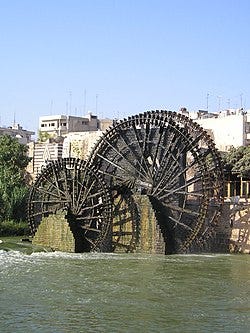
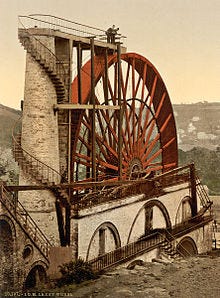
At 21 metres (69 feet) in diameter, the largest Haman noria ––Noria al-Muhammadiya, built in the 14th century to supply water to a mosque about a kilometer away–– may have been the biggest one on the entire planet for some 500 years. It was finally, and barely, surpassed in size in 1854 when the Laxey Wheel was built on the Isle of Man. Here is a photo from some five decades later:
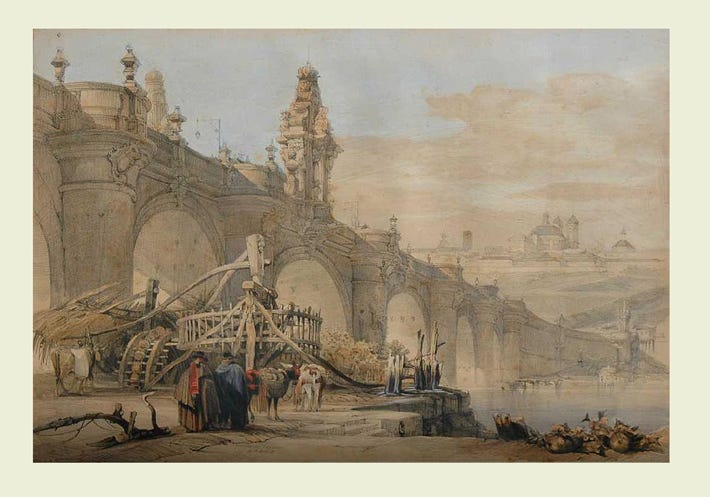
Because Spain was under Muslim rule between the 8th and 15th centuries, you can find norias dotting many parts of the country, even today. David Roberts, a Scottish painter best known for his detailed lithograph prints of Egypt and the Near East, also visited Spain and painted this noria he saw in Toledo (near Madrid):
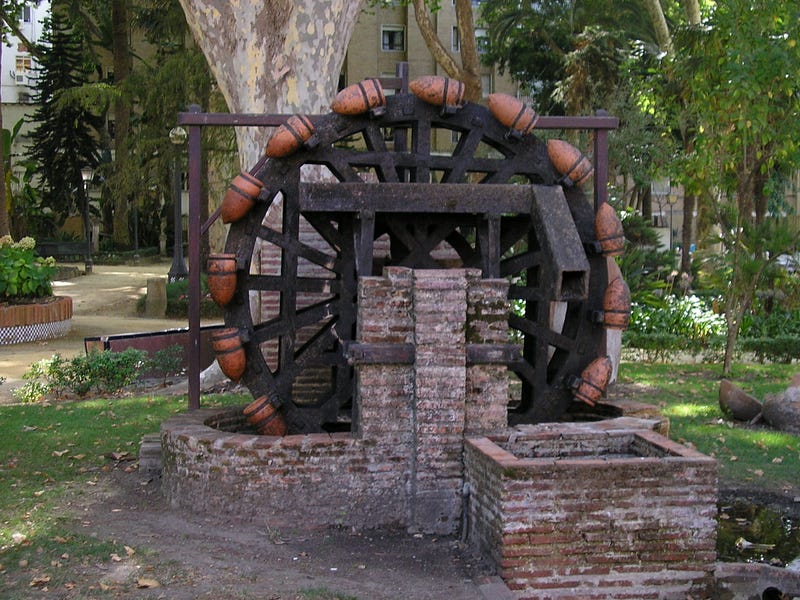
This noria is in Algeciras, a city near the southwestern tip of the country:
I haven’t noticed any norias during my travels across Spain over the last few years, but after writing this artcile I’m definitely going to be on the lookout for them.
En español
As I mentioned earlier, noria has three meanings in Spanish:
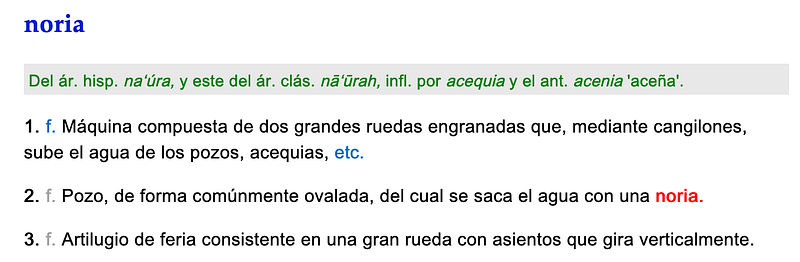
Those of you who don’t understand the language won’t find the above screenshot very helpful, but we here at Silly Little Dictionary! are happy to provide you with a free translation:
- A machine composed of two large geared wheels that, by means of buckets, raise the water from the wells, ditches. (In other words, noria in English.)
- A well, commonly oval in shape, from which water is drawn by a noria.
- A contraption usually found in fairs consisting of a large wheel with seats that rotates vertically.
You may have recognized that last definition as descriptive of a Ferris Wheel.
The term in English comes from George Washington Gale Ferris Jr., who built a huge one for the 1893 World’s Columbian Exposition in Chicago. (A year earlier William Somers installed three fifty-foot wooden wheels at Asbury Park, New Jersey; Atlantic City, New Jersey; and Coney Island, New York. Ferris rode the one in Atlantic City, inspiring him to build his version. Somers sued, of course, but Ferris’s lawyers prevailed after convincing the judge or the jury that the Ferris Wheel relied on much different technology than the contraption invented by Somers.)
Because of its fame, the Ferris Wheel is still known in Spanish as the rueda de Chicago, or “Chicago wheel”. Noria, meanwhile, is a term more commonly used in Spain.
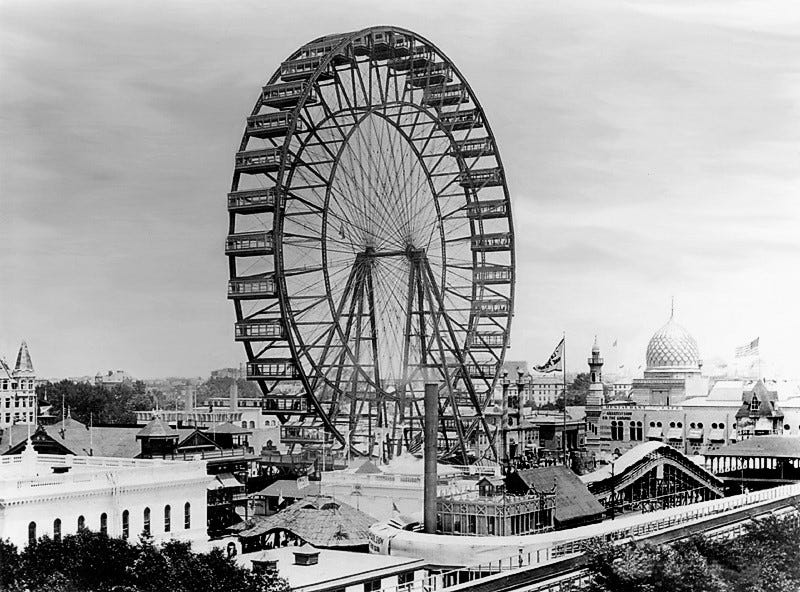
Measuring 264 feet (80 meters), the Ferris Wheel was the tallest attraction at the expo ––and the biggest Ferrish Wheel ever built. Not a big achievement, though, considering it was also the first. However… it didn’t take long for the “who can build the tallest Ferris Wheel in the world” craze to begin, a craze still trending to this very day.
Barely two years after Ferris built his, the Great Wheel was built for the Empire of India Exhibition at Earls Court, London, UK. It was 308 feet (94 meters) tall. Five years after that the French one-upped the Brits by opening theirs, which was 7 feet (2-plus meters) taller. It took 90 years for someone to beat that, although the Paris wheel was demolished in 1920 and a few others popped around as the tallest existing wheels.
In 1989 the Cosmo Clock 21 was built for the YES ’89 Yokohama Expositionin Japan. It originally had a height of 353 feet (107.5 meters), but was dismantled and rebuilt to be even taller, at 369 feet (112.5 meters). The Japanese kept the title of tallest Ferris Wheel until the famed 443-foot London Eye opened in 2000.
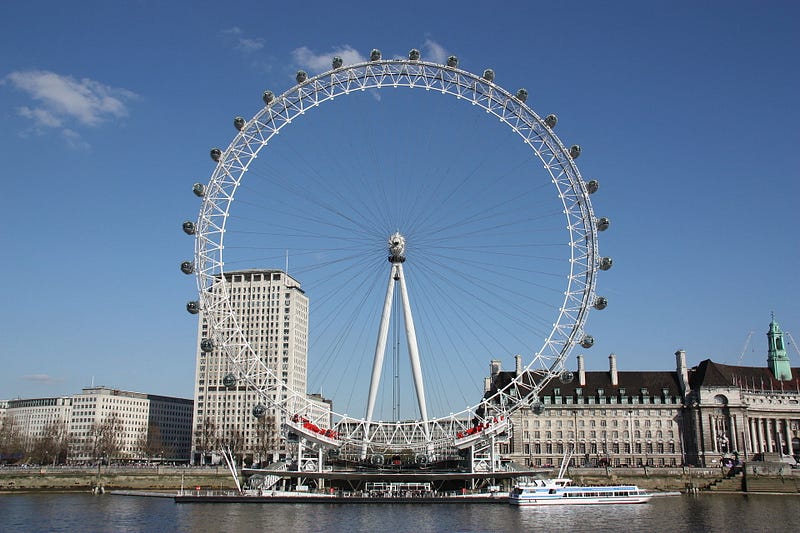
China surpassed it in 2006, Singapore surpassed China in 2008, and then Las Vegas held the record between 2014 and 2021 with its High Roller, with an impressive height of 550 feet (167.6 meters). But last year the UAE made a huge leap in size when they opened the Ain Dubai, which is a whopping 820 feet (250 meter) wheel!
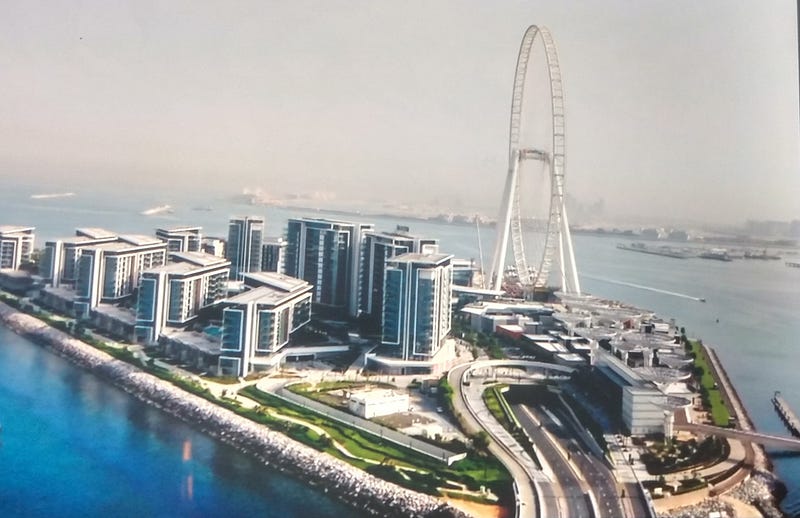
To give you an idea of the size of this Ferris Wheel, it’s more than twice as tall as the Statue of Liberty (305 feet from the base of the pedestal to the torch), about 80% of the height of the Eiffel Tower (1,083 feet, or 330 meters), and more than half as tall as the Empire State Building (1,454 feet, or 443.2 meters).
As a former President would say: “It’s huuuuuuge!”
Now you know. Next time you’re at a state fair, or a theme park, or just visiting London or Dubai, ask the locals if you can ride the noria. Unless you’re in Spain you’ll likely get strange looks from people… because the editors of the Spelling Bee decided that noria is a dord*.
You can check out my previous entry on another dord* here:
*What the heck is a dord, you ask? Here’s the answer: