
Lithify
Like a non-rolling stone

Today’s New York Times Spelling Bee letters:
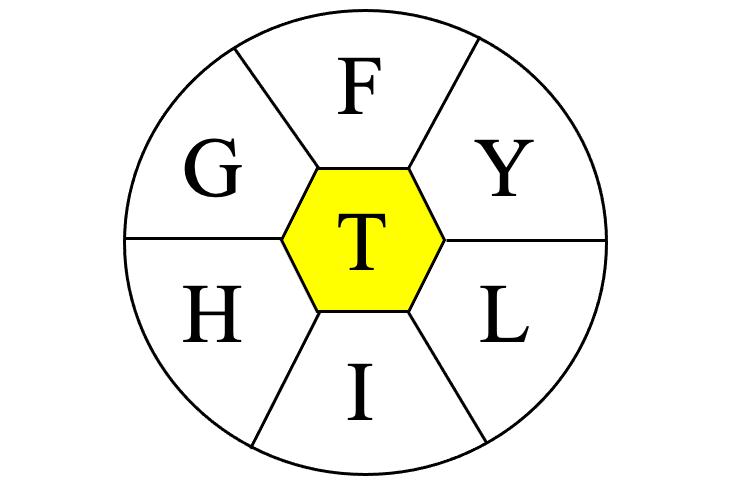
F, G, H, I, L, Y, and center T (all words must include T)
Merriam-Webster says…
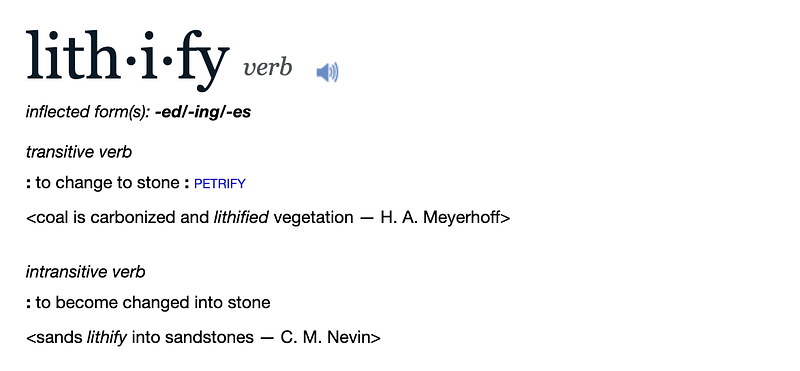
Silly little dictionary! Don’t you know that lithify can’t possibly be a word if The New York Times says it ain’t?
For a complete list of rejected words, check out the Spelling Bee Master.
What’s your favorite dord* from today’s puzzle?
My Two Cents
I thought yesterday was bad in terms of choosing a word to write about… and then today’s Spelling Bee game came along. Ten rejected words on the list that the Spelling Master makes on a daily basis. Ten.
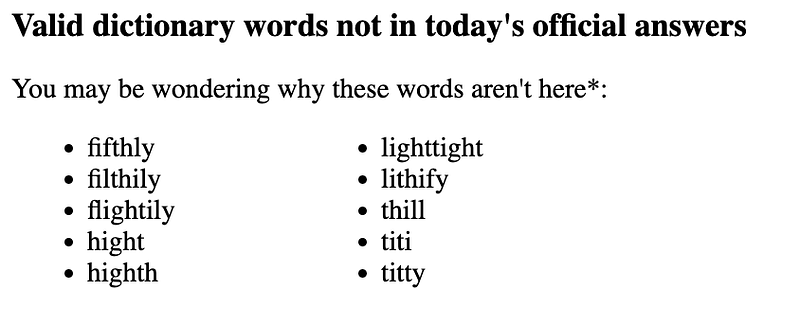
Some days I find dords* of my own that aren’t on the list, but today was not one of those days.
I swear, if I even thought there was a remote chance someone in The New York Times was actually reading my columns about the game and informing Sam Ezersky about my endeavors, I would be convinced that there is a conspiracy to prevent me from writing on Medium and earning 13 cents a day.
As it is, lithify is not a very exciting word to write about. But here we go…
No stone unturned
Our friends at Merriam-Webster tell us that lithification, the noun form of the verb lithify, comes from the Greek lithos (meaning “stone”) and the suffix “-ification” (making of).
This term is often confused or used interchangeably with petrification, which refers to the process by which organic material becomes fossilized via replacement of the original material and the filling of the original pore spaces with minerals. Petrified wood is perhaps the best-known example, and many of us know this from watching Saturday morning cartoons back in the day.
The lithification process, however, does not begin with previously living material, but rather with loose inorganic sediments. Under a process that involves a whole lot of pressure and a whole lot of time, they become solid, compact rocks. During said process, the sediments expel the liquid trapped between their pores as these fuse together and essentially disappear, slowly but surely get compacted and end up getting cemented into their solid rock form.
I don’t have Saturday morning cartoons for lithification, but here is a nice, short animation that explains it:
Security and Music
Interestingly, during my intensive 15-minute research, I ran into a few instances of Lithify with a capital L. The first one is a British company founded in 2018 that, according to their About Us page, “brings together some of the UK’s best-known and highly regarded consultants to provide world-class IT security solutions to medium and large enterprise in the UK and beyond.”
They offer a bunch of services, amongst which are things I understood (protecting the internet of things, email security) and things I had never heard of before (Virtual CISO and OT & SCADA). I’m sure any readers knowledgeable in tech are likely familiar with those terms, but I am not a writer knowledgeable in tech.
Lithify, whose slogan is “IT Security done right” has its own YouTube channel. Hmmm… I’m starting to sense a theme here with today’s word of the day.
To further the video chain, I found a tune called “Lithify”, which apparently forms part of a larger opus called Now That’s What I call Carlos Danger Volume Two!, which seems to satirize both the Now That’s What I Call Music! series of compilation albums and the infamous alias disgraced politician Anthony Weiner chose to use during his second sexting scandal in 2013. I mean, the fact that there is an entire Wikipedia article about Weiner’s sexting tells you all you need to know about him, politics… and us as a society.
The Lithify song information says, among other things, that it was “Auto-generated by YouTube”. I found this information about it in a Vice magazine article: “Google’s support page explains that YouTube creates ‘auto-generated channels’ via algorithms in order ‘to collect trending and popular videos by topic’.”
In any case, to end today’s weird and short column, here is yet another YouTube video:
Now you know. If you’re visiting the Grand Canyon, you can show off your knowledge by telling your tour guide that the rocks were lithified millions of years ago. Don’t be surprised if you’re ignored, though. Not because you’re being rude… but because the editors of the Spelling Bee decided that lithify is a dord*.
You can check out my previous entry on another dord* here:
*What the heck is a dord, you ask? Here’s the answer: