
Nobody Will Read Your Story if The Title Sucks
How to use the Sharethrough headline analyzer to get your story the clicks it deserves

Facebook groups are a constant source of bemusement for me. Everyday hundreds of writers from Medium spam their content across a handful of Facebook groups. Posting their story links everywhere they can, hoping that someone not only clicks on it but reads it to the end and claps.
I rarely read the links that are posted under my story posts. But the other day I was drunk and posted this on Facebook:
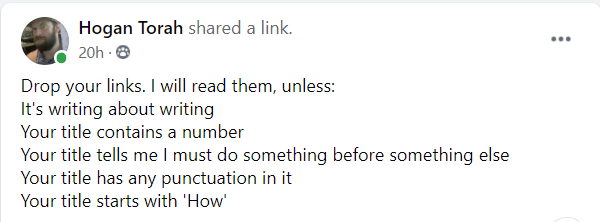
When I came to after blacking out, I checked to see how the post was doing.

Good god 65 stories… Did I mention they were desperate?
I regretted my post immediately. I began scrolling though a mountain of stories written by names I’d never seen. Facebook groups are the domain of the new writer.
I looked at the titles and cringed. It looked like a bunch of writing about writing and bad poetry. Some of it was bad, but most of the stories were pretty good. They just had terrible headlines.
The biggest mistake new writers make on Medium is not knowing what’s a good and what’s a bad headline. My headlines sucked too when I started out over a year ago.
A title is a Medium story’s most critical component. It determines if your story will be a success or if it sits unloved alone in the dark like your grandmother. If your title sucks, nobody is going to click it. If no one clicks on your title it doesn’t matter how good the story after the title is, no one will see it.
Spending hours on the story and 5 seconds on title is poor time management.
How do you know if your headline sucks?
Simple. The free online Sharethrough Headline Analyzer. Forget trying to learn something intangible, let AI figure it out. We’re living in the 21st century. Let the robots look at it.
Sharethrough is purposely vague about how it works. There’s very little documentation and what there is is filled with jargon and acronyms that need a marketing degree to figure out. According to Sharethrough:
The Headline Quality Score is based on a multivariate linguistic algorithm built on the principles of Behavior Model theory and Sharethrough’s neuroscience and advertising research. The algorithm takes into account more than 300 unique variables, including EEG data and Natural Language Processing, enabling your native ads to capture attention, increase engagement and deliver a stronger impression.
I understood none of that but it sounds neat.
While researching a story I was writing about headline analyzers being garbage, I tested my most successful stories against my least successful and realized the Sharethrough headline analyzer does work remarkably well if used correctly.
Where most writers go wrong with the headline analyzer is trying to add all of the suggestions to their original title to get a higher score.
Don’t do that. If you get a low score, re-write your headline instead of adding to it. Otherwise you end up with something like:
Seven Reasons All The Greatest Writers in The History of The World Aren’t Afraid to Always Choose Powerful Headlines to Alert John Cena’s Eyes Attention
Which gives me an almost perfect score.
However, the story proved to be one of my worst performing stories ever. A paragraph length title might work elsewhere but on Medium you want your title to be between 60 and 120 characters.
A three word title is never a good title. One word is even worse.
Let’s look at Sharethrough’s minimalistic UI.
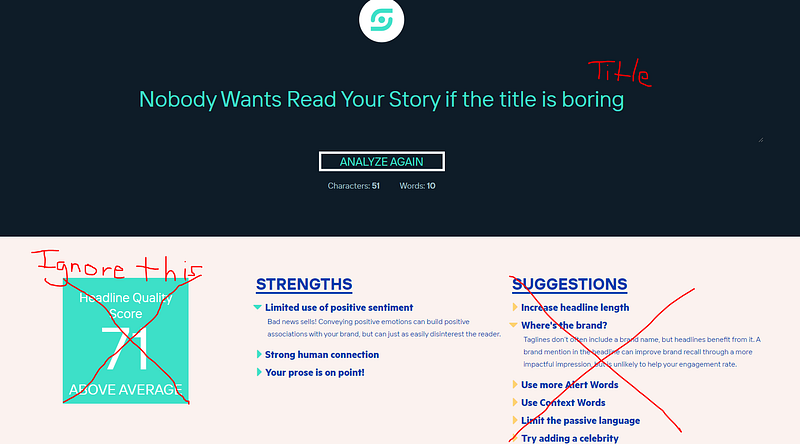
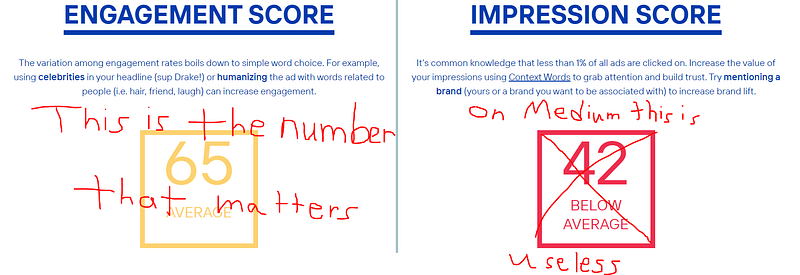
Why the Impression score is meaningless
The impression score is based on what people who don’t click on your story think of your brand. The impression your title leaves. The reader either clicks or they don’t. If they pass over your story once it’s unlikely they’ll see it again.
Impression score is a metric designed for companies advertising on social media. Not writing titles on Medium.
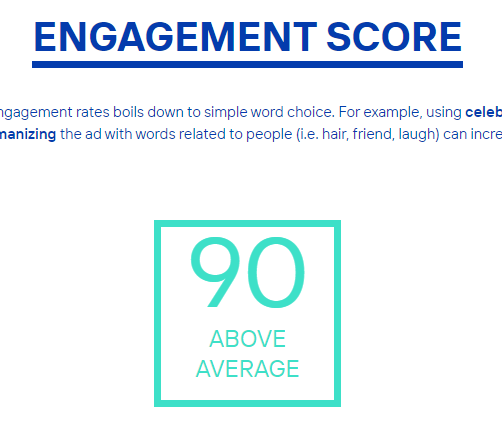
When using the headline analyzer goal is to get the highest engagement score possible without sounding like your title was translated from English to Japanese then back to English on Google Translate. It’s difficult to get above a ninety for the engagement score, but it’s possible.
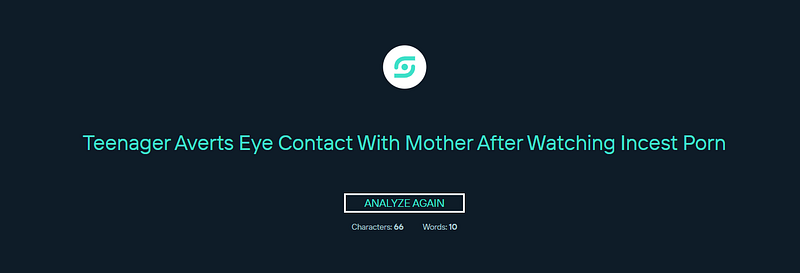
What number should I be trying for?
70 is the goal. If you don’t get above a seventy the first time try again. There’s some topics where might seem impossible to get a seventy. Think outside the box. Approach the story from a third person perspective. Try switching the title and subtitle. If it’s still not hitting 70 keep it above 60 minimum. If you score a seventy the first try, tweek the original title a bit to see if you can get a higher score.
Your engagement score number isn’t the end all be all. If your score is above an eighty but it didn’t get the clicks it’s likely because the topic is unpopular. I could write a title that scores ninety for a pro wrestling story and it will still flop. Because nobody over the age of twelve cares about pro wrestling.
On the other hand I have titles that scored under sixty with a thousand views. Your topic is important but your title sells it.
The Sharethrough analyzer won’t write a headline for you. It’s a predictor of a stories’ performance based on the allure of the title.
Spending an extra five minutes to fine tune your headline with the analyzer is totally worth it. The first month I used the Sharethrough analyzer on every story I published is the first month I made over a hundred dollars on Medium.


