
‘No One Here Gets Out Alive’ is My Favorite Book About Music
Mr. Mojo Risin’ grabbed my attention at a young age
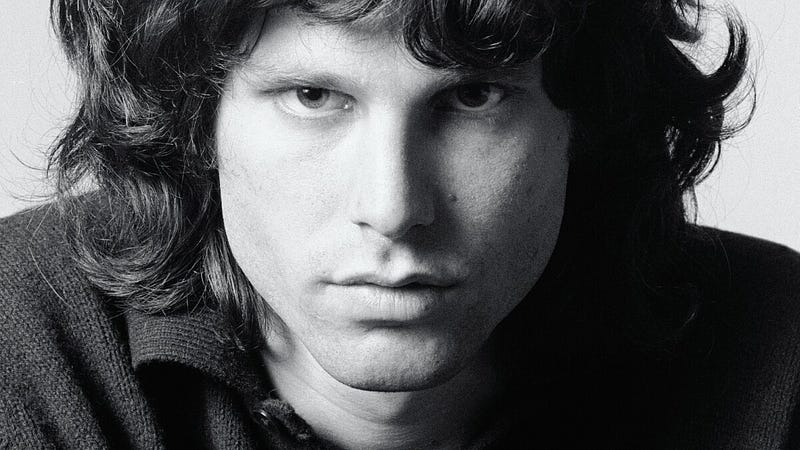
When Pierce McIntyre issued the March writing prompt for Plethora of Pop, he probably thought he knew what I’d be writing about. With a topic like “Your Favorite Books About Music,” surely I’d be writing about Springsteen’s magnificent 2016 autobiography, Born to Run. It will surprise many here that while I may get to that literary masterpiece someday, today is not that day.
That’s because my favorite book about music grabbed that top position over 40 years ago and is not likely to ever surrender it. The books, films and music that impact you at an early age tend to leave a lifelong mark, and just as hearing “Born to Run” for the first time at nine years old changed me forever, so did reading No One Here Gets Out Alive during Christmas break of my freshman year of high school. If you’ve never heard of it, it was the first biography of the lead singer of The Doors, the Lizard King himself: Jim Morrison.
What possessed my mother, who at the time mainly listened to country and western legends Charley Pride and Charlie Rich, to buy me a book about the most notorious member of the 27 Club right before I turned 15 remains a mystery. I had discovered The Doors on the album rock radio stations that I listened to growing up in the 1970s and blasted songs like “Light My Fire” and “L.A. Woman” in my room, so maybe that inspired the gift. I still like to think she secretly liked them, too. Regardless, having heard the music, it was time to learn about the man.
What I quickly learned from reading No One Here Gets Out Alive was that for all the talk about the superior education I was getting from Catholic school, I had heard of almost none of the authors, painters, and philosophers that were influencing Jim Morrison by the time he was a teenager. Reading the book sent me on a quest to read people like Nietzsche, Kerouac, Rimbaud, Huxley, and Camus. What I learned from that was that Jim Morrison was a genius, totally insane, or both, because except for Kerouac I understood none of it. It was, however, impressive that whether he really understood them either, he could take their ideas and turn them into amazing songs.
The first fifty pages or so cover Morrison’s life up to his college years, and the family dynamic does explain some of his later work. But it’s when he sees future Doors keyboardist Ray Manzarek on Venice Beach, shares some lyrics he wrote, and they decide to form a band that the thing really gets moving. That’s because while this is a biography of Morrison, from age 21 to his death at 27 his life and the life of The Doors are so intertwined that they cannot be separated.
The Doors, perhaps more than any other rock band ever, were a unified whole. Though Morrison wrote nearly all of the lyrics to the songs (“Light My Fire” is a notable exception and was, amazingly, the first song guitarist Robby Krieger ever wrote), he insisted that they be credited to all of the band’s members. On every Doors album you will see the same six words: “Words and music by The Doors.” Morrison took this unity so seriously that when a radio DJ introduced them at a concert as “Jim Morrison and The Doors,” Jim refused to go onstage until the man went back out and re-introduced them simply as “The Doors.”
Because of this, the real story of Jim Morrison’s family is found not in the early pages of the book about his parents and siblings but in the chronicle of his time with Ray, Robby, and drummer John Densmore. And like any family, the four of them battled at times, both creatively and over Jim’s excessive use of drugs and alcohol. This flared up most often between Morrison and Densmore, whose personalities were the most different (John looked for his answers in Transcendental Meditation, while Jim embraced the broader spectrum of peyote, acid, and booze).
The book also details Morrison’s relationship with longtime girlfriend Pamela Courson (and their many infidelities), and for me these sections bog down the narrative somewhat. Far better are the stories of the creation of the music itself. After all, the music was what it was all about, and what music it was. Beginning with their self-titled debut album in 1967 and continuing through 1971’s L.A. Woman, the music on the six albums they released defined the late 1960s in all its experimentation, discovery, and excess. Morrison himself represented these things as much as anyone who ever took to a stage. He became, as he had always hoped, a modern-day shaman.
The final part of the book covers the only time I can honestly say I could truly identify with Morrison. In 1971, burned out from the drugs and alcohol and facing serious legal problems in Florida, he fled to Paris to write poetry and be “just Jim.” From an early age I had idolized the Lost Generation ex-pat authors like Hemingway and Fitzgerald who called Paris home in the 1920s, so I understood the allure Paris had for him (as it still does for me).
This final part of the book is also where authors Jerry Hopkins and Danny Sugerman veer into the realm of conspiracy theory/fan fantasy. They take a few questionable details surrounding Morrison’s death (ruled a heart attack by a French doctor) and run with the insane story, believed by many fans from the moment Jim’s death was announced, that Morrison did not actually die on July 3, 1971. I’ll admit that when reading this in 1980, only 9 years after the fact, part of me wanted it to be true.
I said earlier that this was the first biography of Morrison following his death, but in reality it is as much hagiography as biography. Just like St. Bonaventure writing about the life of St. Francis of Assisi in the 13th century, Hopkins and Sugerman are codifying the myths as much as reporting the facts of Morrison’s life. The biographical details (and there are many) are a means to an end, not the end itself; if you want straight facts, then one of the more recent books about Morrison might be more to your liking.
For me, both at 14 and now, the hagiography works just fine. We need myths in order to survive, and we can’t just keep the old ones. We need new ones too, and there’s no better candidate for a modern-day myth than Mr. Mojo Risin’. No One Here Gets Out Alive is the perfect book for keeping that myth alive; pick up a copy for yourself, and in the meantime listen to The Doors below.
What’s your favorite book about music? Let me know in the comments, or better yet, join this month’s prompt and write a story of your own. I know you’ve got one Alex Markham, Terry Barr, Keith R. Higgons, Kevin Alexander, Rob Janicke, David Acaster, Sarah Paris, Simon Dillon, Rui Alves, Mark Holburn, Paul Thomas Zenki, Chris Zappa, Arpad Nagy, Danielle Loewen, and Eric Pierce. Also still waiting on yours Pierce McIntyre.
If you enjoyed this story, you can support my writing directly by joining Medium here. You’ll get access to all of my articles (including my weekly rants and numerous Springsteen stories) as well as those of all the other great writers here. You can also get my articles in your inbox by subscribing here.


