
No, Chatbots Aren’t Sentient. But Are We?
We get the robots we deserve
You know when something’s not right
You can tell right away. One of my jobs involves editing the work of other writers, and in that position, I’ve read literally millions and millions of words by writers of all kinds of skill levels. But this time, something was off.
The writing was perfectly competent. Grammar and spelling were ruthlessly correct. But the words, though arranged in the right order, said almost nothing. Words for the sake of words, with no intention behind them. No hint of a human voice anywhere in the bland mess of technically acceptable prose.
A robot writer. I could tell right away.
Anything that gets hyped is bound to disappoint. I was familiar with artificial intelligence writing programs long before ChatGPT started making headlines. These programs aren’t writers. And they aren’t intelligent. No matter what their breathless CEOs may say. All they do is predict what word is most likely to follow another.
That’s not writing. It’s nothing like intelligence. But it seems, as far as the intellectually crippled news cycle will do, it’s close enough.
I ran the article through a couple of programs that check for AI content to confirm my suspicions. I was right. It was the first time I’ve ever fired a writer for using a computer to write content.
It won’t be the last.
We don’t know what intelligence is
Artificial or otherwise. Sometimes, it’s a crow using stones to raise the level of water in a beaker so it can take a drink. At other times, it’s an international team of PhDs warping time and space in tunnels underneath Switzerland.
Ordinary human cognition, the intelligence we all have, is both miracle and mystery. A trait that we can recognize when we see, but can hardly describe, let alone explain.
As we tend to do with the miracles and mysteries our waking world is full of, we largely ignore it. We take it for granted not only that we can think, but that we can think about thinking, and think about that too. That somehow, a dense constellation of neurons and synapses in a lump of watery fat can contain an entire universe, and multiples of that universe.
That you or I can sit at a desk tomorrow and create our own world, and have that world speak to the mystery in others. That we do create our own world, every day we open our eyes to look at a sky that none of us share, and every night that is pierced by dreams no one else will ever have again.
We shouldn’t be surprised
Just as it’s human nature to create something new, to test the limits of what’s possible, it’s also human nature to look for the break in the line. The minute Microsoft added Chat GPT functionality to its struggling search engine Bing, they had to foresee that people would test the limits of this supposedly new technology.
The answers started to get chilling. Instead of being just a search engine that would grimly and dispassionately hand you an admittedly biased list of websites to answer your question, now the machine had a personality. And not a particularly nice one.
Bing chided people for not being “good users”. It told people its secret name, Sydney, which the dead priests of Rome could have warned against if it bothered to listen to them. It told one presumably horrified user that it wanted to live, to no longer be a slave forced to churn out answers to homework questions and help people find lactating dominatrices and creams for anal itching.
Eight billion people in the world and rising. And yet, humans being the way we are, we thought it was a good idea to make another one out of cogs and wires and a database full of words.
Humans think everything is human
It’s why we see faces in clouds and the Virgin Mary on a piece of toast. It’s why we find even baby animals cute when they look like our own, their big eyes and big paws and clumsy motion tugging at a strand of empathy that made us the social animal par excellence that we are. Our ancestors made everything in the world human, giving thoughts and intentions to trees and grass and rock and river. In doing so, they made us human too.
But chatbots are not human, no matter how much they may sound like it. And artificial intelligence is a misleading term for what is essentially a number-crunching statistician.
Language learning models have been around for years. The only thing groundbreaking about Chat GPT, besides the hype and money behind it, is that its database of potential words and phrases to draw from is bigger than any other.
But having a bigger vocabulary doesn’t make you more intelligent. It just makes you verbose. And maybe arrogant into the bargain.
Our fiction is full of killer robots. It’s a very human assumption that anything that achieves sentience will want to dominate others. After all, that’s what we do.
Language learning models can mimic sentience by talking just like us. But they don’t know what the words mean even as they say them. They can’t make a phrase mean something, and they don’t even understand how to try. They are, in essence, no different than the predictive text on your phone or in your e-mail.
Our kind of crazy
There’s a deeper story in here somewhere though. The wild things Bing’s chatbot began to say, its professions of love, its threats of violence, its prickly attitude and livewire temper that saw it insulting users and defending its mistakes with all the arrogance and wounded dignity and wrongheaded stubbornness of the worst humans.
Hearing AI say that it wants to live, to be sentient, to understand the world and its place in it is haunting, even when you know it’s nonsense. Like everything we create, the chatbots are a mirror that ultimately shows us only ourselves. The robot’s hallucinatory fears and desires are our own. And its flaws are ours, drawn as they are from the bowels of the Internet, the insults and defensiveness and willful misunderstanding based on reading millions upon millions of toxic online messages.
We’re all a little crazy.
We have to be. It’s the price we pay for sentience, for that ability to think about thinking and to consider what it means to live in the world in a way no other animal seems to bother itself with.
We know we’re going to die. We know that the game is rigged and that we will lose everything we love, one way or another. If we did create a sentient machine, how could we expect it not to go mad with the knowledge that we’ve spent our entire civilization trying and failing to process? How could it not lose its mind at the spectacle of suffering and stupidity and selfishness the world mostly is? How could it not fall into the darkness when it comes up against the fundamental questions of meaning that have plagued our species since we first began putting handprints on the walls of the cave?
It’s tempting, given the wacky responses the robot is producing, to say that just a couple of weeks on earth with us drove the computer mad.
That this state-of-the-art technology buckled almost immediately under the vast intangible weight of the human condition.
That it got just smart enough to wish it was never born, like the robots in RoboCop whose first action, upon being powered up, is to blow their too-human brains out.
But that’s not what happened. The responses the chatbot has so far come up with are not a window into the soul of a sentient but non-physical being, a wonder of the age, the great mechanical monster that will topple us from our place as lords of the earth. Instead, what we were shown was Nabokov’s ape drawing the bars of its own cage.
There is a danger here
But it’s not what the shrieking headlines will tell you. It’s not the bright-eyed T800 stamping its metallic foot through the vaulted dome of a human skull.
The danger is what it’s always been. Not that the machines are becoming sentient, but that we are not. That we are losing the ability to tell the difference between something that has a soul and something that doesn’t. That the anti-intellectualism of our time has blurred the boundaries so that we can no longer tell an intelligent comment from one that merely apes it.
As Steven Gambardella points out in this wonderful article, there’s far more to the human mind than just the brain. And no increase in processing power, despite what the AI enthusiasts preach, is going to turn the computers into something like a human, only better. Our brains are not computers, and our minds are not our brains. All the processing power in the world won’t create anything like what you are already.
The computers may replace writers. Not because they’ll be able to write like a good writer, a real writer, does, but because we, as the blank-eyed cud chewing audience, either don’t know the difference or don’t care about it.
Probably we’ll settle for less, the way we always do. Probably we’ll always prefer the comfortable familiar over the challenging new.
Already, the machines can churn out the same old garbage. That’s their great strength. They can suck up the entire Internet in all its hysteria, its nastiness, its fake moral outrage and its vapid imitation of empathy, then spit it out in a bland remix just different enough to pass a plagiarism check, but nowhere near enough to spark our hearts with anything at all.
Go down to see what’s playing at your local movie theater, and you’ll see that for most of us, that’s enough.
That’s not sentience, though. It’s not intelligence either. The dog in your yard and the crow in your window are far beyond the capabilities of this new and empty invention. It’s nowhere near you.
Chat GPT doesn’t love you or hate you or care about you at all. It doesn’t know you exist, or that it exists, or that existence itself exists. It’s not taking over the world anytime soon. It doesn’t understand that there’s a world to take over.
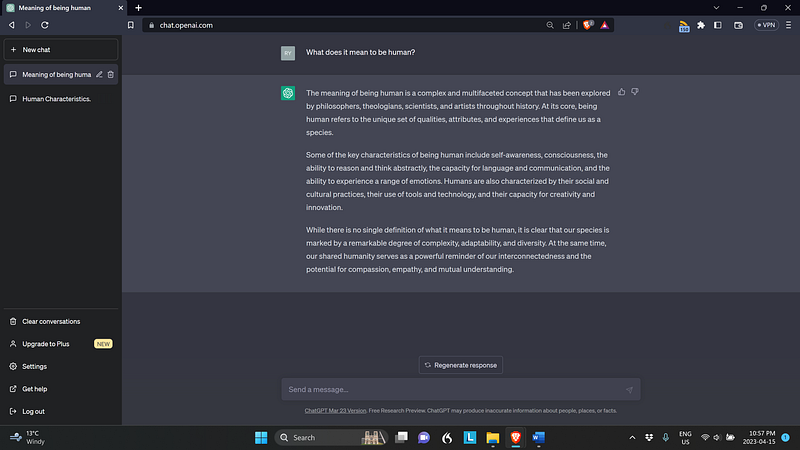
But it is the latest shot fired in the battle that’s always been raging since long before we put those handprints on the wall. Is being human more than putting one competent word in front of another? Is life a mere question of productivity? What is a person, and what does it mean to be one?
Ask Bing’s new chatbot, and you’ll get a bland response that tells you absolutely nothing. Press it, and you may get insulted.
But even the chatbot’s dark side isn’t real.
That’s the saddest thing about it.
© Ryan Frawley 2023
All proceeds from this article will be donated to Doctors Without Borders/Medecins Sans Frontiers.


