
Nine Search Engines We Used BEFORE Google Ruled The Internet
Recalling the early days of Internet Search

Can you remember the days when people said they had “Searched for something on the Internet?”
Now people simply say they “Googled it.”
The first reported usage of the word “Google” as a verb occurred in 1998, and it came from — surprise, surprise — Google founder Larry Page.
I wonder what people hearing him say that at the time thought. I’d be willing to bet that at least some of them felt he was being arrogant.
Within eight years, Google had risen to become THE dominant search engine. Nobody is remotely fazed if you tell them to “Google it” today.
Fun Fact: In 2006 the verb “Google” entered the Oxford English Dictionary.
Not bad for a product which was first launched just 8 years previously!
However — and this may come as a surprise to some of you younger readers — the Internet existed BEFORE Google.
In 1994, I purchased my first PC — and was online before the end of that year. Dial-up internet was the norm, which meant that when I was online, the computer commandeered the phone line. It was also excruciatingly sluggish; if a web page loaded in less than three seconds, people screamed from the rafters about how fast it was.
But how did we find anything with Google around to “Google it?”
Here is a list of NINE search engines that existed before Google.
1. Archie
If you ask Google which was the first EVER search engine, you’ll get a few different answers. But the most common answer seems to be Archie, a tool launched in 1990 at McGill thiUniversity in Montreal, Canada.

Archie (a contraction of “Archives”) was a way to search FTP files. It allowed users to look around the nascent Internet. Archie didn’t understand natural language requests, nor did it index the content inside the FTP files. So it had limited value.
Users had to know the title of the file BEFORE they started searching — so it’s debatable whether Archie was a search engine as we now understand them.
2. ALIWEB
ALIWEB (standing for Archie Like Indexing for the Web) was the next iteration of web searching. It launched early in 1993.
ALIWEB encouraged users to submit the locations of index files on their sites. This allowed the search engine to include individual web pages and add user-written page descriptions and keywords.

This was a quantum leap forward from the limitations of Archie (and other similar tools), BUT it relied on input from webmasters to take the time to submit their data to ALIWEB. Unfortunately, that input was not forthcoming in sufficient numbers. It would need a means of “crawling” sites automatically to make search engines into a truly useful tool.
3. Webcrawler
WebCrawler started life in January 1994, designed by Brian Pinkerton at the University of Washington. At launch, it had — wait for it — 4,000 websites in its database. Within six months of launch, it had racked up one million queries.

While most people have long-forgotten Webcrawler, its place in Internet history is assured — it was the FIRST search engine to provide full-text search capability.
When I first joined the Internet in 1994, Webcrawler was my search engine of choice — so I look back on it with nostalgia. Still active today, Webcrawler aggregates results from Google and Bing; it abandoned its own database in 2001.
4. Yahoo!
Jerry Yang and David Filo introduced Yahoo! search in 1995. Once upon a time, Yahoo! was the internet’s trailblazer, the way the masses accessed the internet. It was a genuine pioneer, existing years before Facebook or Google.

It was front and centre long before anybody texted or tweeted or liked or snapped or shared.
Yahoo! added chat, games, groups, email, and a slew of other services as the site grew in popularity and size. However, it could not keep up with the rapid advancements in Google’s search engine technology.
Yahoo! attempted to be a full-fledged media firm, in contrast to Google, which concentrated on establishing its search technology. It didn’t work, and Yahoo! dismissed hundreds of people as its stock price plummeted — all while Google continued to expand at an exponential rate.
Although Yahoo! is still in business, it is reliant on Bing for its search technology and has a market share of just around 1% of worldwide search traffic. How the mighty have fallen…
5. Alta Vista
Alta Vista, founded in 1995, was a behemoth in the early days of the Internet. It eschewed the portal model adopted by Yahoo in favour of a straightforward search experience that did exactly what it said on the tin.
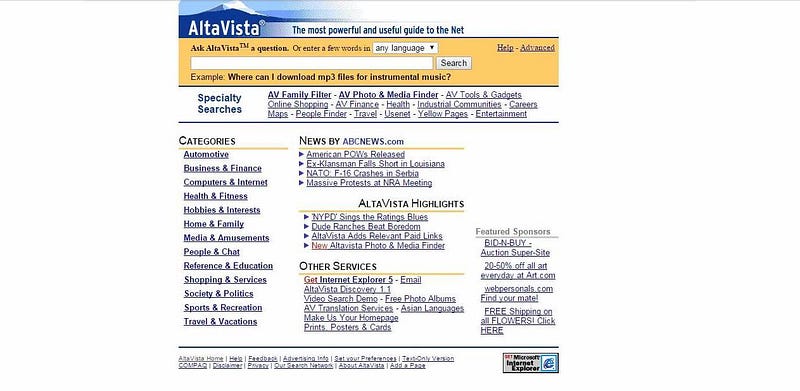
As recently as the turn of the Millennium, Alta Vista controlled 20% of the search engine sector, with Google lagging on 7%.
Alta Vista’s fortunes deteriorated after that peak, and Yahoo! bought the business in 2003. Alta Vista closed down in 2013; if you visit Alta Vista now, it sends you to Yahoo! search page.
6. Lycos
Lycos was one of the earliest search engines to go live, having launched in 1994. It was the first search engine to go public, with a market valuation of more than $300 million on the first day of trading.
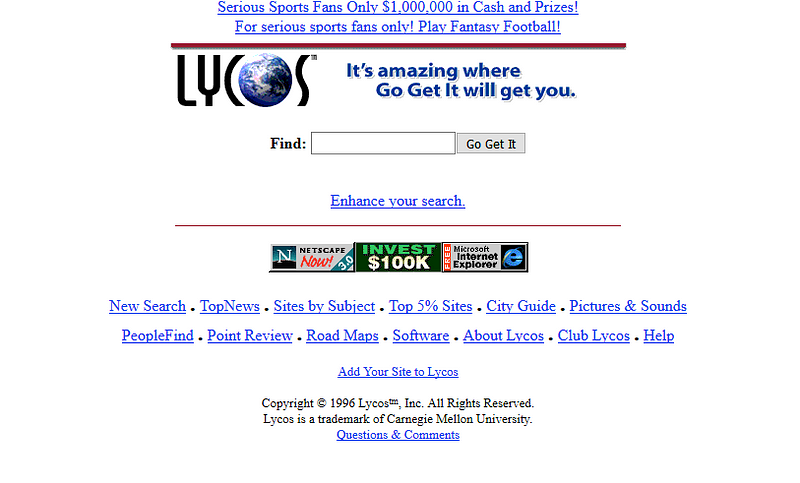
Toward the end of the 1990s, Lycos was one of the most frequented websites on the globe, and the company looked like a potential contender to dominate the industry for many years to come. Sadly, the dot.com crash in 2000 crippled Lycos.
You can still use Lycos today — and it will get results from Yahoo, just as Alta Vista did before (which is pulling its results from Bing). Are you keeping up?
7. Excite
Founded in 1993 by a group of students at Stanford University, this was another of the first raft of search engines to appear on the scene.
When Excite went public in 1996, its main hub site ranked as the sixth most visited website in the world, according to Alexa traffic rankings. It aimed to transform into a portal with content created by journalists.
Although they learned, like Yahoo and others, that most visitors merely wanted to get search results and then leave — something Google, it seems, was well aware of.
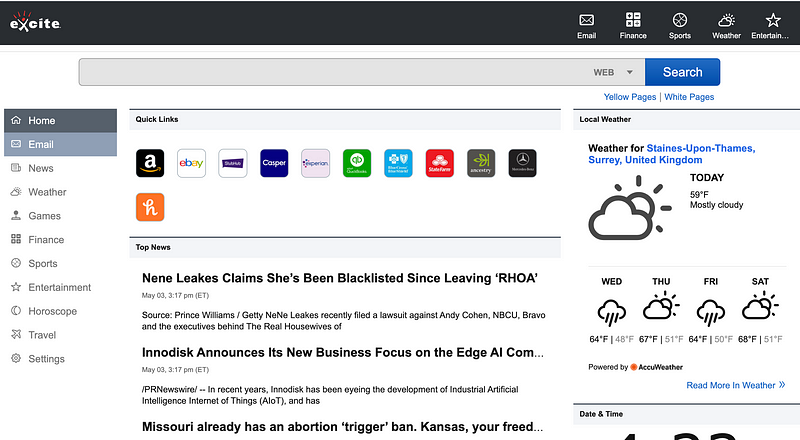
Excite has struggled to keep up with the times, but it enjoys a certain amount of popularity in the Far East today.
8. Infoseek
Infoseek was the search engine that came bundled as the default search in the Netscape browser, which gave it high visibility in the mid-1990s when Netscape was the browser of choice for many users.

Its place in history is that it pioneered complex search modifiers, including boolean modifiers (OR and NOT), parentheses, and quotes.
Launched in 1994, by September 1997, Infoseek had 7.3 million visitors per month. It was the 7th most visited website in the world that year. In 1998, Disney purchased Infoseek and incorporated it into the new Go.Com portal.
In February 2001, Disney canceled the service and lay off the entire staff.
9. Ask Jeeves
After launching in 1996 with unique branding based on the character of Jeeves from the P. G. Wodehouse, Jeeves and Wooster books, this start-up grew rapidly.

Ask Jeeves used a question-and-answer style that, although typical now, was groundbreaking in its day. In 2006, they rebranded the firm to Ask and — sadly — abandoned their distinctive branding.
Although surpassed in popularity by crowd-sourced sites such as Quora and Reddit, it continues on the internet today, still focusing on its Q&A style.
Today around 92% of worldwide search happens via Google, with the second most popular site, Bing, accounting for 2.8% of searches — even though Bing is driving searches on Yahoo, Lycos, and Alta Vista.
It wasn’t always this way, though. Take a trip back precisely 20 years to the first few months of 2002, when Yahoo was the most popular search engine with a 36% market share.
It’s hard to believe, but 20 years ago, there were still many other companies that had a considerable portion of the search industry. Excite (9%), Alta Vista (9%), Yahoo! (9%) and Lycos (5%), among others, accounted for over half of queries.
Google was growing its market share, accounting for around one in every six search inquiries. However, there was no certainty that it could achieve dominance.
How did Google explode from being one of the pack to being the only significant player in town?
A major factor is that Google spent its first several years focusing on building an innovative and robust search engine. As the early start-ups went under, Google was smart enough to stay focused on their key business: search
When it came time to grow, Google had rock-solid search. They had just gone public on the stock market and were flush with cash. In 2005, they could acquire YouTube and Android because of their financial clout.
Everything else is, as they say, history.
Could Google have developed into the juggernaut that it is today if not for those early college geeks toiling away in their parent’s garage?
Who can say?
However, I believe we owe all a debt of thanks to those long-forgotten websites, such as Lycos, WebCrawler, Ask Jeeves, and the others.
Here’s the latest story in my Internet Memory Lane series where I look at those amazing 80s and 90s computer games
Medium is an amazing platform for writers. For a small monthly fee you can read unlimited articles — and write your own. If you decide to join, please consider using my link. It earns me a small commission at no extra cost to you.
Come and find out a bit more about me.
If you enjoy my writing, and would like to fuel my writing perhaps you’d consider buying my morning mocha
? Thanks for reading!


