Nine MORE forgotten sites that once looked like they’d rule the Internet
Where are they now? Most are lost in the mists of time

A few weeks back I wrote a Medium story called Nine Forgotten Sites That Once Looked Like They’d Rule The Internet
I’ve got to be honest — it took off in a way that blew my socks off. More than 14K views, 265 fans and the best earnings I’ve ever had on Medium.
It looks like people enjoy taking a trip down memory lane and reminiscing about sites we used to enjoy many years ago. Some people suggested other sites, and I did a bit more digging — and I’m now delighted to reveal my follow up post:
Nine MORE forgotten sites that once looked like they’d rule the Internet
1. Orkut
Orkut launched in January 2004, a project devised by Orkut Büyükkökten — yes, I cut and pasted that name — a Turkish software engineer. He developed the site while working at Google under a scheme where Google employees could spend 20% of their time working on “other projects”.
Taken under the Google wing, Orkut grew rapidly in the late 2000s and was especially popular in Brazil and India. Security concerns and legal actions dogged Orkut, limiting its ability to compete against the rising star, Facebook (sound familiar?) in the late 2000s.
In June 2014, Google announced Orkut would close. Google engineering director Paulo Golgher said in a blog post:
Over the past decade, Facebook, YouTube, Blogger and Google+ have taken off, with communities springing up in every corner of the world. Because the growth of these communities has outpaced Orkut’s growth, we’ve bid Orkut farewell.
It seems like Google assumed that Google+ would replace the need for Orkut.
Hey, how did that work out, Google?
2. Bebo
Launched in 2005, Bebo once boasted 40 million users with around 1 billion page views per week. Those stats tempted AOL to buy Bebo from founder Michael Birch for a cool $850 million.

Several buyouts later, Birch bought the site back for — wait for it — $1 million.
Not a bad mark-up for the British-born entrepreneur.
So what went wrong? As with so many other social networks, Bebo struggled to compete against social networking rising star Facebook. AOL could not provide the “significant investment” needed to prevent its decline as a business. The BBC’s technology correspondent Rory Cellan-Jones called AOL’s decision to buy Bebo
One of the worst deals ever made in the dotcom era.
Bebo is currently in private beta pending a relaunch. The new version promises a focus on profiles and social interaction, rather than news feeds.
Are YOU excited about a new version of Bebo?
3. Napster
Who remembers the wonder of downloading boatloads of free music from other people’s hard drives on Napster?
Founded in 1999 by two teenagers, Shawn Fanning and Sean Parker, Napster boasted over 20 million users within a few months.
Suddenly, right before our eyes, there was an unlimited library filled with every conceivable musical treat.
It was as if the guard left the door to the vault wide open — and then left the bank.
Of course, it couldn’t last. The litigation came flying at Napster from every angle — most notably from Metallica, angered when unreleased songs leaked onto Napster. Others argued that Napster — far from hurting physical sales — instead stimulated sales. It was a heady time, and the debate raged in the press and TV.
By 2001, it was all over. Napster agreed to pay $28 million in compensation, which they intended to fund by converting the platform into a subscription-based model. However, the millions who pillaged Napster for free weren’t ready to pay for the privilege and Napster quickly faded from the scene.
The name survives to this day, having gone through several acquisitions and relaunches.
But with Spotify having captured the lion’s share of the market, there appears little hope of Napster ever ascending the heights of popularity again.
4. Six Degrees
This site deserves to be on one of these lists — even though I guess that most of you have never heard of it.
Six Degrees was the FIRST ever social networking site. Founded by Andrew Weinreich in 1996, the site launched the following year and combined popular features such as profiles, friend lists and school affiliations in one service.
Its problem was the lack of people connected to the Internet. It would be a few years before the Internet’s infrastructure could catch up with the concept of social networks — and would allow a social network to achieve critical mass.
The site ran from 1997 to 2000 — truly a concept ahead of its time.
5. Foursquare
With its fun interface, including badges and gifts, Foursquare exploded in popularity after its 2009 launch.
Foursquare developed a Facebook app meaning you could check in via your Facebook timeline. Incredible as it seems today, Facebook didn’t have location sharing at that point.

Inevitably, the big boys came calling. Yahoo offered $100 million and Facebook upped it to $120 million. The Foursquare creators held out for $150 — and Facebook walked away.
Instead, Facebook added location sharing and the Foursquare app was immediately redundant. Under funded and outgunned by Facebook — and then by Instagram and Snapchat — Foursquare fell out of the top 1000 apps for iOS.
Foursquare survives to this day — but it makes money by harnessing and monetising your data. Remember how you clicked a button to agree to Foursquare using your data? Foursquare harnesses that data for marketers and developers, including the likes of Adobe and AWS.
A rare example of how a social network reinvented itself.
6. Vine
Vine was a social site and app for sharing brief video clips. It launched in 2012 and acquired by Twitter for $30 million even before its launch. Vine became the most downloaded app in the iOS store and, within 12 months, had collected 40 million users.
So why did Vine fail?
First, despite their tremendous reach, Vine creators did not have a way to monetise their audience. Some of Vine’s biggest stars had amassed millions of followers. Those people found a more lucrative option on Instagram or YouTube.
Second, Vine stuck with its 6-second loops for too long. They eventually changed to 140 seconds in 2016 — however, it was already too late. Instagram and Snapchat had taken Vine’s market share. Former executive Ankur Thakkar commented:
Vine didn’t move fast enough to differentiate — while Instagram video innovated and snatched the market share from Vine.
7. Hi5
Among the most popular social networking sites for a few years after its launch, Hi5 was second only to MySpace in 2007. It rapidly diminished once Facebook came along, although it maintained a solid presence in Latin America.
After an ill-fated attempt to reposition as a gaming site in 2010, they sold it to another social network, Tagged, in 2011. Social discovery platform MeetMe bought both for $60 million in 2017. The new owners refocused the site into a flirting and dating site.
Hi5 limps along to this day, a shadow of its former social network presence and dwarfed by popular dating apps such as Tinder and Bumble.
8. Plaxo
Plaxo was a social contact sharing service founded by Sean Parker — remember him from the Napster debacle? The service officially launched in November 2002.
At one point, Plaxo claimed to have over 50 million users. The service merged users’ contacts, automatically updating information across devices and platforms. Plaxo users also could share personal info like photos, birthdays and mailing addresses.
Comcast acquired Plaxo in 2008 in a deal reportedly worth between $150 million and $170 million. According to a blog post by the startup’s founders, they hoped to turn Plaxo into a way:
to bring the social media experience to mainstream consumers
But Plaxo never expanded beyond being a utility for syncing contacts, and the service was eventually closed down in 2017.
9. Second Life
While some might consider Second Life as a game, it isn’t. Not really. With no end goals or overarching story, it is best described as a life-simulation social network.
Launched in 2003 and peaking at the start of the 2010s, Second Life had a regular user base of over one million people by 2013. At one time, many thought Second Life would become the behemoth of the Internet.
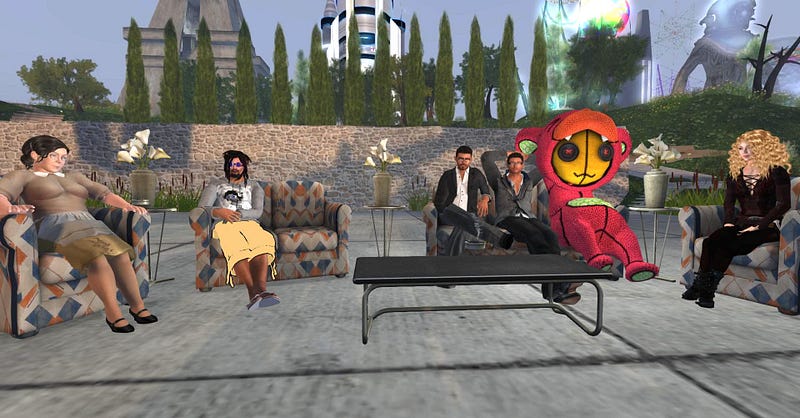
Ultimately, the lack of meaningful activities meant the masses jumped to plot-driven MMO games. The game keeps a dedicated user base — albeit much smaller — to this day.
So, there we go. Another nine sites that looked like taking over the Internet — but didn’t.
Do you remember any of these sites?
Here’s the latest story in my Internet Memory Lane series where I look at those amazing 80s and 90s computer games
Medium is an amazing platform for writers. For a small monthly fee you can read unlimited articles each month — and write your own. If you decide to join, please consider using my link. It earns me a small commission at no cost to you.
Come and find out a bit more about me on Medium
If you enjoy my writing, and would like to fuel my writing perhaps you’d consider buying my morning mocha? Thanks for reading!