
Nikola Tesla — trivia about the eccentric visionary. What happened to his brilliant inventions?
A genius and visionary, but also an eccentric. Today considered the greatest inventor in history, he once lived in the shadow of Thomas Edison, and the conflict with the American cast a shadow on his career. We’re talking about Nikola Tesla — the author of nearly three hundred patents that laid the foundation for the modern world. How did Nikola Tesla live? Trivia about the brilliant inventor are listed below.
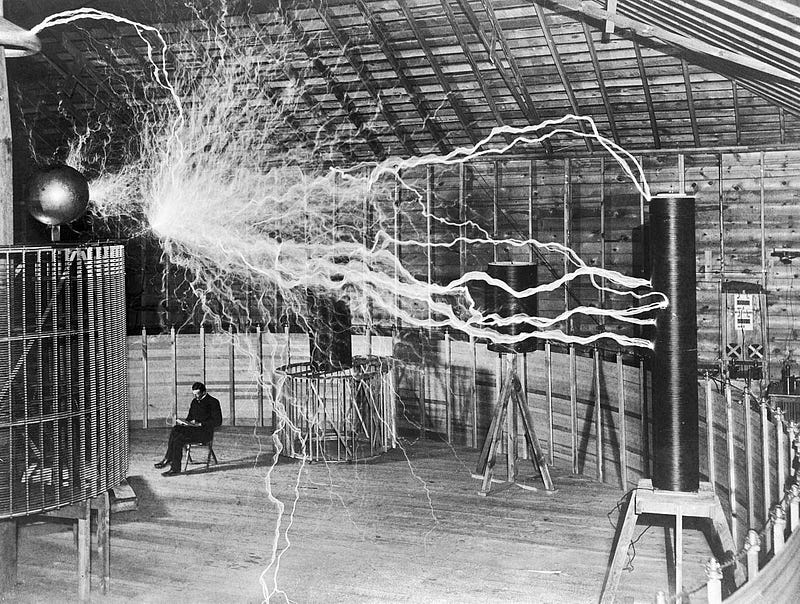
The turn of the 19th and 20th centuries was an incredibly important period in world history. It was during this time that technology was created, becoming the basis for 21st-century innovations without which most of us cannot imagine life. Genius inventors who lived and created during this period can be listed endlessly, but at the top of any such compilation, one name always appears — Nikola Tesla. The inventions of the brilliant engineer surpassed his era and became the foundations of the modern world.
Nikola Tesla’s Origins
Nikola Tesla was born on July 10, 1856, in the small village of Smiljan in the Austro-Hungarian Empire (now Croatia). The future genius’s father, Milutin Tesla, was an Orthodox clergyman. The mother took care of the household, but as Tesla himself claimed, it was from her that he inherited his engineering abilities. Georgina Mandić was not an educated person. Nevertheless, she was said to have exceptional skill in repairing all kinds of mechanical devices.
Reportedly, on the night when Nikola was born, a thunderstorm with lightning raged, unlike anything Smiljan had seen before. The frightened midwife allegedly declared that Tesla would be a “child of the storm.” His mother, however, disagreed and supposedly referred to him as a “child of light.”
Tesla’s Education
It could be said that Tesla became interested in electricity somewhat accidentally. While stroking a cat, he noticed that the animal’s fur became electrified. At that moment, he desired to understand the mechanisms governing this phenomenon.
Milutin Tesla wanted his son to follow in his footsteps and enter the clergy seminary. However, the young boy had a different idea, but his father was adamant. However, two factors ultimately influenced a change in his decision: the opinion of high school teachers who recognized the extraordinary mathematical and technical abilities displayed by young Tesla, and… a cholera epidemic.
Fourteen-year-old Nikola was close to death. Desperate, his father reportedly promised himself (and Nikola) that if he recovered, he would agree to his son’s choice of any school. Nikola regained his health, and Milutin kept his promise, allowing his son to begin studies at the Imperial-Royal Technical University in Graz.
Tesla’s Studies
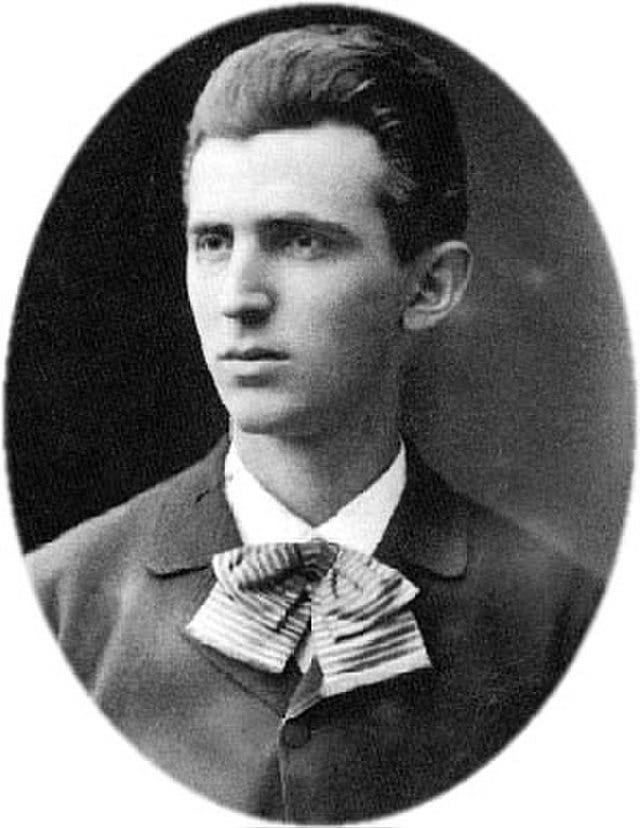
Even in high school, Tesla excelled in scientific subjects. He could even solve differential equations from memory. Thanks to his intellect and immense enthusiasm, he completed the four-year high school curriculum in three years. His university studies were similarly successful. He passed exam after exam, and the university sent written congratulations to his father.
However, certain problems arose. Nikola was fascinated not only by mathematics and physics but also by gambling. The problem of addiction to games grew. Tesla did not pass the third year and had to leave the polytechnic.
Despite this setback, he decided to complete his studies. He went to Prague to study at the local university. However, upon arrival, it turned out to be too late to enroll in classes. He then decided to go to Budapest. There, thanks to a recommendation from his electrical engineering professor in Graz, he secured a job in a telegraph office.
Most likely, it was there that Tesla developed the concept of the alternating current motor. He quickly earned a reputation as a brilliant engineer, so when his employer ran into trouble, he had no trouble finding new employment. After selling the business, the brilliant Nikola began working at the Paris branch of the Continental Edison Company.
Tesla-Edison Conflict
Tesla stood out among other engineers. His knowledge and skills opened doors to further his career. He received a letter of recommendation, with which he set out for New York. He was to meet with the owner of the company where he worked — Thomas Edison.
The famous genius of electrification saw tremendous potential in his employee. He assigned him a task that initially seemed impossible to accomplish. Tesla was to improve the efficiency of an Edison-owned power plant by 50 percent. In the event of success, the employer promised him an incredible gratuity of $50,000.
Tesla proved that what seemed more challenging than the toughest of Hercules’ twelve labors was “a piece of cake” for him. He stated that the targeted improvement in efficiency could be achieved by transitioning from direct current to alternating current. However, Edison did not approve of this solution and refused to pay Nikola the promised bonus. Disappointed, Tesla resigned from the company.
After leaving Edison’s employ, Tesla had to engage in various activities to make ends meet. The brilliant engineer worked physically. However, he would soon spread his wings as the owner of a company competing with his former employer.
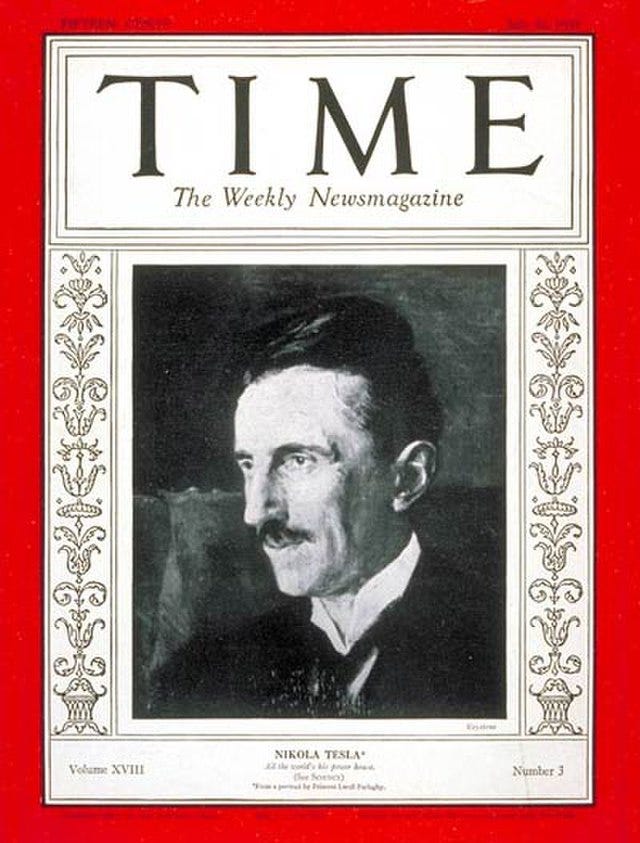
Together with Charles Peck and Alfred Brown, he founded the Tesla Electric Company. At that time, he developed the basics of generating and transmitting alternating current and the induction motor. When he entered into a licensing agreement with George Westinghouse, he gained funds for further work. However, over time, there were financial issues with funding the company’s operations. Additionally, health problems emerged, and a legal battle with Guglielmo Marconi over priority in the invention of radio ensued. As a result, Tesla’s period of prosperity lasted only a few years.
Nikola Tesla — Personal Life
Nikola Tesla never married or started a family. As he claimed, he could not afford to do so because “by giving everything to a beloved woman, he would have to take everything from a beloved field.” He expressed the belief that none of the great inventions were made by married men.
At the time, the press considered Tesla’s attitude toward marriage as an “abnormal emotional state.” There even emerged an unconfirmed theory that the great inventor was homosexual. While today this would not be associated with public condemnation, it’s essential to understand that the realities of America in the late 19th and early 20th centuries were quite different.
Nikola Tesla and his Views on Eugenics
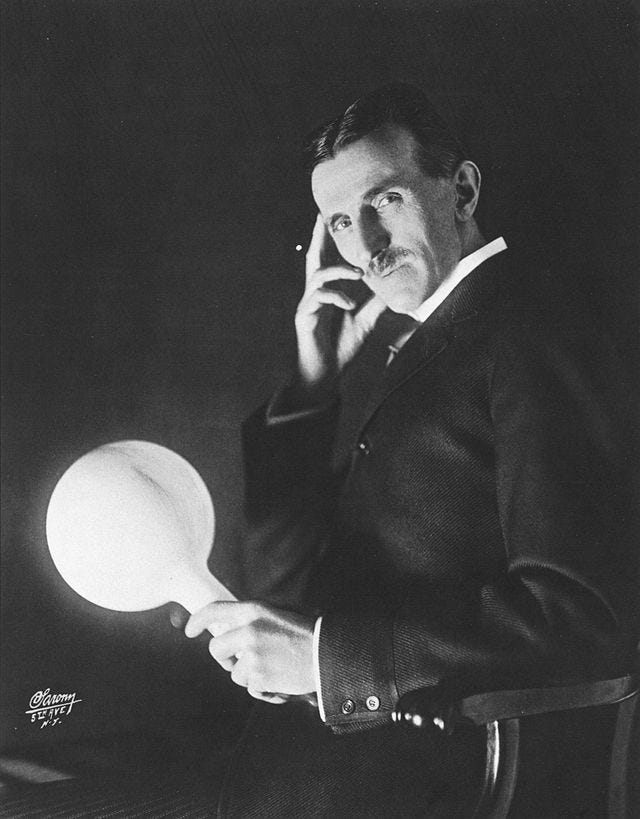
Tesla’s reputation as an eccentric was not only due to his attitude toward women. The Serbian genius also espoused views that were controversial even during his lifetime and are nearly scandalous today. In 1935, the editorial staff of “Liberty” magazine asked the 79-year-old Tesla about his vision for the future development of technology. He presented his predictions and, in the process, shared his imagined vision of an ideal society.
Tesla stated that by the year 2100, eugenics would be widely accepted. In his opinion, a misguided sense of compassion had led to a situation where humans unnecessarily began interfering with the forces of nature, resulting in the breeding of “unfit individuals.” He explicitly asserted that the only chance for civilization was to prevent the reproduction of individuals deemed unfit for society through conscious control of reproductive instincts and compulsory sterilization.
Nikola Tesla and Contemporary Smartphones
While Tesla’s vision of an ideal society can be considered at least controversial, his technological ideas undoubtedly surpassed his time. The Serbian scholar envisioned a revolution in wireless technology, picturing a world without wires, where remotely transmitted energy circulates freely. In his view, the wireless revolution was to transform the Earth into a vast brain, with individual particles forming a cohesive whole. This prophecy also mentioned devices that we, in modern times, first called mobile phones and now refer to as smartphones.
Nikola Tesla foresaw that, regardless of distance, through telephony and television, we would be able to communicate without any delays, hearing our voices and seeing each other as if conducting a face-to-face conversation. He also predicted that the devices enabling this communication would fit into the pocket of a vest.
The brilliant scholar passed away on January 7, 1943. His body was found in one of the New York apartments. We may never know how many groundbreaking technologies he managed to develop before his death, as all his projects and scientific notes were confiscated by the United States government.
Attention all readers!
As content creators on Medium.com, we face minimal compensation for our hard work. If you find value in my articles, please consider supporting me on my “Buy Me a Coffee” page. Your small contributions can make a big difference in fueling my passion for creating quality content. Thank you for your support!


