
Nietzsche: 5 Secrets To Become Who You Are? (7/8)
How To Create Yourself And Become Who You Are?
#1 Break Away From The Herd Mentality: Adapt The Solitude
Friedrich Nietzsche’s philosophy revolves around the idea of breaking free from the herd mentality of following the crowd because this type of thinking is destructive and can lead to unhappiness.
“You have no idea what you are experiencing; you run through life as if you were drunk and once in a while fall down a staircase.”
Those who are willing to forsake the company of others and live life on their own terms will be better suited for greatness.
Those who are content to stay within the herd mentality will eventually become complacent and stagnant, unable to take advantage of opportunities or advance in their careers.
“We want to understand who we are, to correct error, to avoid deceiving ourselves, to get beyond comfortable falsehood”
It is not possible to do this through imitation, but through developing one’s own unique perspective.
Instead, he recommends seeking out solitude in order to be able to create something truly original and understand one’s own motivations. This approach, he says, will help us become more self-reliant and independent.
#2 Know Who You Are: Understanding Your Instincts
His philosophy centers on understanding oneself and one’s instincts. People should know themselves and their instincts in order to be successful. The following are some of his tips on how to do this:
- Be honest with yourself — don’t try to be someone you’re not. Be true to who you are, and accept your flaws as part of who you are.
“Self-discovery is the most difficult journey that human beings have to take, which confirms that life is a means to knowledge.”
2. Don’t avoid or shy away from difficult situations — faced with a difficult situation, don’t try to avoid it or run from it; face it head-on and figure out a way to deal with it. Challenges will help you grow as a person.
3. Don’t ignore your feelings — emotions are important, and should be respected. If something feels wrong or dangerous, trust your instincts and take action accordingly.
“Only when we really know who we are, can we accomplish what we want and actually become who we are.”
4. Don’t be a victim — when you’re in a situation of powerlessness, it’s easy to become passive. You may not like the way things are going, but don’t let that put you in a defensive position.
5. Use your resources — there are ways to make the most of the situation. If you are a woman, don’t let men make all decisions for you. Don’t let them tell you what to wear or how to act. If they’re hitting on you, leave!
#3 Embrace Your Uniqueness And Suffering
He argues that one must embrace their uniqueness and suffer the negative consequences. We can learn a great deal from our suffering and that it is a necessary part of life.
“Few are made for independence — it is a privilege of the strong”
Overcoming suffering is one of the most important things we can do. Greatness comes from embracing one’s weaknesses and this requires a great amount of courage.

In his book “On The Genealogy of Morals”, he discusses how people who are able to do this are the ones who will be remembered for eternity. It is only through overcoming suffering and difficulty that humans can reach their full potential.
“How can the human being know itself? It is a thing dark and veiled; and if the hare has seven skins, the human can slough off seventy times seven and still not be able to say, ‘Now that is what you really are, that is no longer outer shell.’”
Some believe that he is advocating for the individual to become comfortable with their own weaknesses and flaws, while others believe that he is encouraging individuals to find meaning in their hardships.
In any case, his philosophy can be seen as a way of coping with adversity and building resilience.
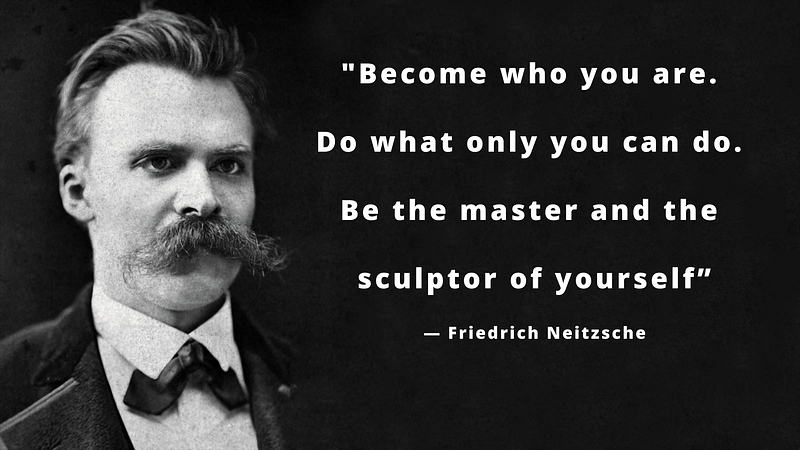
#4 Do The Thing That You Think Only You Can Do It
In “The Will to Power” he stresses the importance of doing what you think is only possible for you. This is often interpreted as advice to live in the moment, do what makes you feel suffer, and not worry about what others might think.
We should be true to ourselves and do what we feel is best for us, even if it means creating who we are or what others expect from us.
We are our own creators and we have the power to shape our own destinies. He encourages us to be daring and take risks, even if they are uncomfortable.
By doing something great, we can create a legacy that will be remembered long after we’re gone.
“Direct self observation is not nearly sufficient for us to know ourselves: we need history, for the past flows on within us in a hundred waves.”
People should be autonomous and not rely on others to make decisions for them. This type of self-assertiveness will lead to our own happiness and fulfillment.
This is a valuable piece of advice for anyone looking to achieve their goals. The idea is that if we can identify what it is that we are truly capable of doing, then we can focus our efforts on achieving those goals.
This perspective can help us overcome any obstacle or challenge that comes our way.
#5 Create Your Own Values: Take Risks And Be Bold
Nietzsche’s philosophy revolves around the idea of creating one’s own values and living by them. This advice urges people to take risks and be bold because these actions are the only way to find true happiness.
“There is a false saying: “How can someone who can’t save himself save others?” Supposing I have the key to your chains, why should your lock and my lock be the same?”
For him, it is important to follow one’s own conscience rather than blindly following society or traditional morals.
He suggests that you should not be afraid to break away from traditional ideas and customs if they no longer serve you. Instead, strive to create your own values based on your own unique experiences and beliefs.
“At the bottom of us, really “deep down,” there is, of course, something unteachable, some granite of spiritual fatum [personal fate or destiny], of predetermined decision and answer to predetermined selected questions. Whenever a cardinal problem is at stake, there speaks an unchangeable “this is I.”
This will allow you to find happiness and create meaning in life, regardless of the circumstances. By embracing risk and being bold, you can truly create your own path in life and can determine what is truly important to you in life.
Nietzsche believed that conventional morality was a dead end and that people should instead create their own codes of morality. By doing so, they can find meaning in their lives and become truly satisfied.
To be continued……
I appreciate your time spent reading my article. do not forget to comment, follow, clap, and highlight. Drop your thoughts, Let’s support authentic thoughts!
✔️ Please subscribe here to receive latest insightful stories by email