
Nietzsche and Redemption
How a thought experiment about time unburdens us of shame
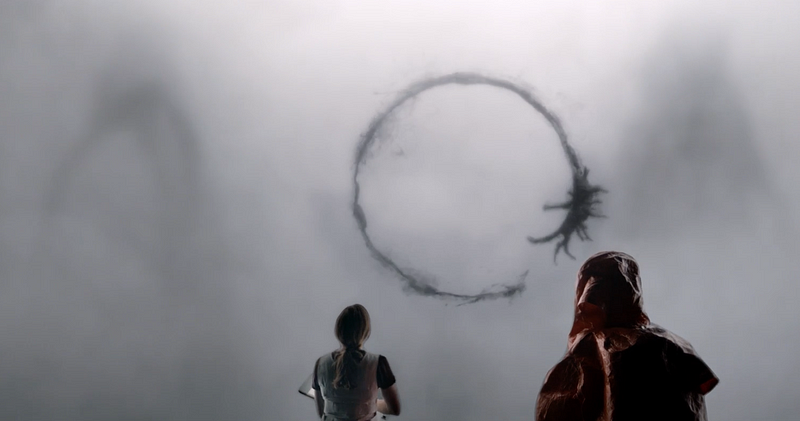
In the film Arrival, based on a short story by Ted Chiang, Dr Louise Banks, an academic linguist, is recruited by the US Army to investigate an extraterrestrial landing site. During a number of contacts she is confronted with the knowledge that everything in her life is determined, that “free will” is a fiction.
While the story explores the complexities of contacting extraterrestrial life, language, philosophy and even international relations, it is ultimately about suffering. The discovery enables Banks to a look at all the suffering in her life in a new way, empowering her to face the most tragic aspects of her life in a calm light.
Friedrich Nietzsche, as I have outlined in a previous article, suffered immensely throughout his life. His father died when he was just five years old. He had problems with his sight that left him almost blind, and had been sickly almost all his life having been afflicted with injuries and disease as a soldier in the 1860s and later as a medical orderly in the Franco-Prussian War of 1871, a conflict which also left psychological scars.
Nietzsche had also suffered deep emotional upsets in his adult life. Lou Andreas-Salomé, the woman he loved and proposed to a number of times had spurned him and eventually abandoned him in 1883.
Because of his infatuation with Salomé, Nietzsche endured a rift with his sister and mother in the 1880s. His radical ideas alienated him from philosophers in the academic community, killing his chances of resuming his distinguished career. Nietzsche became a damaged loner, a man who endured illness and suffering with only ideas to comfort him.
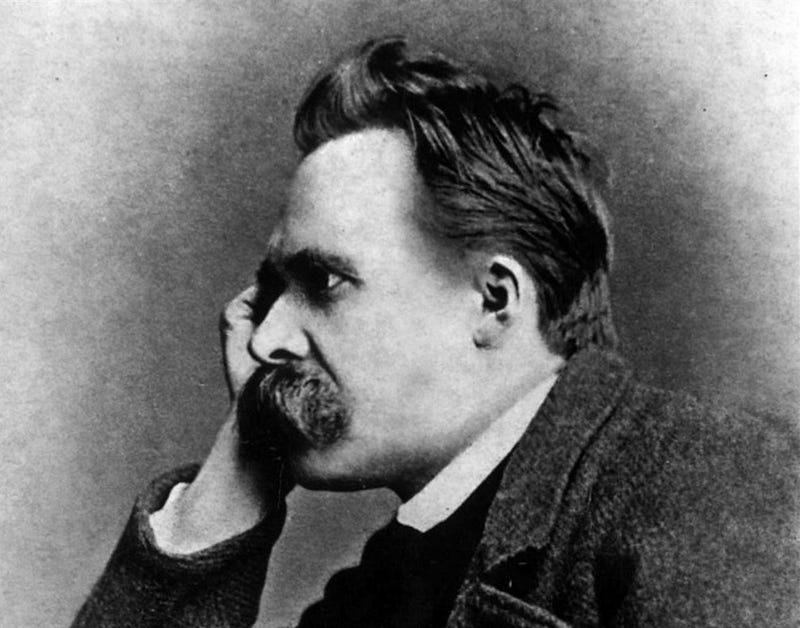
Yet it was in the wilderness years of the 1880s that Nietzsche wrote some of his most lucid and beautiful philosophy. It was writing produced at this time that outlined some of Nietzsche’s most optimistic ideas about the potential of human beings for invention and creativity.
Nietzsche is the great philosophical therapist — or a coach, if you like — who gives us the tools to take everything bad that life throws at us and still find happiness. One of these tools was Nietzsche’s unique theory of redemption.
Traditionally redemption is a moral concept. It is the making up for failings. We make mistakes, we may do wrong, we feel guilty and we seek redemption. We can do that by fixing what was broken, by seeking forgiveness, or simply by acknowledging what went wrong and expressing regret.
The will seems powerless to change what has been done, and indeed is powerless to fix anything that went wrong or badly. In Thus Spoke Zarathustra, he wrote:
“Powerless against that which has been done, the will is an angry spectator of all things past […] It is sullenly wrathful that time does not run back; ‘that which was’ — that is the stone which it cannot roll away is called.”
But would we be the same if what we experienced in the past was different?
Free Will
Like the ancient Stoics, Nietzsche believed that “free will” is a fiction. In his groundbreaking book Beyond Good and Evil, Nietzsche tore down the notion of free will, likening it to Baron Munchausen pulling himself out of a swamp by his own hair. Moreover, Nietzsche believed it was a myth perpetuated to make people feel guilty for their actions. “Free will” allows us to be judged.
Nietzsche’s view was that our consciousness of our actions was not the same as having absolute control over our destiny. Our emotions, thoughts and actions are a byproduct of forces out of our control.
Nobody has a sufficiently free will to be entirely responsible for their actions. We have “will”, but its freedom is variable depending on the individual. You are a product not only of your own actions but of everything that has happened up until this moment.
Nietzsche believed that the freest among us can “will” themselves to their goals, but must understand that they are not entirely free to be able to do so.
Amor Fati: The Love of Fate
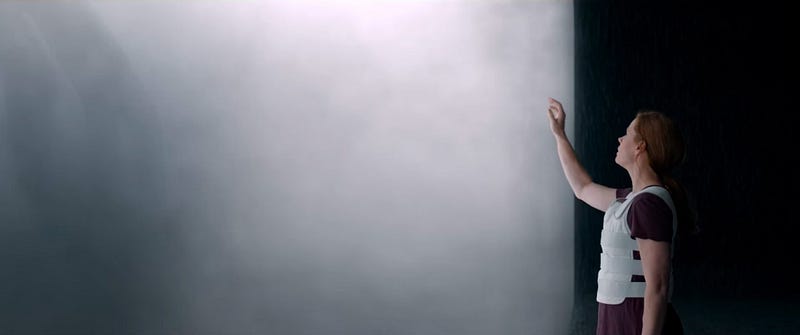
Nietzsche, a master of language, started to use the Latin phrase “amor fati” in his work.
This phrase, meaning the “love of fate”, is often misattributed to Marcus Aurelius, the Roman emperor and Stoic philosopher, who wrote words to similar effect, but never actually wrote in Latin (Marcus wrote in Greek which — like English now — was the international business language in Roman times).
By “amor fati”, Nietzsche meant an attitude to life that would embrace all that happens in life — including suffering and loss — as necessary and therefore good.
To love fate is to wish that nothing in your life was different. As Nietzsche explains:
“My formula for greatness in a human being is amor fati: that one wants nothing to be different, not forward, not backward, not in all eternity. Not merely bear what is necessary […] but love it.”
It’s hard to convey just how radically optimistic this attitude is.
We can’t go back in time to make things right for ourselves, but we can acknowledge that was has been done in the past is what makes us what we are today. Nietzsche is not just referring to the actions we take, but the whole web events that our very being is woven into.
“If we affirm one single moment, we thus affirm not only ourselves but all existence. For nothing is self-sufficient, neither in us ourselves nor in things; and if our soul has trembled with happiness and sounded like a harp string just once, all eternity was needed to produce this one event — and in this single moment of affirmation all eternity was called good, redeemed, justified, and affirmed.”
Redemption
Nietzsche went even further. He elevated the principle of amor fati to the level of redemption. The very embrace of fate is not just the key to enduring life, but the path to spiritual perfection.
In one of the most extraordinary passages of Thus Spoke Zarathustra, Nietzsche writes that our attitude to time must change to truly “redeem” ourselves and the world.
As Zarathustra — Nietzsche’s mouthpiece in the book — crosses a bridge, he is accosted by ‘cripples and beggars’ (the book was written in the nineteenth century, so excuse the antiquated language). A hunchback (a very common condition in the nineteenth century) tells Zarathustra that for people to be truly convinced of his teaching, he must “cure the blind and make the lame walk.”
Those of us brought up as Christians will see an immediate parallel between what is asked of Zarathustra and the works of Jesus of Nazareth. It is often repeated in the Gospels that people were convinced of Jesus’s teachings when he performed miracles such as healing the sick and the crippled.
Unlike Jesus of Nazareth, Zarathustra refuses to perform miracles. He tells the hunchback that the crippled and blind would learn nothing from being cured. If the blind could see, Zarathustra reasoned, they’d see many bad things in the world and “curse the man who cured them”. His point is that merely curing blindness is not sufficient to cure the soul.
Furthermore, the hunchback is told that “if one takes the hump away from the hunchback, one takes away his spirit.”
This remarkable statement is key to Nietzsche’s own brand of Stoicism. Like the ancient stoics before him, Nietzsche believed the obstacle or the burden is the way. Our disadvantages and handicaps, the Stoics reasoned, are to be embraced as necessary. We can turn all that is misfortunate to our advantage.
Nietzsche’s addition to this was that to truly create ourselves, we must will backwards as well as will forwards.
“To redeem the past and to transform every ‘It was’ into an ‘I wanted it thus!’ — that alone do I call redemption!”
The point Nietzsche (in the guise of Zarathustra) is making is that to truly create yourself, to achieve the ideal of self-actualisation, you must not only reconcile yourself with the past but fully affirm it, to say: I would never be who I am now if it were not for all that came before this moment. By taking this transformative perspective on things, you “will” the past as much as you “will” the future.
Eternal Recurrence vs. Eternity
Nietzsche proposed the idea of “eternal recurrence” to be the benchmark of how we assess our actions. The concept is very simple: would we act in the same way if we knew it would be repeated for eternity?
Some people are confused by eternal recurrence. They think that Nietzsche literally believed that your actions would be repeated for eternity.
The best way to think of eternal recurrence is to compare it with religious morality. In religious morality, your actions are judged to grant you eternity — i.e. the afterlife. Nietzsche did not believe in eternal life, but instead posited the idea of impermanent life eternally repeating.
As such, eternal recurrence is an alternative ethical benchmark to religious ethical systems. Most religions promise a better life (i.e. Heaven) or a worse life (Hell) in an eternal world beyond ours depending on our conduct in this life. Nietzsche’s ethic simply asks, would you be happy if your life — as it is right now — was repeated over and over in eternity? If not, why not? What would you do to wish your life to be repeated over and over?
“What, if some day or night a demon were to steal after you into your loneliest loneliness and say to you: “This life as you now live it and have lived it, you will have to live once more and innumerable times more; and there will be nothing new in it, but every pain and every joy and every thought and sigh and everything unutterably small or great in your life will have to return to you, all in the same succession and sequence — even this spider and this moonlight between the trees, and even this moment and I myself. The eternal hourglass of existence is turned upside down again and again, and you with it, speck of dust!”
…how well disposed would you have to become to yourself and to life to crave nothing more fervently than this ultimate eternal confirmation and seal?”
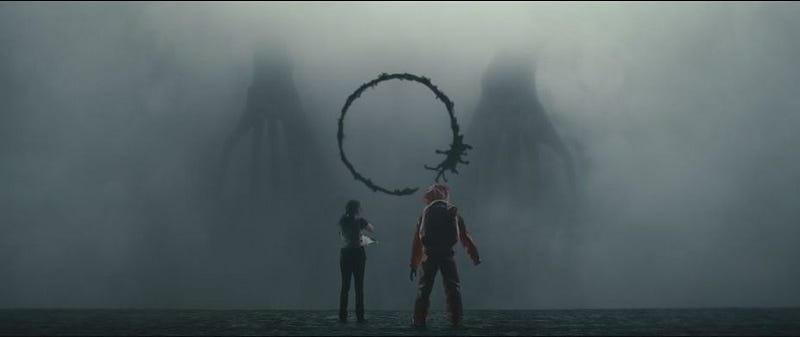
Eternal recurrence — the idea that time is a circle and all things are bound and repeated for eternity — is not a literal belief. Think of it more as part-parable, part-thought experiment. Like Arrival (and The Story of Your Life), Nietzsche’s recurring conception of time is ultimately about suffering.
This novel perspective of considering our lives and our choices is a way of redefining pain and uncertainty. Our treatment of these facts of life have hitherto been escapist and conformist. In eternal recurrence, Nietzsche wrote that we have a “new means against the fact of pain” by conceiving it as “a tool, as the father of pleasure”, and that uncertainty can be “enjoyed”.
Unlike Louise Banks in Arrival, we’ll likely never know the secret of whether or not we are in control of our destiny, or to what extent we are. The point Nietzsche is making is that we need not know. Eternal recurrence is a tool to help us live, not to explain life.
Nietzsche’s philosophical ideas of fate, redemption and eternal recurrence are not cosmological (not literally about the universe), but therapeutic — for individuals and for all of mankind. With these tools, Nietzsche believed we could all free ourselves of suffering too much, not only through pain, but also regret, guilt and shame.
Try this thought experiment: think of a painful part of your past, or a great regret. Do not dwell on the pain, do not think “it happened”, think instead of where you want to be, the pleasures you want to know, your better, stronger self. Now think of that past moment again, and think “it had to happen, it is part of the story of what I am becoming. As such I want it that way.”
Thank you for reading. I hope you learned something new.
Nietzsche is often considered as an early existentialist. If you enjoyed this article, you might like my article on existentialism:


