
You are Condemned to be Free
Finding Truth and Purpose in Existentialism
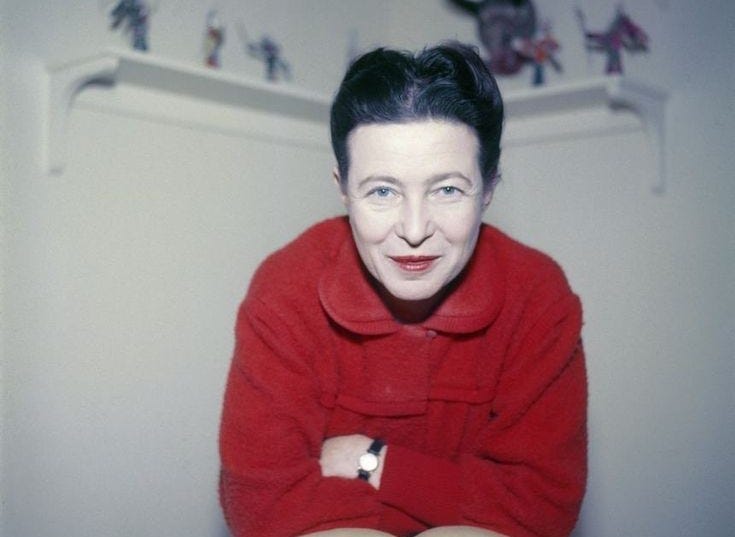
“It is in the knowledge of the genuine conditions of our life that we must draw our strength to live and our reason for acting.” — Simone De Beauvoir
Jean Paul-Sartre’s ideas for his Existentialist masterpiece, Being and Nothingness, began to form while being held as a prisoner of war in 1940. After release, he helped establish an underground resistance group with his partner Simone De Beauvoir to oppose the Nazi occupation of France.
The Paris that Sartre worked in was a “sham”; the wine bottles displayed in shop windows were empty, all the wine had been taken to Germany. An estimated 32,000 French people were working as informers for the Nazis. People disappeared overnight. Their relatives would say that “polite” German officers had come for them. In their apartments you’d find stubbed out German cigarettes. Cafe conversations were stilted; people avoided talking about anything important, lest they themselves would get a polite visit from the occupiers, or “the others” (les autres) as they were known.
It’s fitting then that freedom is absolutely central to the philosophy of Existentialism as defined by Sartre and Beauvoir. However, we’re not talking about a cosy idea of freedom as liberty from constraint.
Freedom as Sartre understood it is a fundamental aspect of human experience that causes us more pain than we’d like to admit (I will get to this later).
Existentialism is a challenge laid down to us, to be brave and embrace the freedom at the heart of our nature. If we do so we will not only find meaning and purpose in our lives, but also become better citizens of the world.
No True Self
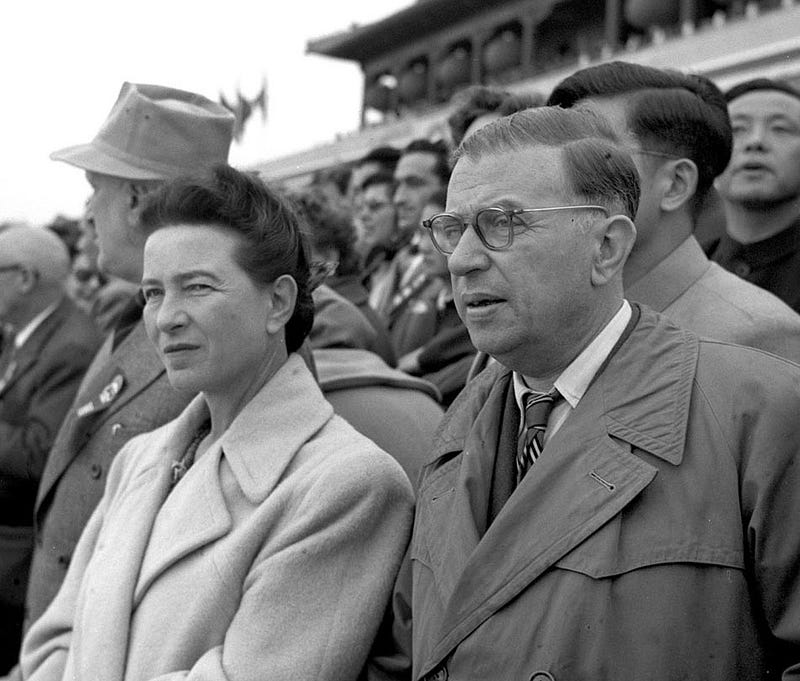
Sartre coined the most famous maxim of Existentialism in a 1945 lecture (L’existentialisme est un humanisme):
“Existence precedes essence”
Our understanding of our essence or “the self” is in many ways conditioned by the religious idea of the soul. That is, “the self” is a hidden essence of what we are. In casual language, we often talk of “our true self”, or our “hidden self”, or we go about trying to discover our “true self”, as if the self that we currently are doesn’t correspond to the one that is hidden.
Sartre would say there is no core “self”. There’s no essence to what you are that is there, waiting to be discovered by either yourself or other people. What you are is what you do. You create and recreate your essence in every moment through your choices and the resulting actions. Your existence precedes your essence.
The 17th century theologian and mathematician Blaise Pascal’s advice for non-believers was to get on their knees and pray. As soon as they did, he reasoned, they would be believers.
Sartre would have some sympathy for that idea. It’s no good thinking of your “self” as a brave or charitable person if you’ve neither been brave nor charitable in deeds.
While we have control over our essence in the actions we undertake, we are of course limited in what we can do. I cannot be the president of Brazil, for example, no matter how much I could want to be.
Our circumstances may well have never given us the opportunity to be brave or charitable. But we have more control over our essence than we’d often like to think. We can abseil down a skyscraper or volunteer at a soup kitchen, for example. These tasks are not easy, but if you want to be brave or charitable you need to do something. Sartre wrote, “You can always make something out of what you’ve been made into.” (Situations (my emphasis))
According to Sartre, there are two foundational aspects of what make us what we are and how we make choices: “Facticity” and “Transcendence”, these terms basically describe your true self and your new self.
Facticity: Your True Self
Facticity is what is basically true of us at a given moment. In a sense it’s our static “true” self, a collection of facts that describe us. For example, I am English, I have a driver’s licence, I do not own a car, I live in London, England, I have brown hair (turning grey), I can play the guitar, but not very well.
These facts could go on and on, and it’s possible for one given moment there could be an exhaustive inventory of facts about me that describe what I am at that moment. Facticity is us as inert matter, as “stuff”. Facticity is also the background against which our freedom exists and is limited to.
There’s nothing I can do about where I was born, that fact just is and that fact can restrict the choices I have in my life. Facticity can also outright preclude choices. For example, I could never be a professional basketball player because of the facticity of my height.
Transcendence: Your New Self
What facticity does not take into consideration is potential. As conscious human beings we have the potential to change our facticity — the inventory of facts about us. This is because we are to a greater or lesser extent free to do so. The only time that a human being can be pure facticity is when they are dead.
Human beings are full possibility and possibility transcends facticity through choice. While we do have a set of facts about us that are true right at this second, we always have the ability to change what we are, moment to moment. For example, I could have just decided that I will run a marathon next year; the facts about me just changed.
Your True Self and Your New Self Work Together
Facticity and transcendence are interconnected, we are neither completely either of them, and they are bound together as we live out our lives: transcendence is limited by facticity (for example, I am too short to ever be a professional basketball player), and facticity is recreated by transcendence at every moment we make a choice (I decided to run a marathon, so it is now a fact that I am now training to do a marathon). These two aspects of my being are like a double helix spiralling into the future as I make my choices.
Facticity and transcendence always reminds us that we don’t have to be this way. You may be unhappy with some facts about yourself, transcendence reminds you that you can change that. The responsibility of knowing that often terrifies us, it gives us anguish. It’s rare to feel this anguish because more often than not we are distracted from anguish by necessity.
We have to get up in the morning to go to work by necessity, sure, but the fact that we work a 9 to 5 job is ultimately our choice. Necessity is therefore a superficial distraction from the anguish which comes from freedom. So where do we hide when we’re truly confronted with our own decisions?
Bad Faith
Faced with the anguish that transcendence poses us with, we take refuge in excessive facticity, we try to wholly embrace being an object. Sartre uses the example of a waiter (Sartre was probably writing in a cafe at that moment). The waiter stands very upright, has affected manners in his speech and he walks in a particular way.
“trying to imitate in his walk the inflexible stiffness of some kind of automaton… his gestures and even his voice seem to be mechanisms…. he is playing at being a waiter in a cafe.” — Being and Nothingness
Sartre points out that this waiter is playing the part of a waiter, he is denying himself his own “self” as a being of possibilities. Does that waiter speak and act in that way when he is among his friends or family? Of course not. He is reconciling himself with what he has faith in as best way to be a waiter and earn some money. The key word being “faith” — bad faith.
Sartre uses this extreme example to show that we are all susceptible to bad faith. We describe ourselves and make proclamations about what we are to objectify ourselves for other people. We do this because to truly take control of our lives requires an immense amount of effort. Possibility is anguish, and bad faith as a way of precluding it (not merely distracting us from it).
Embracing Authenticity
Sartre wrote of an “ethics of authenticity”, but never really built this idea into an ethical system that could explain good conduct. Sartre believed sincerity to be the opposite of bad faith, but sincerity is neither intrinsically virtuous, nor does it account for why we enter into bad faith in the first place. Sartre struggled to account for virtue.
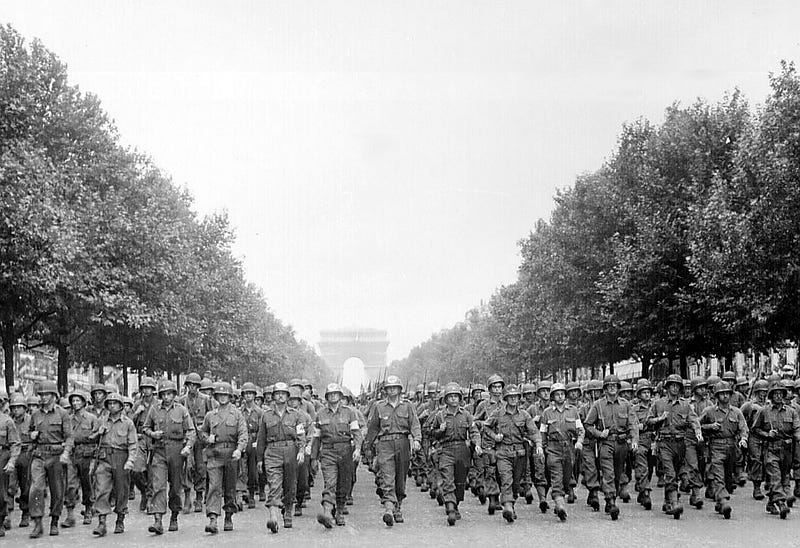
His life-long companion Beauvoir could. Beauvoir wrote The Ethics of Ambiguity in 1945. At the time of writing Europe was once again in flames as the Allies drove the Nazis back to Germany. This smaller book took much of Sartre’s theory about reality (his “ontology”) as a basis on which to build a moral system.
Ambiguity as defined here is Beauvoir’s distillation of the conflict between facticity and transcendence. Our freedom comes from the nothingness (the lack of essence) inside of us, but we are constrained by our facticity. We are both subject and object, a free agent and just a “thing”.
The crux of Beauvoir’s moral argument is as follows: our freedom is dependent on other people’s freedom. In order to be more authentic and free, we must work to making other people more free, we must therefore not treat other people as things.
This is an enormous step up from Sartre’s original idea of freedom. Beauvoir addresses the interconnectedness of human beings, and in doing so she recognises that our freedom is interconnected too. Freedom becomes not just a matter of authenticity (i.e. creating meaning for yourself in a meaningless world) but also a matter of ethical responsibility.
Our attitude to the fundamental nature of our freedom can vary. To simply know our freedom is not sufficient to be truly free, and certainly not virtuous.
Personal Freedom and Other People
Beauvoir devises a number of types of people who know their freedom, but act to ultimately avoid the responsibility of their freedom: The nihilist, the adventurer, and the passionate. These people are not in bad faith, in effect they are sincere: they choose their own values, and make their essence. However, they do so in a way that skirts their ultimate freedom, which is to make other people more free.
Beauvoir wrote:
“Men of today seem to feel more acutely than ever the paradox of their condition. They know themselves as the supreme end to which all action should be subordinated, but the exigencies of action force them to treat one another as instruments or obstacles, as means.”
The Nihilist understands that the world is meaningless and that their destiny is in their own hands, but they reconcile with this fact by believing in nothing. Beauvoir wrote: “The nihilist is right in thinking that the world possesses no justification … but he forgets that it is up to him to justify the world and to make himself exist validly.” (my emphasis) This self-contempt manifests in the contempt for other people, since the nihilist has no morals, they believe in nothing.
Unlike the Nihilist, the Adventurer and Passionate find purpose but subordinate other people to their purposes. The Adventurer is not invested in the destination but the journey itself. “He likes action for its own sake.”
The Passionate cares about their destination, but in doing so will use other people to get them to their goal. The passionate sees other people as a means to an end. Both these types share the nihilist’s contempt for other people because they treat people as “instruments or obstacles” in reaching their goals.
The truly free
For Beauvoir, the truly free are those that recognise and respect the freedom of others. “To will oneself free is also to will others free,” she wrote.
“Since the individual is defined only by his relationship to the world and to other individuals; he exists only by transcending himself, and his freedom can be achieved only through the freedom of others. […] Man is free; but he finds his law in his very freedom.”
To find your “law” in freedom reads like a paradox, and it’s that paradox that gives us the anguish that Sartre wrote about. Freedom is a challenge not just to live your life with purpose but also to find meaning with other people. We can try to hide or shrink from the challenge, but if we embrace it as much as we can, we become better people.
Thank you for reading. I hope you learned something new.
If you found this article interesting, you may like to read my article on Friedrich Nietzsche, who also believed that we must create our own meaning for life: