
Nick Cave and Warren Ellis Talk About “Carnage”
A Conversation About the Album
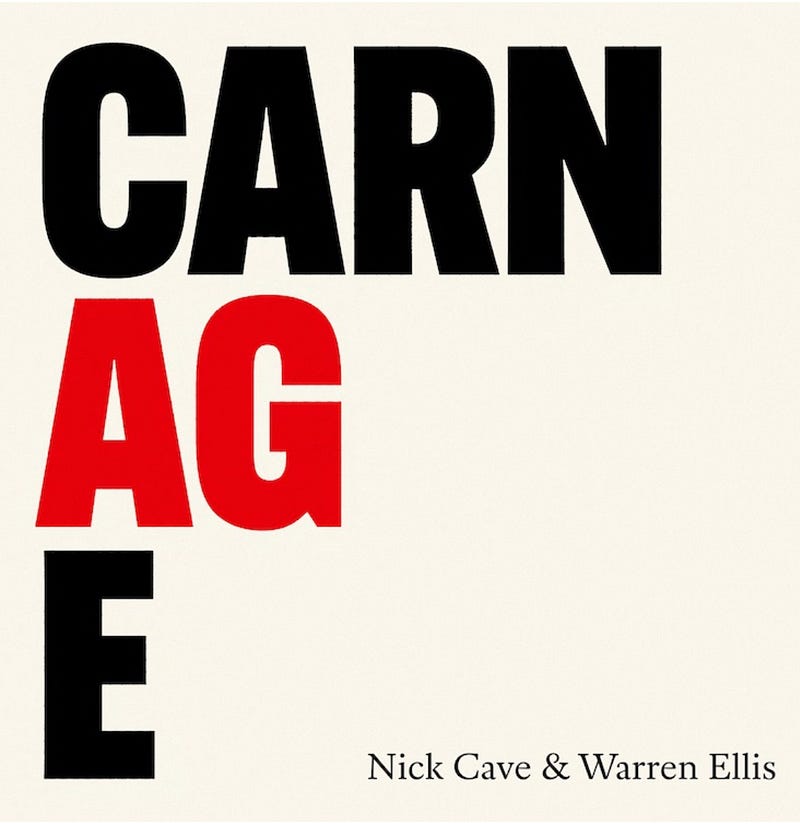
For two men who are as media-shy as Nick Cave and Warren Ellis, events such as tonight’s candid conversation, recorded live — where the pair got together over a good old chinwag, answering fan questions, and also discussing their collaborative dynamics relative to their most recent album, Carnage — are a pure gem.
One thing I think gets particularly overlooked with the “Prince of Darkness” label cast on Nick Cave is the man’s sense of humor, and from the outset of the conversation, you can feel these two humble musical geniuses riffing off each other with delight, especially when a fan asks if Warren Ellis is the Yoko Ono of the band who caused Cave to “split” from the rest of the Bad Seeds. The humility in Warren’s answer, in that he finds the question insulting to Yoko, because “she’s awesome and I’m not,” is not only cute, as it is moving.
We get the very clear feeling that both musicians have an intense admiration for each other and, as Cave says, ”I feel that the ideas that I have are just made a lot better when I collaborate with you.”
And, to an extent, this much is true: were it not for the rich inventiveness of Cave’s collaborators, especially Ellis, one gets the feeling that Cave’s songs, simply, at the piano, would be more those of a witty, hyper-literate balladeer than the more experimental direction Ellis pushes them towards.
You can hear it in every song these two write: if Ellis is the particle accelerator, then Cave becomes the accelerated particle. Cave points out that the freedom he feels to ad-lib his ideas over Ellis’ musical soundscapes comes precisely from the fact he is not playing the piano, and that he does not know where things will go once they are out of his hands.
One of the things I adore about the Bad Seeds music, and especially the Ellis-Cave dynamic is how, since the departure of guitarists Blixa Bargeld in 2003, and Mick Harvey in 2009, following “Dig, Lazarus, Dig!!!” there was a great big guitar-shaped-hole left to fill, which was the moment Ellis stepped into his own, in 2013’s “Push the Sky Away,” gently leading the band away from their rock roots towards more experimental moods.
With the Bad Seeds’ music at it has been since then, I am constantly surprised by everything new they put out because it is just that: entirely new and different from the last. They never rehash old formulas, and this has been one of Cave’s main concerns as an artist from the beginning of his career from The Boys Next Door, to The Birthday Party, to The Bad Seeds.
“That is a trust issue, because we very much allow each other the room to do things that don’t work.” (Nick Cave)
In listening to Cave and Ellis’ conversation, I was surprised to know how close I came in my “Carnage” album review to the actual main themes and intent of the album as professed by the musicians themselves, which was that it was an album chronicling catastrophe from on high, all the attempts to flee it being foiled and that any movement that happens, does so in the imagination and memory of Cave’s characters in the songs.
We also learn that “White Elephant” was a poem that Cave read into the mic in between takes and when they reconvened the next day, Ellis had put the heavy, bass-saturated beat to it which, Cave says:
“The beautiful thing about it is that I didn’t perform that song to the beat, if I had to perform that song to a beat, and a driving thing that it is, it wouldn’t have that kind of soft, lazy, sort of feel, contemptuous sort of feel. (…) I really loved the restraint of the vocal against the drive of the music.” (Nick Cave)
The song “Albuquerque,” was a metaphor born of a real story about Susie Bick, Cave’s wife. When she was three and living with her family in Africa, she was taught to swim by being pushed off a boat to swim to another boat which, he says, literally turned it into a song about not going anywhere.
As for each man’s favorite songs, for Ellis, they are the sumptuous “Lavender Fields” and the very eerie, yet still melodic “Carnage.”
“I heard “Lavender Fields” the other day, just by chance, somewhere on the radio or something and it really kind of moved me, so I’d say Lavender Fields” (Warren Ellis)
And he is right: how not to be moved by “Lavender Fields” in its grandiose, ceremonial string and horn arrangements.
One of the pertinent statements from a fan was that upon a first listen, “Carnage” seems weak and lo-fi, but commands a second listen. And by the third listen, the magic has come through, likening it to what the fan calls a “reverse narcotic,” which Warren agrees with. For him, making a record that divides people and takes risks is far more important:
“I find it more terrifying when people would just say ‘Oh, it’s like the last record,’ that’s way more terrifying to me.” (Ellis)
If the record is lauded as somewhat apocalyptic, it is no more so, says Cave, than the daily micro-catastrophes in life through which we grow and change. While he does admit that it is impossible to listen to without the sense of catastrophe, it is nonetheless filled with hope.
“I am not ever interested in writing hopeless songs, all our songs that we always do are hopeful, they may be coming out of disasters, and they may be coming out of the sorrows and things like that, but there’s always an upward trajectory towards the songs.” (Nick Cave)
What is also interesting in this conversation is the working dynamic of the pair, when Ellis admits that he really cares less about form than Cave, which is something the latter pushes Ellis towards every time, definitely because Cave, as a storyteller, is necessarily cloaked in structure.
At the end of the day, having filled myself on this candid conversation, guffawing at some points, nodding in full agreement at others, I am truly moved by how similar the way I listen to and think about music is to theirs. I just wish I had an inkling of their talent. That said, I mustn’t be so hard on myself: I only unlocked my compositional approach to music a few years ago; these guys have been at it since the late 70s.
I hope you all enjoy this conversation about making music and what art means, and what it should do as much as I did tonight. Thanks for reading! You can listen to Nic and Warren’s intimate, insightful chinwag here:
© Pedro B. Gorman
18.6.2021