
The Carnage in the Cave
Music for the Curious: Nick Cave and Warren Ellis’ Crisis Record
The pandemic might have frozen the world in its tracks, but Nick Cave remains relentless in his output, having released “Ghosteen” in October 2019; in November 2020, a solo piano performance film and album, “Alone at Alexandra Palace;” and now, “Carnage.”.
Be it in the work he does with his band, the Bad Seeds, or in his many side projects, Cave has gone from strength to strength in adding to his diverse body of work; be it as novelist, film director, poet, singer-songwriter or rock star.
A messianic-looking, sharp-suited prince of darkness air all about him, he is a writer who enjoys throwing together the most disparate, symbolic characters, plagued by imagined or real, outer demons, then gently shoving them through the metaphorical meat-grinder of extraordinary, epiphanic plights. Cave has always thrived on the gritty lows of life, on the stories of the dispossessed; of those driven mad; over the course of decades, he has created a veritable written “beastiarium” of loons, monsters, beasts from his own mythologies, serial killers, false prophets, and small gods. Then he finds them musical homes.
Over the last year, the whole world was put through its own meat-grinder of extraordinary plights, and the comparison seems appropriate that we have all become characters in a Cave song — he put out the whorls of his telepathy fingers, heard us, conducted our fears, and made an album of it.
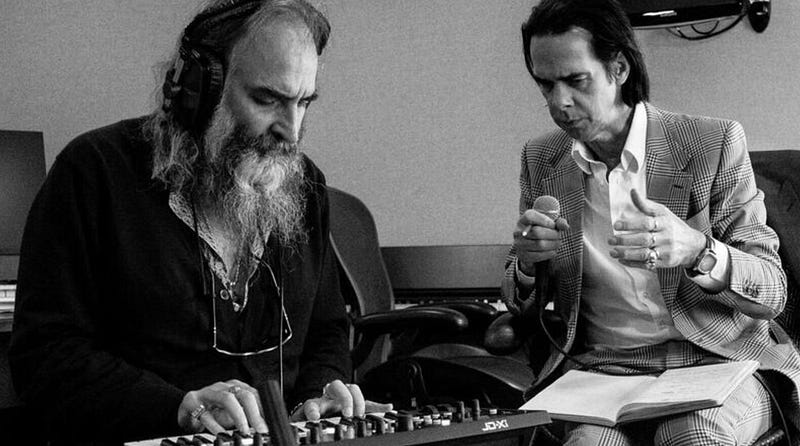
While Ellis and Cave — the main songwriting duo of the Bad Seeds — have often composed and released commissioned soundtracks outside the band, this is the first album by the pair in their own name, created and recorded during the pandemic. A concept album of expertly crafted poetry, recitation and musical experimentation; for me at least, this is doubtless what I call a sonic chapbook. Do not expect songs. But expect exquisite mind-moods.
If you are not acquainted with the intensity of Cave’s work, here is an official trailer to an exhibition he arranged containing a plethora of real Cave memorabilia — reproductions of his works spaces, old furniture of his; notebooks, artwork, entire libraries of his books, room decorations, his typewriter. Then you’ll know what you’re up for.
The tonality of the record is such that it evokes a prophetic tone in tune with the times — a catastrophe always implicit, never named, with all the biblical weight of a holocaust. Cave intimately takes us by the hand through apocalyptic vistas, processes of loss and grief, transcendence through pain, visions of celestial kingdoms, and exhausted, yet hopeful sunrises.
With Cave’s former narrative style subdued in favor of greater abstraction through the conventions of poetry, he delivers each piece with the malleable, idiosyncratic inflections of a method actor possessed by each of his characters’ voices. There are maddened mumblings, there is recitation; quasi-sermons from the pulpit; there is lamentation and pleading, rich monologues are delivered in dejected tones; soothing moments of intimate, confessional whisper and brief snatches of song.
The opening track, “Hand of God” uses classic storytelling convention in the sense that for its first twenty-five seconds, we are presented with the normal world in what starts as a piano ballad.
“There are some people trying to find out who There are some people trying to find out why There are some people aren’t trying to find anything But that kingdom in the sky In the sky.”
Nick Cave
But it is soon disrupted by the transonic boom of Ellis’s violin soaring across the sky — as if vengeance from on high — followed by a manic beat reminiscent of a heart throb. Catastrophe strikes, and a psychotic mantra obsessively and shrilly chants the words “hand of God” as Cave recites impending doom over it.
It acts as a sort of biblical, Old Testament apocalyptic voicing: of an exhausted God enacting vengeance on his wayward children. Yet, to me at least, it also stands as a potent hymn to humility and reverence. Leave it to us humans, in our arrogance, to think we are invincible — the apex predators — and yet that which brings us down is the microbial; the unseeable, that which defies our best or worse intentions. It is, to me, a song of baptismal fire…of rebirth in the face of catastrophe.
“Old Time” sees us hit the road, evoking the hum of the engine, the rimshot click of triggered time and emotional miles, as if running from the beast in the shadow of ourselves, bags in trunk to escape disaster.
“By the side of the road is a thing with horns Steps back into the trees. And a child is born Upon this trembling earth Displays each day Thrown across the hallucination of your hair A strip of ordinary sun, a biblical sun A colonial sun, an enlightened sun The same sun Made always glorious at your head Well, we stop at a motel and go jumping into bed Just like the old times Wherever you are, darling I’m not that far behind.”
Carnage,” contrary to its title, provides much needed relief from the tension of the previous two pieces. There is a sadness in looking back at what we have lost, which Cave’s tone reflects, and the refrains are lifting, grandiose, as if nostalgic for a time just gone. Here, memory is love.
“My uncle’s at the chopping block Turning chickens into fountains I’m a barefoot child Watching in the rain That stepped into this song Took a bow and stepped right out again I’m sitting on the balcony Reading Flannery O’Connor With a pencil and a plan.”
In “White Elephant,” we are kicked into the metaphysical world of iconoclasm, dismantling obsolete mythologies, reinventing them in a pastiche of symbols. The track starts off stark and hypnotic, then moves into heavily orchestrated, layered refrains harking back to a gospel chant of deliverance. It is a piece which gnaws at you on account of Ellis’ slow-oscillating, heavily saturated bass loop and Cave’s paranoid threats, hinting at a devolution back to gung-ho, trigger-happy mentality, where dog eats dog in a post-apocalypse setting.
“A protester kneels on the neck of a statue The statue says I can’t breathe The protester says now you know how it feels And kicks it into the sea.
I am a Botticelli Venus with a penis Riding an enormous scalloped fan I’m a sea foam woman rising from the spray I’m coming to do you harm With the gun in my pants full of elephant tears And a seahorse on each arm With my elephant gun of tears I’ll shoot you all for free If you even think about coming round here.”
Albuquerque” gives us the most song-like structure and delivery of the album, moving us into the sublime loll of love, and the resignation of upended plans. It is the first tender, untainted moment, where all strife has temporarily fallen away.
“This morning crawls towards us, darling With a memory in its paws A child swims between two boats Her mother waving from the shore, darling And we won’t get to Amsterdam Or that lake in Africa, darling And we won’t get to anywhere Anytime this year, darling.”
Lavender Fields” comes over majestic and hymnal, with celestial horns; it feels stately and portentous, with both lyrics and sonic landscape tones evoking the atmosphere of a mass exodus of incommunicable souls.
“I am travelling appallingly alone On a singular road Into the lavender fields That reach high beyond the sky.
People ask me how I’ve changed I say it is a singular road And the lavender has stained my skin And made me strange.
The lavender is tall and reaches Beyond the heavenly cover I plough through this furious world Of which I’m truly over.”
Shattered Ground” on the other hand, is the tale of those left alive, the sound of a battle lost, a song of parting, a complaint to mortality. Here, Cave’s intonation hits you in the heart with its sincerity, as if pleading for one sweet fading memory to keep him warm.
“Everywhere you are I am And everywhere you are I will hold your hand again Only you are beautiful, only you are true I don’t care what they are saying They can scream their fucking faces blue again I will be all alone when you are gone All alone when you are gone And I will not make a single sound Not make a single sound Not make a single sound But come softly crashing down.”
Balcony Man,” the closing track, is the post-apocalypse view from the balcony, how our identity has been compromised. How we see ourselves now through our shattered psyches and rebuild. There is a sunrise/new morning quietude to the closing piece, as Cave softly launches into one of the many things he does best : his piano ballads.
“In the morning sun What am I to think on this balcony, Fred? Where everything is amazing that stays in bed I’m a two hundred pound octopus under a sheet Dancing round your world with my hands and feet And this much I know to be true Yeah, this much I know to be true And this much I know to be true Yeah, this much I know to be true This morning is amazing and so are you.”
It is a work of sparse instrumentation, yet the rich — if at times intentionally overwhelming — textures are expertly constructed in cycles of tension and release, like a breathing organism in and of itself; and when it gets melodic (which it veers on the edge of without ever unfolding full into song) it is heartbreakingly poignant.
It tugs at the very fabric of our discomfort, because our collective, global wound is still gushing, still fresh. With the album’s rawness, its tenderness, the brutality of its circumstance, we get the feeling that there is faith, there is hope, but at the same time one feels driven to ask if it can be any more than a palliative balm for the irrevocably disgruntled hearts of now.
Do yourselves a favor. Listen to the album. I cannot reproduce it here due to copyright infringements, or else I would leave a link. It may not be for everyone, but for those of you who love it, please let me know in the comments.
Clap if you liked the article, and don’t forget to follow. It would mean the world.
Lolling, lapping waves of Love to all our fellow travelers trudging the arid Covid plains.
© Pedro. B. Gorman, 2021