
HELP FOR NEW WRITERS | WHAT TO WRITE ON MEDIUM | BEST STORIES
New Writers: Advice on Types of Stories that Do Best on Medium
And other useful tips for new writers

Hey, we were all new at one point. I started writing on Medium a couple years ago and got serious about writing here. And, since then, I’ve had some ebbs and tides with my writing frequency. But I do know how to purposely increase my earnings on the platform in any given month.
And, I’m going to tell you exactly how you can increase your income from month to month as well as what types of stories I have found to be the best attention-grabbers.
Types of Stories that Are Most Successful
If you want to be a successful Medium writer, then the main thing that you should know is that it is not easy when you are first starting out. But it is also not impossible. It’s going to take some work on your part. But do not worry.
You can do this!
And you don’t have to be the best typical type of writer, either. You can just be yourself. In fact, that’s the best way to be. Don’t try to be anyone else. Be inspired by other writers. But do not copy them. Because even the best writer can’t beat you at being you.
Gauging from personal experience and observation of other writers on the platform, I have found that the best types of stories that get a lot of views and interaction are personal experience stories, relatable stories like stories about relationships, For example. But that’s just one example.
And personal experience stories can include stories about things that you’ve done or gone through in your life, experiences from going places, meeting people, things you’ve seen or witnessed, how you feel about something like walking out in nature or maybe your thoughts and opinions on political issues, religious or spiritual topics, or maybe your views about other current events and what’s happening in the news. Personal experience stories are just like any other time you would have conversations.
Other types of stories that do well are stories about:
- Travel adventures
- How-to do something
- Pets and kids
- Controversial topics
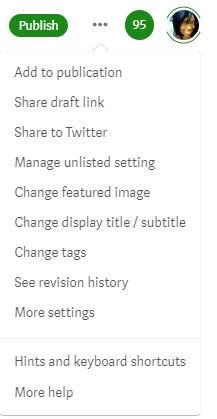
Another thing to keep in mind is making sure to add relative tags to your story. You can add up to five tags, so do that.
In the upper right portion of the screen is where you add/change tags as well as other useful features:
Also, being conversational — but appealing to human nature and to people’s emotions is the key.
Stories that do well connect with people and evoke some type of emotion or offer some benefit to the reader.
And it doesn’t matter what emotion is triggered.
It could be the emotion of happiness, anger, sadness, sympathy, surprise, fear, hope, excitement, curiosity, empathy, etc. You need to make your readers feel as if they are experiencing what they’re reading.
Or your readers should get something out of reading your story, whether that’s advice or entertainment or validation, encouragement, motivation or something that educates them in some way, or makes them laugh, have a good cry, or something else that they can actually relate to like a real person.
With stories on personal accounts, you can dig deep or keep it light. For example, I wrote and shared a story on my ability to see ominous signs in people’s eyes before they died.
This is a deeply personal story and it was very emotional for me to even write it. And, I had no idea it would do as well as it did. But, I figured out that it’s because it evokes a lot of emotions in readers. It sparks curiosity, awe, sadness, empathy, and maybe some fear. And, from the comments, I see there are many people who could relate to the story because they’ve had similar experiences in their own lives.
Here are the stats for that story:
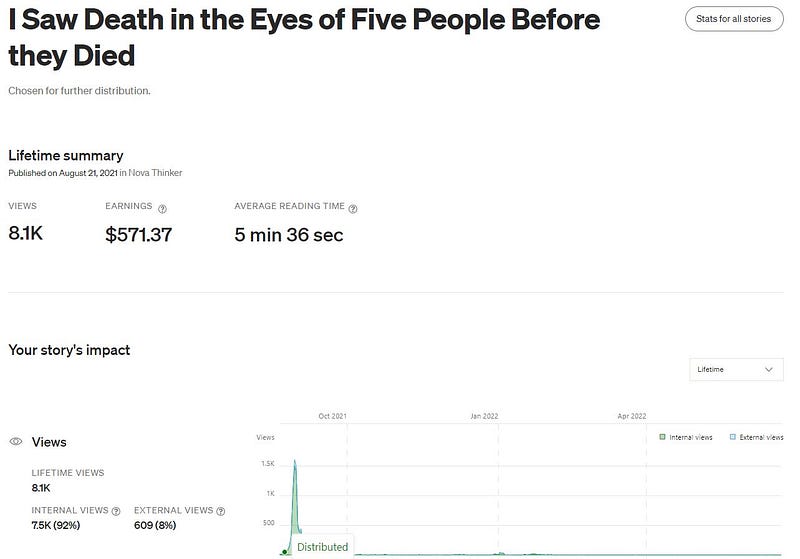
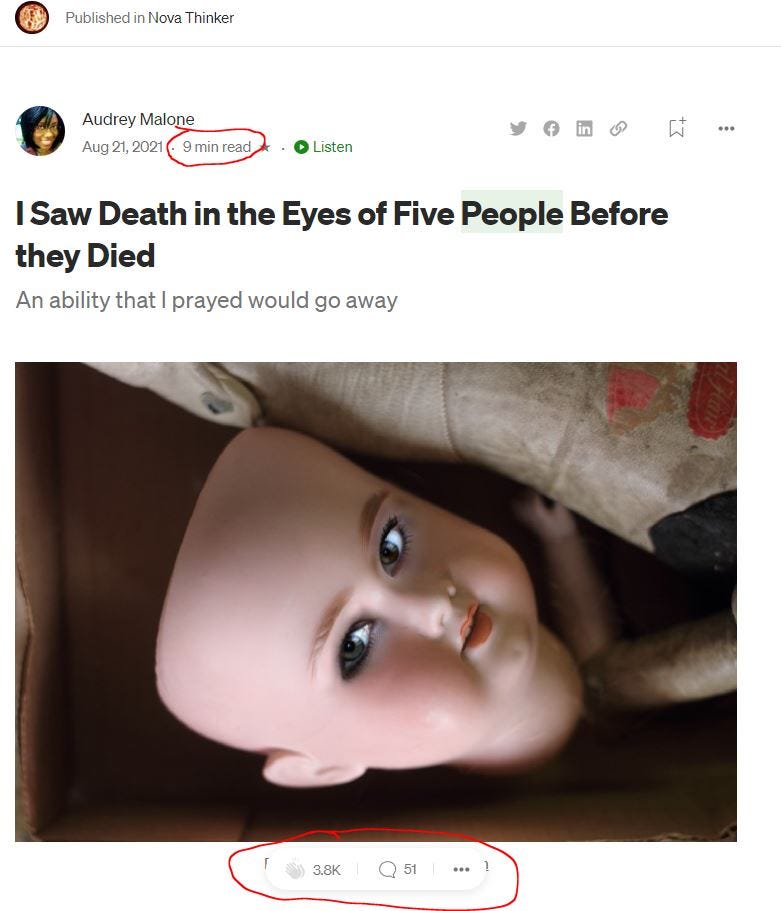
Five things contributed to the success of this story:
- Story length (9 minutes)
- Engagement (views, read time, claps, comments)
- Title (sensational, interesting)
- Image (thought-provoking, eerie)
- Content (personal, relatable, evokes emotions, tells a story)
Keep in mind this is just one example. You do not have to write long 9-minute stories to be successful.
But many writers will agree that the sweet spot for story length is usually between 4 and 6 minutes.
This is because story length dictates how much a story will earn, along with audience engagement, largely calculated based on READ TIME, not VIEWS.
But the more views a story has the more people are likely reading it. And, this refers to INTERNAL views rather than external views. Many times Medium stories get picked up by Google and receive lots of views from people who do not have Medium memberships. So, it is possible to have an extremely high number of views but low reads because most of the readers are originating from outside of Medium.
Here is an example of a story I wrote that got picked up by Google but had low views/reads from Medium members:
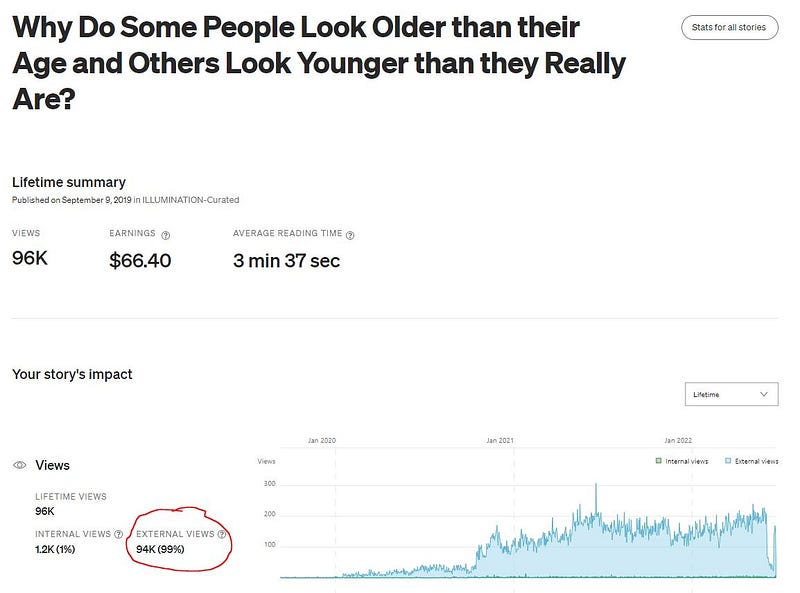
See how this story has gotten 96,000 views but earned only $66.40 while the story above has 8,100 views but earned $571.37? That’s because of the difference in percentage of internal views. For this story, 99% of the views came from people OUTSIDE of the Medium paywall (Medium members paying the monthly subscription). The story above it has 92% views from readers INSIDE the paywall.
Now, again, we are paid on reads (read time), not views. But more views mean more reads.
What the two stories have in common though is the ability to attract readers to their titles, and offer some type of information that readers consider valuable or worth the read.
Your story needs to add value in some way.
It’s when you stir the readers’ emotions is when you make a real connection, and you establish something meaningful between your writing and what the reader sees and feels. Readers are looking for something when they make a decision to read a story or an article. They’re looking to feel something.
Now, stick a pin right here.
Be careful that your story doesn’t read like a book report. Not that those types of stories are bad, it’s just that they are difficult to pull off and still keep the reader’s attention. Also, you want to make sure that your stories are not boring. And the way to do that is to just be yourself. Write stories as if you were speaking to your best friend. Make it interesting. Ask yourself if your story is something that you’d want to read.
How to Have Something to Write About Everyday
You need to build up a bank of stories, but first you should build up a bank of drafts.
Here’s a good way to build up your drafts.
Click on Write a Story and just have at it. The key is to have a brainstorming session with yourself and just do rapid-fire drafts of just titles and maybe subtitles and a few lines of content if the mood strikes you.
Take no more than 15 seconds on each and then move on to the next one. Don’t over-think it. Just keep clicking on Write a Story and put down titles of whatever comes to mind.
Another way to build up your drafts is simply by making a draft whenever something comes to mind during the course of your everyday life. Story topics can originate from anything.
Then, choose one of your drafts every day and flesh out the story. You may not even finish right then and there, and that’s ok. Come back to it when you have something else to add to it and select another draft or start with a new blank page. Just make sure you write something every day, even if you don’t publish it every day.
And that’s another thing, don’t worry about thinking that you have to publish your stories in publications to be successful, because that is not the case. Self-published stories can earn money and still be distributed.
But even if your story isn’t chosen for further distribution, it can still be a successful story. It helps but it doesn’t necessarily mean a story will take off. I have plenty of stories that were chosen for further distribution and got almost no views or reads.
Here’s a tool to help you with your writing:
It’s the dictate feature in Microsoft Word, so it’s free!
I use this to speed up my story writing. I open a blank Word document, turn on the dictate feature and speak. Then I go back and make edits and copy and paste the content in a blank Write a Story page on Medium.
This is a great way to get over writer’s block and I find that it’s a lot easier to get my thoughts down on the page.
BIG TIP:
Don’t just be selfish and hung up on your own stories. Read, comment, clap, follow, and highlight what moves you in other people’s stories. Not only will you learn a lot about what works when it comes to writing on Medium, but you will also be delighted by all of the wonderful stories out here! And, the Medium algorithm will begin to recognize that you’re an active participant on the site, which will boost visibility for your stories.
So, it’s: Write, read, engage, repeat.
Keep doing this and you’ll be a successful Medium writer. The more you do it, the quicker the success will come. You must be CONSISTENT though. This is not a once every two weeks sort of thing if you plan on making money here and getting noticed for your writing.
One last thing.



