
Machine Learning Art
New Text-Image generation method
KNN-Diffusion
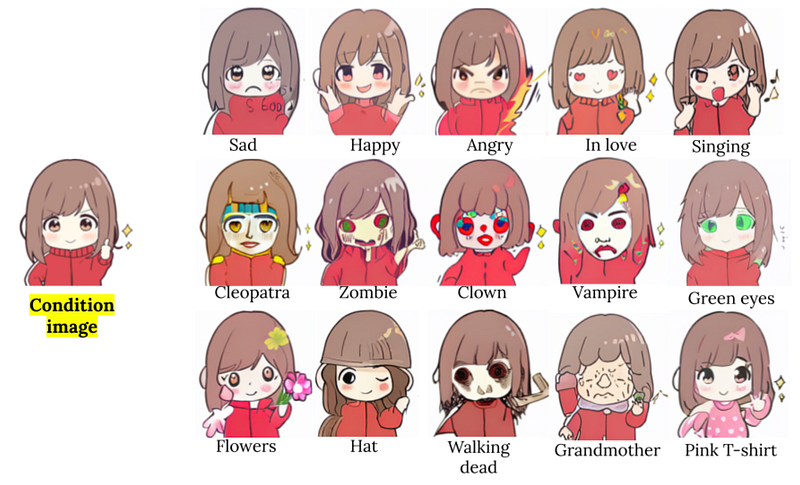
Since the late 1950s, artists have used computers to make art. One of the fundamental goals of computer vision and graphics is to enable individuals to create visual art using computers. Generative models have lately shown promise in allowing new kinds of art. They gradually add new and intriguing features, such as entirely automated generation based on unconstrained human input. Finally, the creator must imbue it with their own spirit, personality, and creativity to come to life. As a result, how individuals contribute input to these models is critical.
Large-scale generative networks have recently been used to create hyper-realistic pictures with great success.

Art is not just a way to express ourselves, but it also provides us with a deeper understanding of the world around us. It offers us new ways of thinking and helps us see things from a completely different perspective. https://mlearning.substack.com
- April 2022 — AI art tools update can be found ➡️ HERE ⬅️
While the availability of substantial Text-Image datasets has been tremendously valuable in training large-scale generative models (e.g., DDPMs, Transformers), the quality of both the input text and the training dataset has a significant impact on the output. The authors describe how to train a model to adapt to new data using large-scale retrieval approaches, such as efficient K-Nearest-Neighbors (KNN) search. Learning to adapt opens up a world of possibilities. Sifting through billions of data at inference time is incredibly efficient, and it can eliminate the need to train or memorize a generative model that is sufficiently massive. It’s also possible to fine-tune trained models to fresh samples by simply adding them to the database. Even if they aren’t included in the training set, rare ideas can be used during testing without requiring any changes to the generative model. For example, a diffusion-based model solely trains on pictures using a combined Text-Image multimodal metric.
Project Page (scroll down)
When evaluated on a public multimodal dataset of natural photos and a gathered collection of 400 million Stickers, this generation achieves state-of-the-art outcomes in both human assessments and perceptual ratings compared to baseline approaches.
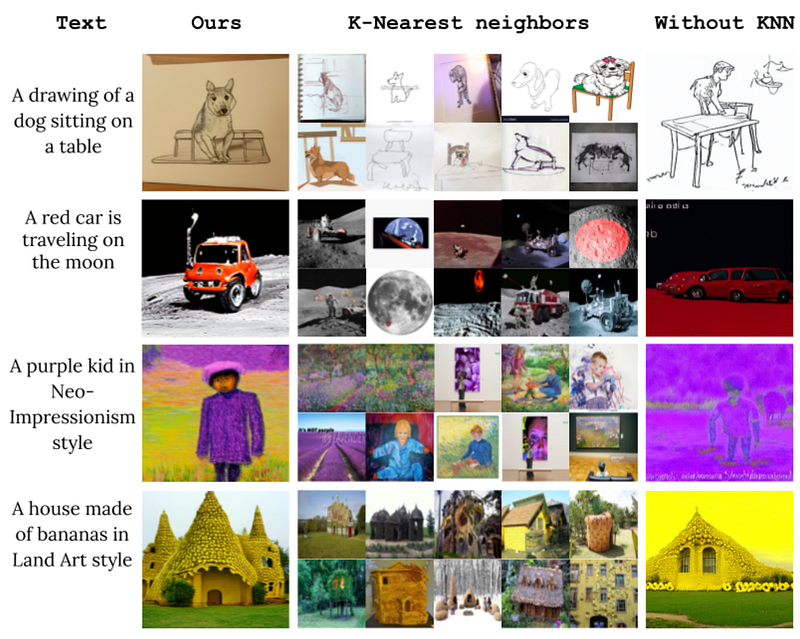
Both in terms of zero-shot performance and the capabilities that arise from the generative model, it is obvious that scale may lead to enhanced generalization. The well-known methodology of gathering additional training data, increasing the model size, and improving it, however, has its limitations. The approach described here learns to adapt to new samples that it only sees during testing. It does this by using a large-scale diffusion-based generative model in conjunction with a large-scale K-Nearest Neighbors search.
title: KNN-Diffusion: Image Generation via Large-Scale Retrieval
the authors: Oron Ashual, Shelly Sheynin, Adam Polyak, Uriel Singer, Oran Gafni, Eliya Nachmani, Yaniv Taigman
Project Page:
https://arxiv.org/pdf/2204.02849.pdf
Keywords: Computer Vision, Pattern Recognition, Artificial Intelligence, Graphics, Machine Learning, AI art, art, digital art,
I invite you to explore the concept of “AI creativity” by reading and learning from the many articles found on 🔵 MLearning.ai 🟠
- Check out my instagram with new material every week
- If you enjoyed this, follow me on Medium for more
- Want to collaborate? Let’s connect on LinkedIn
- https://linktr.ee/datasculptor
- 3D Machine Learning generated model on sketchfab
Data Scientists must think like an artist when finding a solution when creating a piece of code. Artists enjoy working on interesting problems, even if there is no obvious answer.
All our writers (members) receive the opportunity to be promoted on our social media, which increases the popularity of articles published on MLearning.ai


