
New Study on Chimp Menopause Shows Women May Have Another Purpose Besides Breeding
New research finds female chimpanzees go through menopause and…keep on living. The science community is still recovering from the shock.
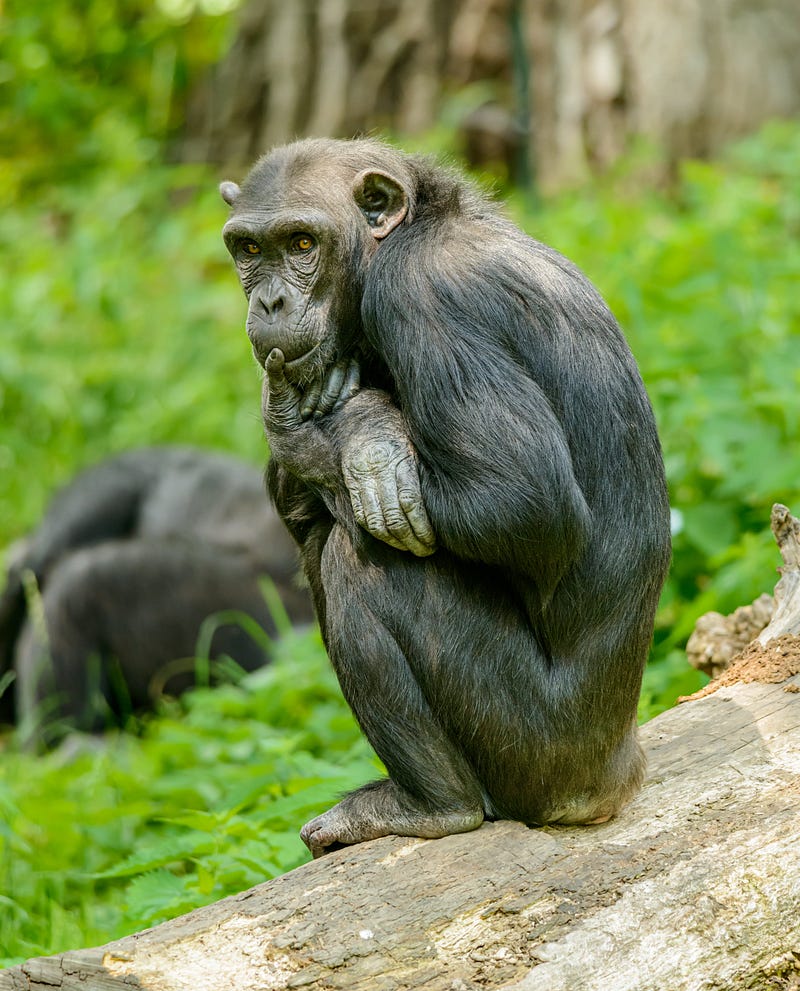
Her tussled gray hair stands at odd angles over patchy bald spots, and her teeth, once ivory pillars, are now worn down to brown stumps. Her wizened brow and hollowed eyes are etched with years of wisdom. Her sinewy limbs hang like gnarled branches that have borne the weight of too much fruit.
Her name is Garbo. She is part of a 20-year study on menopause in wild chimpanzees (Pan troglodytes) and one of the stars in Netflix’s Chimp Empire.
A serene narrator introduces the 61-year-old Garbo as the “oldest chimp at Ngogo.” She had her last baby at 38, and despite going through menopause, she “still plays her part in the community.”
Yep, that’s right. Garbo is one old broad, and the chimps have not bludgeoned her to death…yet. (Unlike Pork Pie, who got murdered by ape thugs!)
Garbo’s refusal to drop dead in her menopausal years has scientists in a tizzy. Except for some toothed whale species, most female species do not go through menopause. And until this study, it was believed chimpanzees die once they reach their nonreproductive years.
Menopause, in general, doesn’t make a lot of sense from a cutthroat evolutionary standpoint. In theory, women who are too old to have children have served their purpose.
Once past their fertile years, they should just die.
But not the Ngogo chimps. These sassy vixens continue to inhabit the earth past their baby-making years. What gives?
Since chimpanzees and humans share a common ancestor, researchers wanted to know why so they could apply these theories to women. Here are three hypotheses.
Why women live past menopause: The grandmother hypothesis
The most accepted theory is the “grandmother hypothesis.” Basically, when women’s ovaries dry up, they stick around to help raise their grandbabies.
However, scientists have not found this true for the Ngogo chimps. Daughters left their patriarchal group to spread their genes elsewhere. Nor did they observe any grandma chimps clocking babysitting hours for their sons.
Many evolutionary biologists have argued that the math doesn’t add up with the grandmother hypothesis. Why be a doting grandmother and protect your 25% gene investment in your grandchildren when you can continue to breed and pass on 50% of your genes to your children?
Why women live past menopause: The motherhood hypothesis
These researchers argue that as childbirth becomes more dangerous in older mothers, women focus their resources on the survival and reproduction of their living children rather than having babies when their pubes are gray.
Another evolutionary biologist team even used game theory to determine why women pass the reproductive mantle.
Their conclusion: female competition.
The age of female menopause coincides with when women encounter reproductive competition from the next generation of breeding females. Therefore, women hit menopause in their 40s and 50s to step aside for their daughters and more nubile competition.
So which is it? Is it their role as moms or grandmas that gives these golden girls a reason to stick around past their reproductive years?
Let me answer that one for the curmudgeonly male scientists at the back of the bus…
Why women live past menopause: the sisterhood hypothesis
I am torn between calling my theory the “sisterhood hypothesis,” the “humanists hypothesis,” or the “Can we please stop assuming evolutionary biology explains all human behavior” hypothesis. (Research funding pending.)
Here goes…Women are not breeding machines. Women are not female chimps. Just for once, would evolutionary biologists ever consider that women might stop breeding because we have better things to do with our lives?
Maybe women want to build cathedrals, run for office, or start the next Fortune 500 company. Maybe these grand dames go on to create an OnlyFans page for hot grandmas. Or maybe older women just want to spend their remaining years playing Bridge and getting drunk on top-shelf gin instead of changing diapers. (In this dream sequence, Betty White is my bestie.)
And most importantly, maybe some women don’t give one science f*ck about having children so they can pass on their genes.
Between the fifteenth and eighteenth centuries, if you were a woman who lived past menopause, you clearly were a witch. And if you were outspoken, financially independent, or practiced non-traditional forms of healing or spirituality, well, then you must be in league with the devil. (Or stealing penises and hiding them in trees.) These women challenged the prevailing power structures and paid the price with their lives.
Today, the witch hunter comes cloaked in science with the same message — older women are at their worst, worthless past their reproductive years, or at their best, just plain weird.
History says differently.
The American geneticist Barbara McClintock (1902–1992) was awarded the Nobel Prize in Physiology in 1983 at 81. Her groundbreaking work on “jumping genes” revolutionized the field of genetics.
The American chef, author, and television personality Julia Child (1912–2004) became a culinary icon in her 50s.
African-American novelist Zora Neale Hurston (1891–1960) was 49 years old when her most famous novel, “Their Eyes Were Watching God,” was published.
Spunky fashion icon and businesswoman Iris Apfel (1921 — present) was 70 years old when the Metropolitan Museum of Art hired her to curate an exhibition on fashion.
Country singer and songwriter Dolly Parton (1946 — present) was 51 when she released her biggest-selling album, “9 to 5.” The album won her four Grammy Awards and made her a household name.
And let’s not forget Garbo’s humble namesake — Greta Garbo. At 49, Garbo was awarded an Honorary Academy Award “for her luminous and unforgettable screen performances.” She did not show up at the awards ceremony.
But there is something else these women have in common besides their late-bloomer success.
They were not grandmothers or mothers. None of them had children.
One could argue that their contributions to humanity are their children. They may not have pushed them through their loins, but they did birth new ideas and inventions, cultivated them, and then set their children loose upon the world to make it better. Not all contributions to humanity are of the zygote kind.
Yes, humanity. Perhaps next time evolutionary biologists want to come up with a theory on why menopausal women don’t die, they should look to humans, not apes.
“Beautiful young people are accidents of nature, but beautiful old people are works of art.” – Eleanor Roosevelt

Carlyn Beccia is an award-winning author and illustrator of 13 books. For past articles grouped by subject, see my Table of Contents.
Update! I am launching Conversations with Carlyn soon to have more open and honest conversations with readers about sex, love, feminism, culture, and the latest science behind our most intimate human interactions.
If you enjoyed this article, please support my research and writing by becoming a paid pledge. You won’t be charged until the conversation gets rolling.


