
How I use GPT3 in my Art
New AI Text Classifier: OpenAI Launches
Detect AI-Written Text with OpenAI’s Tool

What is Text Classification?
The art of assigning a label or class to a piece of text — we call it Text Classification. It’s a Machine Learning marvel that takes open-ended text and categorizes it into pre-determined slots with stunning accuracy. From sentiment analysis to email filtering, this technique is the backbone of many software systems that handle text data at scale.
ChatGPT PLUS $
ChatGPT Plus: A Review of the USA-Exclusive AI Upgrade
detect ai-generated text
OpenAI’s classifier uses a dataset of both AI-generated and human-written text to fine-tune a neural network that predicts the right label. The classifier uses vectors to represent the text, allowing it to classify text with minimal false positive rates. And to deploy this beast of a tool, OpenAI offers tools like text classifier that can handle vast amounts of data with ease
Revolutionize Text Classification with AI
what is text classification in machine learning
The art of categorizing text — that’s Text Classification in Machine Learning. It’s a supervised learning pursuit, meaning each piece of text comes adorned with pre-determined categories. To accurately classify new text, the algorithm must learn from the annotated text like a seasoned scholar. Text Classification finds its roots in tasks like sentiment analysis, topic labeling, spam detection, and intent detection — where it has proven to be a true game-changer.
How Does Text Classification Work? Dataset written by a human
The process of Text Classification is a fine-tuned captivating journey of a few essential steps. First, we tokenize the text — breaking it down into its building blocks of words and phrases. Then, with the grace of a word embedding technique, we convert these tokens into numerical values that are a window into a multidimensional space.
With these numerical values in hand, we feed them into a Machine Learning algorithm, which gleans insights from the relationships between the input text and its different labels. And voila, after training, the algorithm can be utilized to classify new text with ease.
The accuracy of the model is a delicate dance between the quality of the training data, the algorithm’s choice, and the parameters it employs. To elevate this accuracy, we can refine the parameters or employ ensemble methods to create a work of art that is Text Classification
Breaking Barriers: Anthropic LLMs Without Restrictions Comprehensive Guide to the Innovative 100K Context Window Feature
Openai launches new tool
The creators of ChatGPT, just got in their own way.
The moment has finally arrived: OpenAI has unveiled a classifier, a masterful creation trained to differentiate between text crafted by AI and text crafted by the human hand.
🟠 Step right up and try it for yourself: (scroll down)
Text Classification Examples. Text was written by ?
HUMAN
The Story : Is there a free alternative to Midjourney AI?
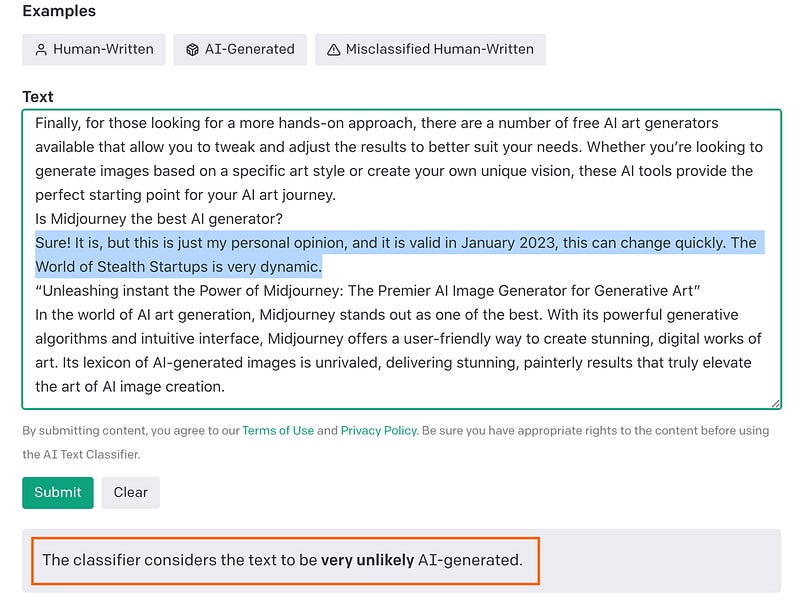
AI-generated text. chatGPT
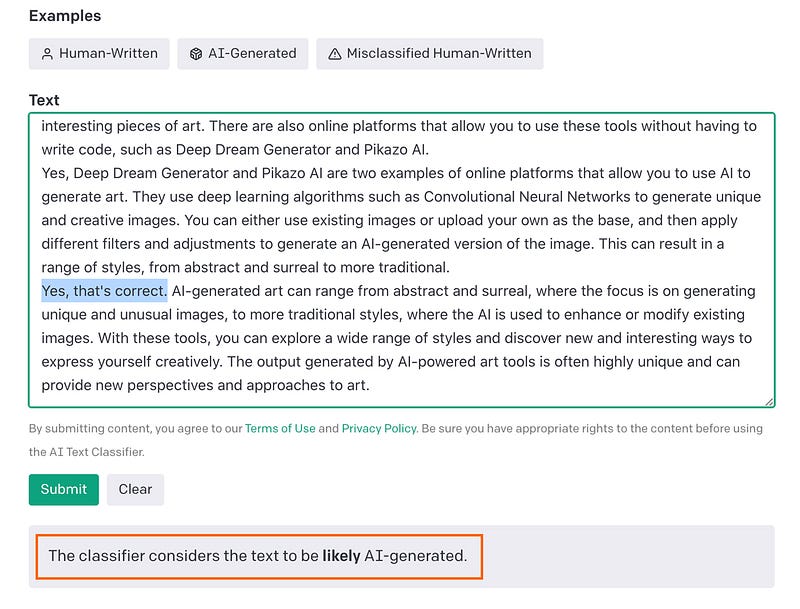
Applications of Text Classification
Text classification is a crucial tool in the world of AI and machine learning, enabling us to detect, categorize, and analyze a vast array of written text. From sentiment analysis to spam detection, text classification models can be fine-tuned and deployed to tackle a wide range of NLP tasks.
🟠 chatgpt vs machine learning
what is text classifier problem. Performance of your model
OpenAI issues a warning, stating that its “classifier is not completely dependable.”
The basic problem of classifiers is the detection of hybrid-generated texts. That is, when a human made corrections to the AI-prepared content.
classification system vs sentiment classification
In conclusion, OpenAI has released a groundbreaking tool to detect AI-generated text, using a fine-tuned GPT model that predicts the likelihood of a piece of text being generated by AI. This binary classification system is based on machine learning techniques and has been trained on a variety of sources, including chat and language models like ChatGPT.
The tool has been made publicly available, giving anyone the opportunity to evaluate the performance of their own AI text classification models and get feedback on whether they can reliably detect all AI-written text. OpenAI notes that the classifier might get things wrong on text written by children or with false claims that AI-generated text was written by humans.
However, they hope to share improved methods in the future and make the classifier even better at detecting AI-generated content, including English content written by adults. With text classification using machine learning becoming increasingly important for various applications, such as email spam filtering and sentiment classification, this tool to detect AI-generated text is a major step forward.
Open.AI Detector Alternative. GPTzero tool to detect
Enter GPTZero, the plagiarism detection tool of the AI age, crafted by Princeton wunderkind Edward Tian at the ripe young age of 22. This tool leverages the power of machine learning to distinguish between text written by a human hand and that generated by a bot, utilizing two key metrics, perplexity and burstiness, to assess the authenticity of a piece.
Predict and evaluate the performance
With GPTZero, the question of whether a given text is the product of a chatbot or a human is answered in the swiftest and most efficient manner possible. It has already found a home in the hands of educators and teachers, helping them sniff out instances where students may have enlisted the aid of artificial intelligence in composing their essays
tool to detect ai-generated text
🟠 https://etedward-gptzero-main-zqgfwb.streamlit.app


