
Need an Easy Solution to the ‘I Want to Be Healthy Blues’?
Live longer and better, with The Blue Zones® project.
Are you ever puzzled about how to maintain healthy body weight, blood pressure, and fitness? Cholesterol and other health indicators not where they should be?
What about your state of mind? Are you lonely or having a hard time finding your purpose in life? Feeling too much stress?
Are you wondering what the heck these things have in common?
A lot, as it turns out. Many of us have a general sense we could be healthier, but somehow it’s become so complicated, we rarely know where to start.
Should you eat keto, vegan, paleo? Lift weights or run? Cross fit or yoga? How do you stay well and have a long, peaceful life? How can you find a balance of work and rest?
In 2003, I had my annual health checkup and blood test.
Not good news. My cholesterol levels were frightening, and my blood pressure was way too high. My best friend had discovered the Mediterranean way of eating and told me how much she and her husband enjoyed this new way of eating.
Worried about my diet, I switched to the Mediterranean Diet. Now I think of it as a life-long, delicious way of eating, not a diet. Visit the Oldways Cultural Traditions website for helpful information on this and other traditional ways of eating that emphasize real food.
Humanity needs a way of living that makes health easier.
Not a diet, not an exercise regime—just a manner of life that makes feeling our best not quite so challenging.
After one year, my cholesterol dropped 90 points. Impressed, I continued studying healthy habits. One day I heard a fascinating story on NPR about specific places where people live unusually long lives.
Years ago, Dan Buettner’s research started with an article in the Journal of Experimental Gerontology documenting the longevity of people living on the island of Sardinia, Italy. It made sense to look at people who are doing something well and learn from their experience and this was the beginning of his journey.
The term Blue Zones® first appeared in Buettner’s 2005 National Geographic article The Secrets of a Long Life. Along with other researchers, he studied areas of the world with a larger than the average number of centenarians.
These five regions are Sardinia, Italy; Loma Linda, California; Okinawa, Japan; Nicoya Peninsula, Costa Rica; and Icaria, Greece.
Digging deeper, they identified characteristics found in the five societies highlighted in the original book, The Blue Zones Solution: Secrets of the World’s Healthiest People.
I’m a huge proponent of the Blue Zones®.
It’s evidence-based, easy to implement, and it now serves as a guideline for my life.
Researchers have identified nine common characteristics that people who live to be 100 years old or more — in these Blue Zones all share.
Nine traits these long-lived societies share
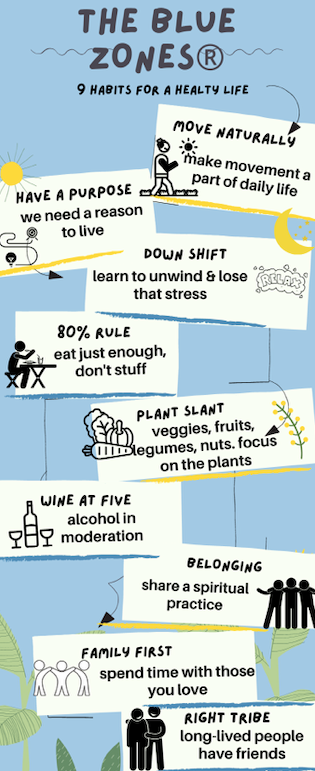
1. Move Naturally For most of my life, I’ve been fortunate to get exercise in daily work. Lifting a weight over and over, I can’t help thinking I’d rather be hoisting crates of vegetables, boxes of books, or 50-pound bags of dog food.
People living in these long-lived regions would probably agree with me. Their environment makes it easy to move. They grow gardens, walk to shop, and many don’t have all the mechanical conveniences for yard and housework.
2. Purpose
Living with purpose, having a reason to get up in the morning, can give you up to seven years of life.
Have you known people whose lifeforce seems to dwindle once they retire? Or parents who don’t know what to do with themselves once the kids fly the coop? It’s essential to have a deep purpose in life.
Our job or our family can be our reason to live, but so can a cause, a project, or a moral purpose. Whatever it is, we all need a goal more significant than ourselves.
3. Down Shift
People in the Blue Zones experience stress. Stress leads to chronic inflammation, associated with every major age-related disease. What the world’s longest-lived people have, are routines to lessen tension. Whether it’s a glass of wine with friends, daily prayer, or dancing—healthy people take time to relax.
4. 80% Rule
Hara Hachi bun me is a Confucian teaching that instructs people to eat until they are 80 percent full. The Japanese phrase translates to, “Eat until you are eight parts (out of ten) full” or “belly 80 percent full”. Buettner discovered that people in the Blue Zones eat their smallest meal in the evening and do not overeat.
5. Plant Slant
Lots of legumes, whole grains, fruits, vegetables, nuts, seeds, and spices form the basis of the diet. Small amounts of meat are eaten, fish more often.
6. Wine @ 5 Except for Adventists in Loma Linda, many people in the Blue Zones drink alcohol regularly and moderately.
7. Belong
Having a spiritual practice and a faith community to meet with adds between four to fourteen years of life expectancy. Giving back and helping others is an integral part of every practice.
8. Loved Ones First
Putting family first is a central point in all of the most long-lived societies. Living near or with aging parents, grandchildren, and children lowers disease and mortality for all family members.
Having a committed life partner can add up to three years to a lifespan, too.
9. Right Tribe
Studies show we absorb and reflect the behaviors of those we spend the most time with. Having a social circle committed to health and well-being helps all of those involved. Long-lived people have friends. Okinawans have the word moais, meaning meeting for a common purpose.
Life-long friends form a circle of social-support that will help each person financially, spiritually, and practically.
Great! You may think to yourself.
This sounds ideal, but what if I don’t even know five people, let alone have life-long friends? Maybe you’re single, and your family is not even in your life? Everyone has complications and challenges to work around.
Please — think about it? What is more important than your health? If you don’t have time to move your body, feed yourself nutritious food, and make friends, it’s a sign to look at your life.
Do you have to work so much? Are you planning to relax and exercise next year?
I want to challenge you with a question.
What if you are debilitated next year because you didn’t take care of yourself? How much time and money would you spend to recover your health or that of your loved ones? As much as possible, I bet!
So, try prevention instead. Choose three things off this list of nine crucial traits and start making gradual changes. Look at your own life and choose a couple of things to improve.
And, no–starting with the wine doesn’t count! Try learning some new recipes and adding more plants to your meals.
Start making changes in your own life.
I am one hundred percent confident you will see noticeable benefits. Sharing your results is the best way to influence your friends and family to adopt a more healthy lifestyle.
One of the most exciting additions to everyone's work at the Blue Zones® is the outreach programs across the United States. When cities help people exercise more, access healthy food, and create positive changes in their lives—it spreads throughout the community.
These changes at a grassroots level have produced staggering results. Statistics include 25% reduced obesity and 36% less tobacco use in Beach Cities, California, and a 49% reduction in health care claims in Albert Lea, Minnesota.
This program has been implemented in about 50 cities, and I’m excited to hear that my city of Austin, Texas, is building interest in becoming a Blue Zones® city.
Learn, commit, plan, and get going!
Use the resources at the Blue Zones® website and these helpful sites.
My health is better now than it was 20 years ago, and I give these ideas credit. Join me in this journey to share in the joys of better health.
Cindy loves nature, books, gardening, and preparing amazing plant-based foods. Join the conversation and follow her on Medium.