
Nearly All Girls Start Getting Sexually Harassed in Childhood
Why don’t more men know that and why don’t more men care?
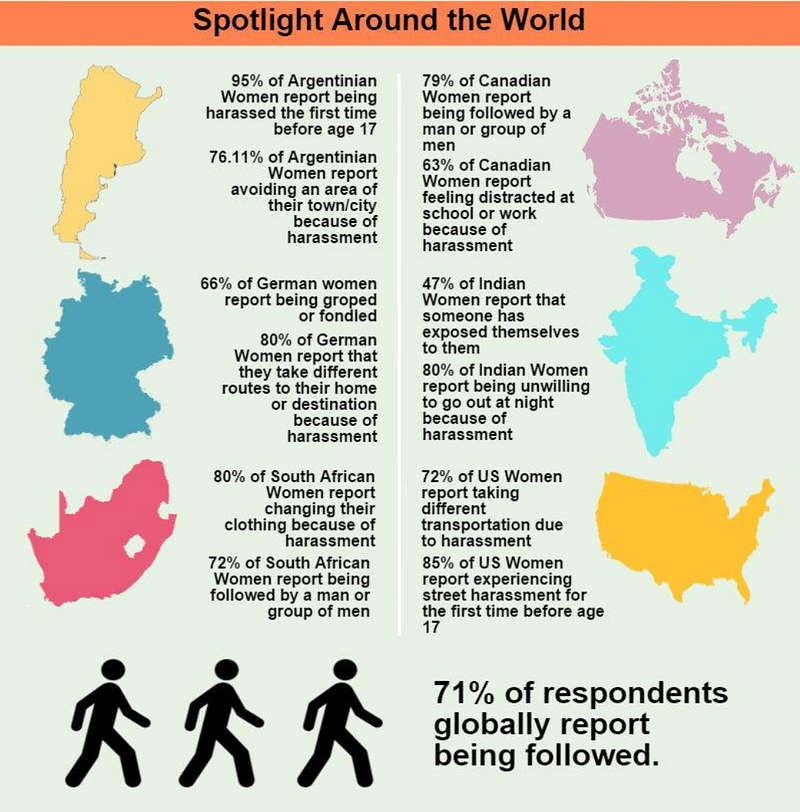
In 2014 Hollaback (now known as Right To Be) partnered with Cornell University to release the largest analysis to date of street harassment. They surveyed women and girls from 42 cities around the world about the particulars of street harassment they had faced, including when it first began, and also about the emotional toll. The majority reported the onset of street harassment began for them before the age of 17. A substantial number first started getting harassed at the tender age of 10.
Although some will be tempted to say that it’s not illustrative of our culture to lump us in with places like India and Argentina, 85% of American women reported being harassed before the age of 17.
In other words, when they were children.
Unfortunately, this doesn’t surprise me at all. Most women I know were first sexually harassed in their very early teens. I was 11 or 12. Often this occurs on the street and comes from grown men, but sometimes it comes from boys in school or in the neighborhood as well.
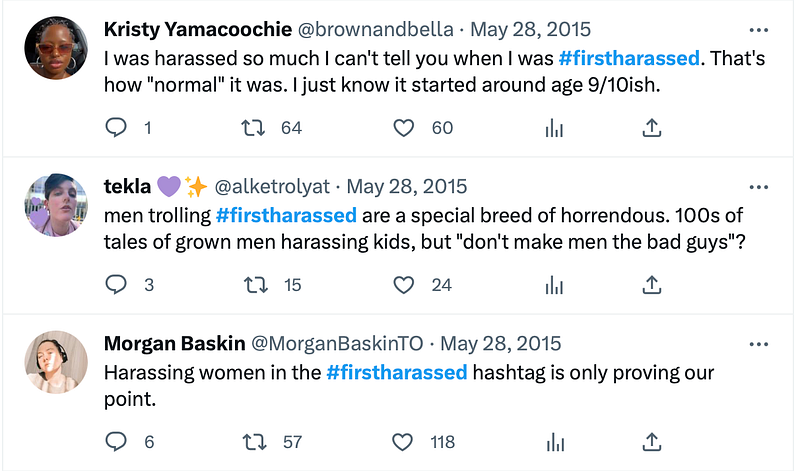
If you take a look at #FirstHarassed on Twitter, not only will you see thousands and thousands of women reporting really disturbing things happening to them at a young age, you’ll also notice a lot of fragile men berating and further harassing them simply for saying things like, “When I was 10 and walking home from school, three men in a car said inappropriate things to me and made me feel scared because they wanted me to go with them.”
Some of the women using the # even reported being harassed at age 6, 7, and 8. How depraved do you have to be to not only sexualize random children, but to believe that these young girls invited or asked for this in any way. And how on earth could it not be traumatizing to them? You’re a little kid who is being told that your body doesn’t belong to you, it’s an enticing piece of meat, and that simply walking around in that body (which you don’t have any choice about) puts your safety in jeapardy.
Whenever I bring this up to men, most of them seem to have had no idea. I guess they assume that sexual harassment begins for women when they’re young adults and is really only a minor problem that happens to some women, not to nearly all women when they were very literally children. But why don’t men know about this? And why are so many of them defensive and belligerent when they hear women telling their personal stories about it?
This in itself is a huge part of the problem!
Not only is it horrendous that we live in culture where little girl-children start feeling unsafe and objectified at a very young age, we live in a culture that mostly doesn’t seem to care. It’s just the way things are. Women’s bodies belong to the general public of men anytime they leave the house. Oh well… It’s been like that as long as we can remember. Even the men who don’t personally feel entitled to comment on women in public spaces often seem to sort of accept that this is how our culture works. If they didn’t, it wouldn’t work that way. As many of the nasty commenters on Twitter had to say to women — “Get over it.”
Some people may believe that a grown man telling a child that her body is attractive to him should find that flattering or no big deal, but catcalling is not a compliment — it’s a demand for attention and a way to flex power. It’s a method of exerting dominance, and to do that to a child is to remind her that for the rest of her life, this is all she will ever be — a sexual object for the entertainment and gratification of men. That is exactly the point.
All of the men I know in person and many that I know online do not condone this behavior and would find it disgusting. But the fact remains, most of them had no idea until a woman told them that this sort of thing goes on to this degree. Perhaps it’s because they don’t hang around with these types of men, or that the women in their lives never thought to mention it because it’s just so ubiquitous. But I seriously doubt that most men haven’t witnessed this sort of thing before because it takes place all of the time and has been widely discussed — particularly around the time that #MeToo first broke.
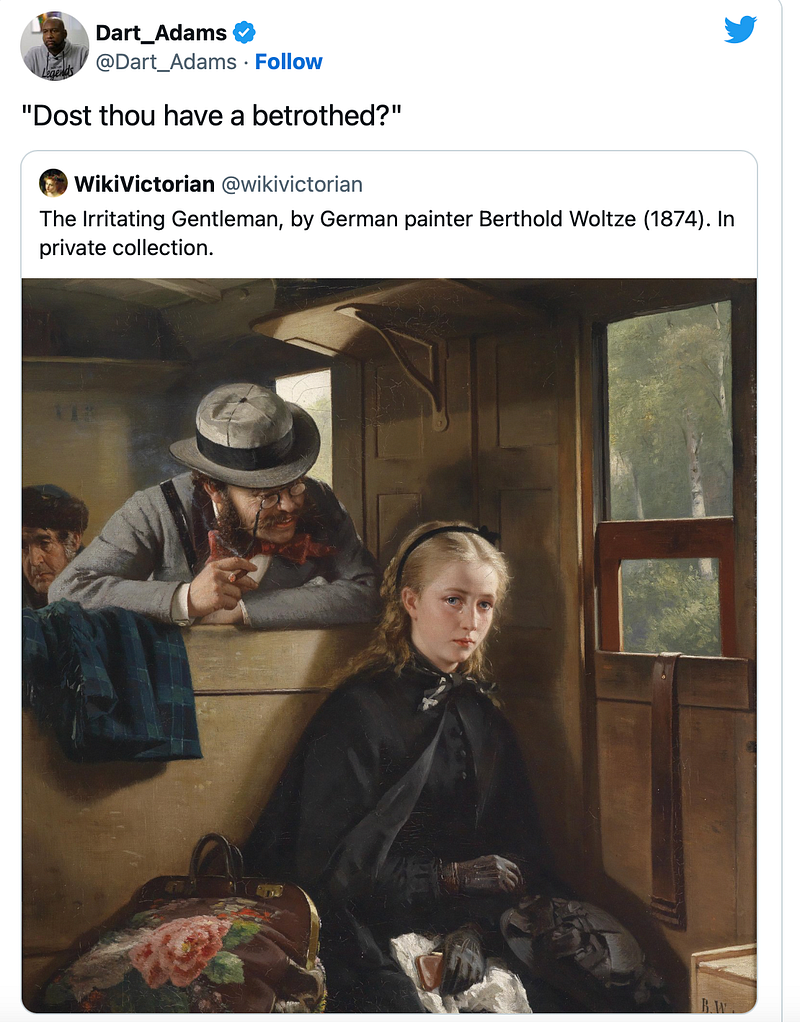
If you look closely at this rather well-known painting from 1874 that is often used to illustrate the long-standing dynamic of public harassment of young girls, you may notice a few things. First is that the girl is wearing black, indicating that she is likely in mourning. Does the man care? No he does not. He’s too busy inserting himself into her space and leering at her.
The second thing you might notice is that there are tears in her eyes. She is trapped there — unless she is willing to give up her seat — and even then, he might well decide to follow her. She just has to endure his unwanted attention — something that unfortunately most women I know have a lot of experience with. Even if there was someone to complain to, the typical response tends to be, “You don’t need to over-react.” But these incidents do cause real harm.
In fact, a huge number of women worldwide, but also in countries like Canada and the US, report things like changing their route in order to avoid street harassment. Not only are the barrage of words unwelcome, but sometimes threatening behavior accompanies them, and it is difficult to know what this particular unpleasant encounter will bring.
Whether or not escalation occurs, the fear of potentially being groped, followed or raped means that street harassment often has negative psychological effects, including depression, sleeplessness, anxiety and chronic stress.
For example, an individual may receive one cat-call on their walk to work. In isolation, this could be an unpleasant and mildly stressful event, or may not have any bearing on that person’s day. However, should that experience of a mild stressor occur every day for months or years, then it becomes a chronic source of stress that can negatively impact mental health.
Imagine how this is compounded when it happens repeatedly to a child. And worldwide, that’s when nearly all girls first experienced sexual harassment on the street. Street harassment is unacceptable at any age, but the wholesale assault on girls who are essentially still children is particularly reprehensible and should not be dismissed as no big deal.
I heartily commend the men on the Twitter thread who called out the a-holes and who spoke about what a serious issue this is, but sadly there were 2 or 3 of them to every hundred haters. I certainly don’t claim that Twitter is a representative cross-section but the fact remains, the dark undercurrent of men who affirmatively do believe that women exist for their pleasure and enjoyment seems to be on the rise. At a minimum, they are more and more emboldened about speaking it loudly. The more equality women gain, the more some men want to push back against that.
In 2018 France went so far as to outlaw catcalling and street harassment. Rather than making it a crime, which would require reporting, arrest, trial, etc., the French have made it something that law enforcement can issue a fine for immediately upon witnessing it. Alexandra Louis, a lawyer who helped work with political parties in France to come up with appropriate language for the new law had this to say about it 2 years later:
In France, we were met with a lot of reluctance on the part of people who explained to us that we were going to prevent certain men from being able to seduce women. However, there was never any doubt that street harassment is not seduction, and seduction is not street harassment. The offense of sexist harassment obviously does not sanction seduction, but it sanctions well-defined behaviors, which also consists of attacking the dignity of people and preventing them from having their freedom to come and go.
Now we really have to support this cultural change, but it’s everyone’s fight — a law is not enough. Civil society must mobilize, politicians, obviously, have to mobilize and we are working hard on it, but I believe that on subjects so fundamental, such as human rights, it is everyone’s business. Everyone, in their own way, can do something to help this cause. For example, many private companies are developing applications and reporting tools. It is the work of civil society, the work of those in politics, but all of this must be built together.
Although street harassment is technically illegal in many US states and municipalities, it’s still a huge problem that goes on largely unaddressed.
The anti-harassment group Stop Street Harassment compiled a thorough list (last updated in 2013) that details street-harassment laws by state.
While laws against street harassment are vital, punishments alone won’t end the epidemic of public abuse against women. Sexism is not a problem that can be legislated out of existence. (Complex)
We cannot change this dynamic unless we all work together — but people need to realize this is happening and to understand both how prevalent and how destructive it is. Most women already know this because they have experienced it first hand. We need men to get on board. Street harassment is an attack on women — one that invariably starts when they are only just girls. A compliment is at its foundation a show of respect. Street harassment is not a compliment.
© Copyright Elle Beau 2023
Check out this excellent piece from Toni Hargis about how to be an effective ally and “upstander.”
“There’s currently a lot of talk about how others (particularly men) can help women facing discrimination, harassment and abuse. Usually called “bystander intervention” (I prefer “upstander”), the call is out for more people to intervene when women are being targeted. This is a good thing. Standing back and saying nothing adds to the problem because it validates the offender and can lead to more serious abuse.
Silence is complicity.
What I’m also seeing, though, are men who profess to be allies, who recognise the need for upstanding, but want it on their terms. When women describe experiences they find offensive, alarming, scary or painful, these men designate themselves as the arbiters of what’s legit. In what is the epitome of Mansplaining (yes, I’m using that word), they seek to tell women how they should feel despite probably never having been in that situation.”


